

5.5 Four Policy Types
83
• In the upper right corner, M2 can easily reach A but M1 gets a little more distant
from B.
• In the upper left corner, both must go toward and probably reach M1 = M2 = A.
• In the lower left corner, the situation is extremely urgent and new water should
be allocated to M2 with the target being M1 = M2 = A.
It should be noted that M1 does not have excess water (ZW) but it has more than
M2 that under this condition can help it to come out of the Extreme Water Poverty or
get closer to the equality line. In other words, if M2 is below A, there is an alarming
urgency to take it out of this category without lowering M1 to such a disastrous
category.
Policy Type II
Policy type II (PtII) covers six segments, namely Sg13, Sg14, Sg15, Sg23, Sg24,
Sg25, and manifests both water shortage, and water excess for reallocation. Segments
14, 15, 24 and 25 are more straight forward as the excess water of M1 can be
reallocated to M2, having in mind the M1 targets of [B, C]. As an example, let
us suppose that a WUS is operating in Sg15, which puts it in Target A with sever
water shortage for M2 (SW2) and much excess water from M1 (ZW1). If we plan
to reallocate some of the ZW1 to M2 in order to reach A (i.e., the Amin threshold),
then the system say gets to Sg24. This is because we reduced water allocation to M1,
hence changing it from Extreme Water Abundance to Water Abundance. However,
M2 is in Water Poverty and needs more water to move to Water Wise (Sg33), which
can be done by further reallocation of water from M1 to M2, with M2 operating at B
(the Min threshold) and M1 somewhere between B and C. Although this reallocation
example takes the WUS out of water poverty, we need to move forward and check
for the possibilities of making the system Sefficient, using the ideas of Policy type
IV given below. For these four segments of PtII, if ZW1 cannot satisfy SW2, then
new water is needed, which take us to the following procedure.
The points mentioned in the rest of this subsection apply to all the segments of
PtII, however let us focus on the more complex segments, i.e., Sg13 and Sg23. One
clarification is worth mentioning considering Table 1.5, which gives a range for the
target of a member in Water Wise category. However, for Sg13 and Sg23, we should
use B as the target for M2 because of the (Extreme) Water Poverty situation of M1.
In other words, ZW1 is defined relative to B and as such presenting the potential
amount of water for reallocation, but it does not mean that M1 must be reduced to
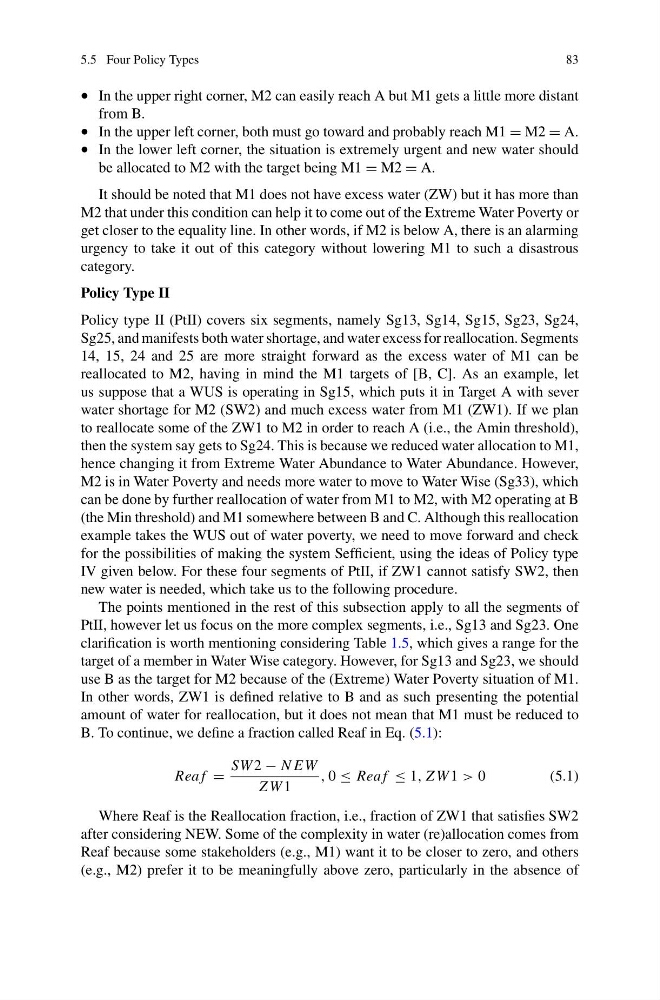
B. To continue, we define a fraction called Reaf in Eq. (5.1):
Rea f =
SW 2 − N EW
Z W 1
, 0 ≤ Rea f ≤ 1, Z W 1 > 0
(5.1)
Where Reaf is the Reallocation fraction, i.e., fraction of ZW1 that satisfies SW2
after considering NEW. Some of the complexity in water (re)allocation comes from
Reaf because some stakeholders (e.g., M1) want it to be closer to zero, and others
(e.g., M2) prefer it to be meaningfully above zero, particularly in the absence of
83
• In the upper right corner, M2 can easily reach A but M1 gets a little more distant
from B.
• In the upper left corner, both must go toward and probably reach M1 = M2 = A.
• In the lower left corner, the situation is extremely urgent and new water should
be allocated to M2 with the target being M1 = M2 = A.
It should be noted that M1 does not have excess water (ZW) but it has more than
M2 that under this condition can help it to come out of the Extreme Water Poverty or
get closer to the equality line. In other words, if M2 is below A, there is an alarming
urgency to take it out of this category without lowering M1 to such a disastrous
category.
Policy Type II
Policy type II (PtII) covers six segments, namely Sg13, Sg14, Sg15, Sg23, Sg24,
Sg25, and manifests both water shortage, and water excess for reallocation. Segments
14, 15, 24 and 25 are more straight forward as the excess water of M1 can be
reallocated to M2, having in mind the M1 targets of [B, C]. As an example, let
us suppose that a WUS is operating in Sg15, which puts it in Target A with sever
water shortage for M2 (SW2) and much excess water from M1 (ZW1). If we plan
to reallocate some of the ZW1 to M2 in order to reach A (i.e., the Amin threshold),
then the system say gets to Sg24. This is because we reduced water allocation to M1,
hence changing it from Extreme Water Abundance to Water Abundance. However,
M2 is in Water Poverty and needs more water to move to Water Wise (Sg33), which
can be done by further reallocation of water from M1 to M2, with M2 operating at B
(the Min threshold) and M1 somewhere between B and C. Although this reallocation
example takes the WUS out of water poverty, we need to move forward and check
for the possibilities of making the system Sefficient, using the ideas of Policy type
IV given below. For these four segments of PtII, if ZW1 cannot satisfy SW2, then
new water is needed, which take us to the following procedure.
The points mentioned in the rest of this subsection apply to all the segments of
PtII, however let us focus on the more complex segments, i.e., Sg13 and Sg23. One
clarification is worth mentioning considering Table 1.5, which gives a range for the
target of a member in Water Wise category. However, for Sg13 and Sg23, we should
use B as the target for M2 because of the (Extreme) Water Poverty situation of M1.
In other words, ZW1 is defined relative to B and as such presenting the potential
amount of water for reallocation, but it does not mean that M1 must be reduced to
B. To continue, we define a fraction called Reaf in Eq. (5.1):
Rea f =
SW 2 − N EW
Z W 1
, 0 ≤ Rea f ≤ 1, Z W 1 > 0
(5.1)
Where Reaf is the Reallocation fraction, i.e., fraction of ZW1 that satisfies SW2
after considering NEW. Some of the complexity in water (re)allocation comes from
Reaf because some stakeholders (e.g., M1) want it to be closer to zero, and others
(e.g., M2) prefer it to be meaningfully above zero, particularly in the absence of