

82
5 Sequity (Sustainable Equity)
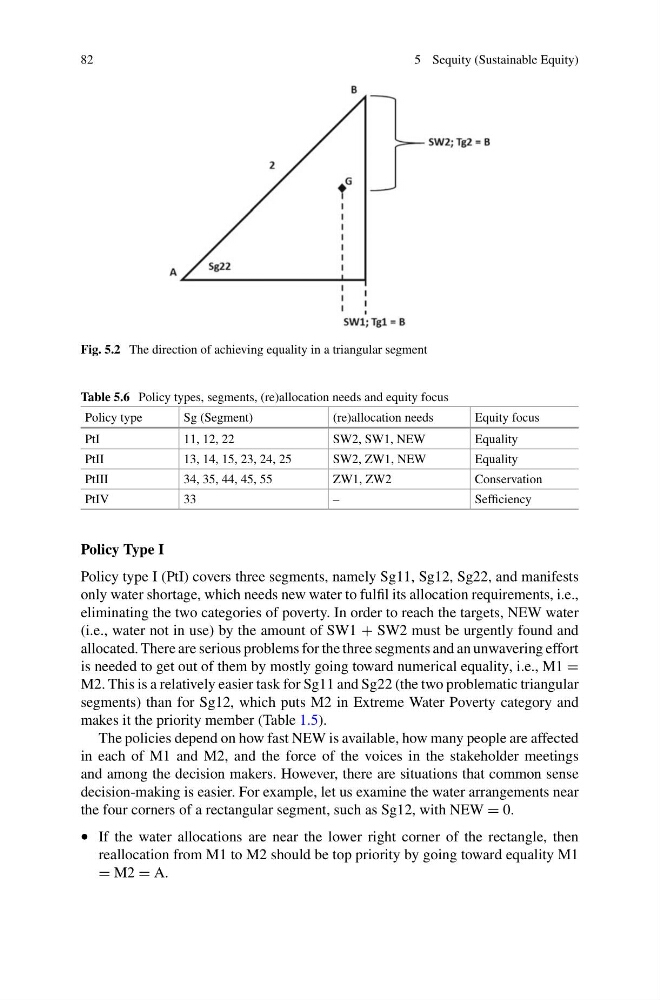
Fig. 5.2 The direction of achieving equality in a triangular segment
Table 5.6 Policy types, segments, (re)allocation needs and equity focus
Policy type
Sg (Segment)
(re)allocation needs
Equity focus
PtI
11, 12, 22
SW2, SW1, NEW
Equality
PtII
13, 14, 15, 23, 24, 25
SW2, ZW1, NEW
Equality
PtIII
34, 35, 44, 45, 55
ZW1, ZW2
Conservation
PtIV
33
–
Sefficiency
Policy Type I
Policy type I (PtI) covers three segments, namely Sg11, Sg12, Sg22, and manifests
only water shortage, which needs new water to fulfil its allocation requirements, i.e.,
eliminating the two categories of poverty. In order to reach the targets, NEW water
(i.e., water not in use) by the amount of SW1 + SW2 must be urgently found and
allocated. There are serious problems for the three segments and an unwavering effort
is needed to get out of them by mostly going toward numerical equality, i.e., M1 =
M2. This is a relatively easier task for Sg11 and Sg22 (the two problematic triangular
segments) than for Sg12, which puts M2 in Extreme Water Poverty category and
makes it the priority member (Table 1.5).
The policies depend on how fast NEW is available, how many people are affected
in each of M1 and M2, and the force of the voices in the stakeholder meetings
and among the decision makers. However, there are situations that common sense
decision-making is easier. For example, let us examine the water arrangements near
the four corners of a rectangular segment, such as Sg12, with NEW = 0.
• If the water allocations are near the lower right corner of the rectangle, then
reallocation from M1 to M2 should be top priority by going toward equality M1
= M2 = A.
5 Sequity (Sustainable Equity)
Fig. 5.2 The direction of achieving equality in a triangular segment
Table 5.6 Policy types, segments, (re)allocation needs and equity focus
Policy type
Sg (Segment)
(re)allocation needs
Equity focus
PtI
11, 12, 22
SW2, SW1, NEW
Equality
PtII
13, 14, 15, 23, 24, 25
SW2, ZW1, NEW
Equality
PtIII
34, 35, 44, 45, 55
ZW1, ZW2
Conservation
PtIV
33
–
Sefficiency
Policy Type I
Policy type I (PtI) covers three segments, namely Sg11, Sg12, Sg22, and manifests
only water shortage, which needs new water to fulfil its allocation requirements, i.e.,
eliminating the two categories of poverty. In order to reach the targets, NEW water
(i.e., water not in use) by the amount of SW1 + SW2 must be urgently found and
allocated. There are serious problems for the three segments and an unwavering effort
is needed to get out of them by mostly going toward numerical equality, i.e., M1 =
M2. This is a relatively easier task for Sg11 and Sg22 (the two problematic triangular
segments) than for Sg12, which puts M2 in Extreme Water Poverty category and
makes it the priority member (Table 1.5).
The policies depend on how fast NEW is available, how many people are affected
in each of M1 and M2, and the force of the voices in the stakeholder meetings
and among the decision makers. However, there are situations that common sense
decision-making is easier. For example, let us examine the water arrangements near
the four corners of a rectangular segment, such as Sg12, with NEW = 0.
• If the water allocations are near the lower right corner of the rectangle, then
reallocation from M1 to M2 should be top priority by going toward equality M1
= M2 = A.