

5.5 Four Policy Types
81
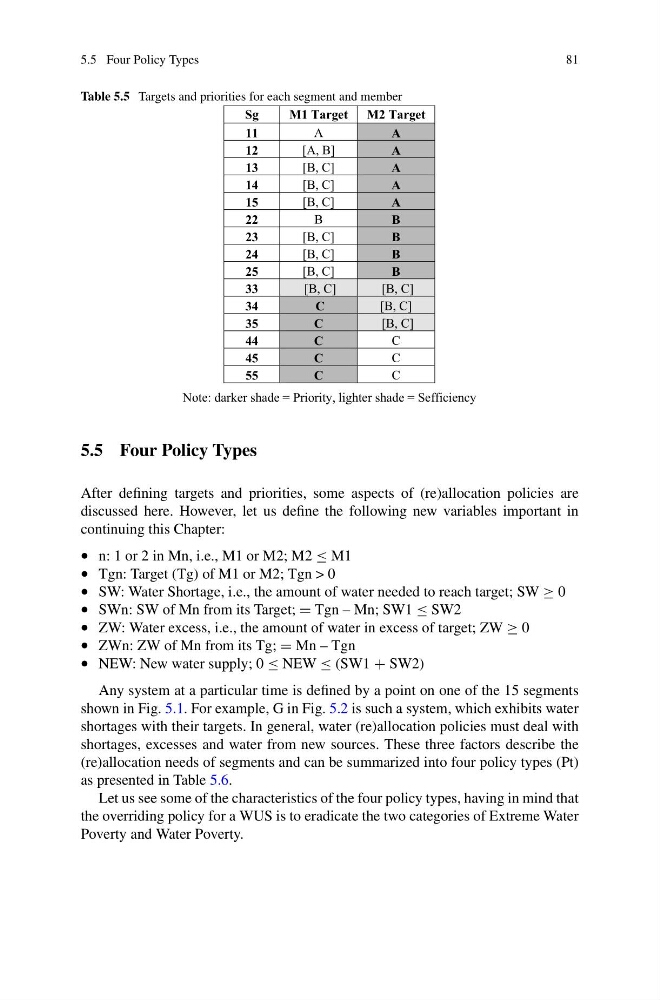
Table 5.5 Targets and priorities for each segment and member
Sg
M1 Target M2 Target
11
A
A
12
[A, B]
A
13
[B, C]
A
14
[B, C]
A
15
[B, C]
A
22
B
B
23
[B, C]
B
24
[B, C]
B
25
[B, C]
B
33
[B, C]
[B, C]
34
C
[B, C]
35
C
[B, C]
44
C
C
45
C
C
55
C
C
Note: darker shade = Priority, lighter shade = Sefficiency
5.5 Four Policy Types
After defining targets and priorities, some aspects of (re)allocation policies are
discussed here. However, let us define the following new variables important in
continuing this Chapter:
• n: 1 or 2 in Mn, i.e., M1 or M2; M2 ≤ M1
• Tgn: Target (Tg) of M1 or M2; Tgn > 0
• SW: Water Shortage, i.e., the amount of water needed to reach target; SW ≥ 0
• SWn: SW of Mn from its Target; = Tgn – Mn; SW1 ≤ SW2
• ZW: Water excess, i.e., the amount of water in excess of target; ZW ≥ 0
• ZWn: ZW of Mn from its Tg; = Mn – Tgn
• NEW: New water supply; 0 ≤ NEW ≤ (SW1 + SW2)
Any system at a particular time is defined by a point on one of the 15 segments
shown in Fig. 5.1. For example, G in Fig. 5.2 is such a system, which exhibits water
shortages with their targets. In general, water (re)allocation policies must deal with
shortages, excesses and water from new sources. These three factors describe the
(re)allocation needs of segments and can be summarized into four policy types (Pt)
as presented in Table 5.6.
Let us see some of the characteristics of the four policy types, having in mind that
the overriding policy for a WUS is to eradicate the two categories of Extreme Water
Poverty and Water Poverty.
81
Table 5.5 Targets and priorities for each segment and member
Sg
M1 Target M2 Target
11
A
A
12
[A, B]
A
13
[B, C]
A
14
[B, C]
A
15
[B, C]
A
22
B
B
23
[B, C]
B
24
[B, C]
B
25
[B, C]
B
33
[B, C]
[B, C]
34
C
[B, C]
35
C
[B, C]
44
C
C
45
C
C
55
C
C
Note: darker shade = Priority, lighter shade = Sefficiency
5.5 Four Policy Types
After defining targets and priorities, some aspects of (re)allocation policies are
discussed here. However, let us define the following new variables important in
continuing this Chapter:
• n: 1 or 2 in Mn, i.e., M1 or M2; M2 ≤ M1
• Tgn: Target (Tg) of M1 or M2; Tgn > 0
• SW: Water Shortage, i.e., the amount of water needed to reach target; SW ≥ 0
• SWn: SW of Mn from its Target; = Tgn – Mn; SW1 ≤ SW2
• ZW: Water excess, i.e., the amount of water in excess of target; ZW ≥ 0
• ZWn: ZW of Mn from its Tg; = Mn – Tgn
• NEW: New water supply; 0 ≤ NEW ≤ (SW1 + SW2)
Any system at a particular time is defined by a point on one of the 15 segments
shown in Fig. 5.1. For example, G in Fig. 5.2 is such a system, which exhibits water
shortages with their targets. In general, water (re)allocation policies must deal with
shortages, excesses and water from new sources. These three factors describe the
(re)allocation needs of segments and can be summarized into four policy types (Pt)
as presented in Table 5.6.
Let us see some of the characteristics of the four policy types, having in mind that
the overriding policy for a WUS is to eradicate the two categories of Extreme Water
Poverty and Water Poverty.