

80
5 Sequity (Sustainable Equity)
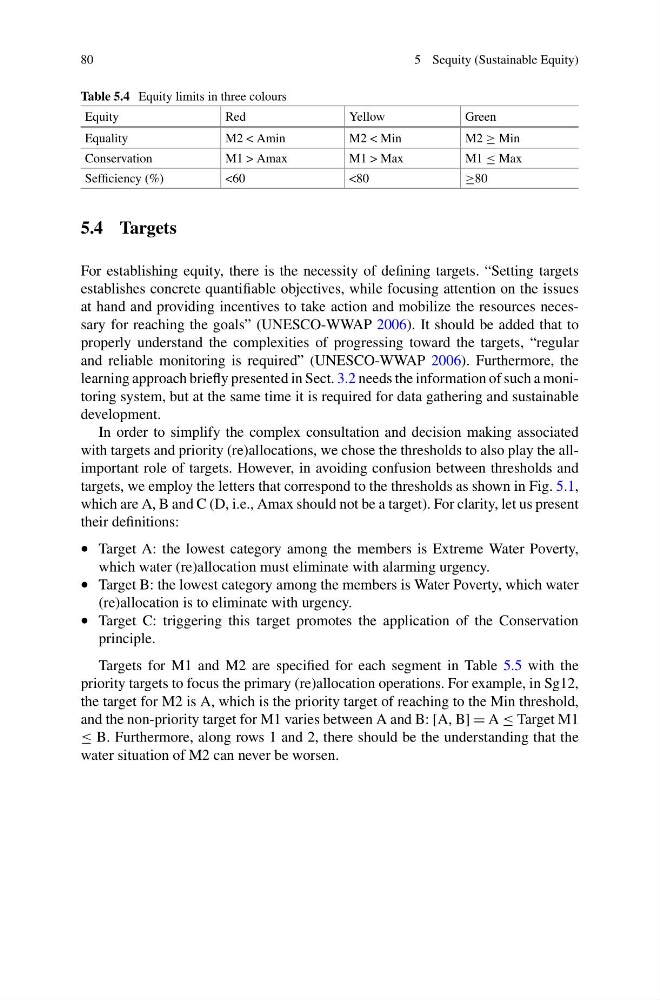
Table 5.4 Equity limits in three colours
Equity
Red
Yellow
Green
Equality
M2 < Amin
M2 < Min
M2 ≥ Min
Conservation
M1 > Amax
M1 > Max
M1 ≤ Max
Sefficiency (%)
<60
<80
≥80
5.4 Targets
For establishing equity, there is the necessity of defining targets. “Setting targets
establishes concrete quantifiable objectives, while focusing attention on the issues
at hand and providing incentives to take action and mobilize the resources necessary for reaching the goals” (UNESCO-WWAP 2006). It should be added that to
properly understand the complexities of progressing toward the targets, “regular
and reliable monitoring is required” (UNESCO-WWAP 2006). Furthermore, the
learning approach briefly presented in Sect. 3.2 needs the information of such a monitoring system, but at the same time it is required for data gathering and sustainable
development.
In order to simplify the complex consultation and decision making associated
with targets and priority (re)allocations, we chose the thresholds to also play the allimportant role of targets. However, in avoiding confusion between thresholds and
targets, we employ the letters that correspond to the thresholds as shown in Fig. 5.1,
which are A, B and C (D, i.e., Amax should not be a target). For clarity, let us present
their definitions:
• Target A: the lowest category among the members is Extreme Water Poverty,
which water (re)allocation must eliminate with alarming urgency.
• Target B: the lowest category among the members is Water Poverty, which water
(re)allocation is to eliminate with urgency.
• Target C: triggering this target promotes the application of the Conservation
principle.
Targets for M1 and M2 are specified for each segment in Table 5.5 with the
priority targets to focus the primary (re)allocation operations. For example, in Sg12,
the target for M2 is A, which is the priority target of reaching to the Min threshold,
and the non-priority target for M1 varies between A and B: [A, B] = A ≤ Target M1
≤ B. Furthermore, along rows 1 and 2, there should be the understanding that the
water situation of M2 can never be worsen.
5 Sequity (Sustainable Equity)
Table 5.4 Equity limits in three colours
Equity
Red
Yellow
Green
Equality
M2 < Amin
M2 < Min
M2 ≥ Min
Conservation
M1 > Amax
M1 > Max
M1 ≤ Max
Sefficiency (%)
<60
<80
≥80
5.4 Targets
For establishing equity, there is the necessity of defining targets. “Setting targets
establishes concrete quantifiable objectives, while focusing attention on the issues
at hand and providing incentives to take action and mobilize the resources necessary for reaching the goals” (UNESCO-WWAP 2006). It should be added that to
properly understand the complexities of progressing toward the targets, “regular
and reliable monitoring is required” (UNESCO-WWAP 2006). Furthermore, the
learning approach briefly presented in Sect. 3.2 needs the information of such a monitoring system, but at the same time it is required for data gathering and sustainable
development.
In order to simplify the complex consultation and decision making associated
with targets and priority (re)allocations, we chose the thresholds to also play the allimportant role of targets. However, in avoiding confusion between thresholds and
targets, we employ the letters that correspond to the thresholds as shown in Fig. 5.1,
which are A, B and C (D, i.e., Amax should not be a target). For clarity, let us present
their definitions:
• Target A: the lowest category among the members is Extreme Water Poverty,
which water (re)allocation must eliminate with alarming urgency.
• Target B: the lowest category among the members is Water Poverty, which water
(re)allocation is to eliminate with urgency.
• Target C: triggering this target promotes the application of the Conservation
principle.
Targets for M1 and M2 are specified for each segment in Table 5.5 with the
priority targets to focus the primary (re)allocation operations. For example, in Sg12,
the target for M2 is A, which is the priority target of reaching to the Min threshold,
and the non-priority target for M1 varies between A and B: [A, B] = A ≤ Target M1
≤ B. Furthermore, along rows 1 and 2, there should be the understanding that the
water situation of M2 can never be worsen.