

84
5 Sequity (Sustainable Equity)
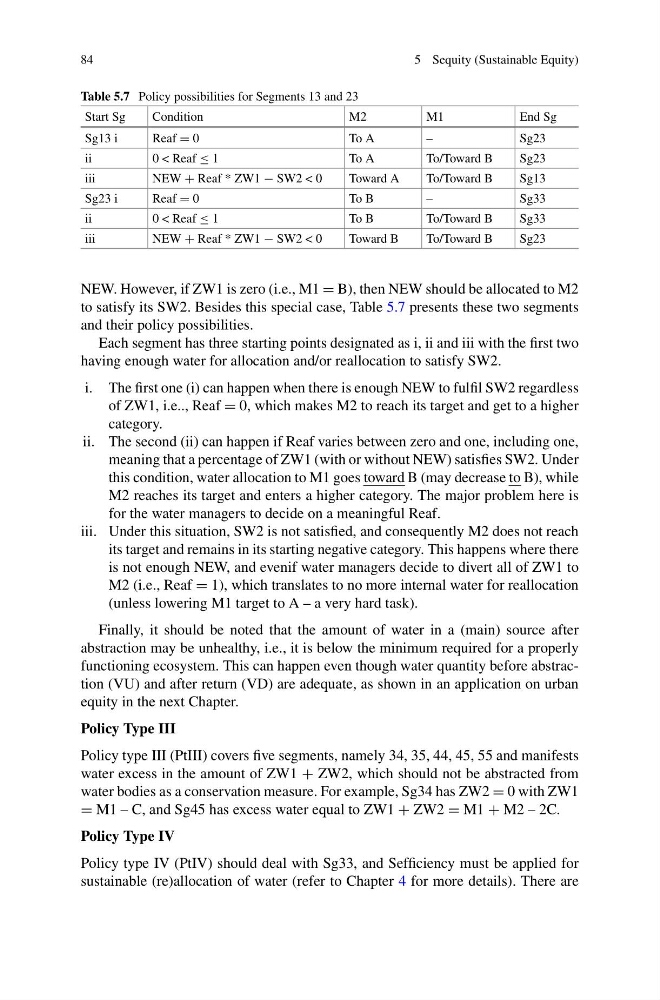
Table 5.7 Policy possibilities for Segments 13 and 23
Start Sg
Condition
M2
M1
End Sg
Sg13 i
Reaf = 0
To A
–
Sg23
ii
0 < Reaf ≤ 1
To A
To/Toward B
Sg23
iii
NEW + Reaf * ZW1 − SW2 < 0
Toward A
To/Toward B
Sg13
Sg23 i
Reaf = 0
To B
–
Sg33
ii
0 < Reaf ≤ 1
To B
To/Toward B
Sg33
iii
NEW + Reaf * ZW1 − SW2 < 0
Toward B
To/Toward B
Sg23
NEW. However, if ZW1 is zero (i.e., M1 = B), then NEW should be allocated to M2
to satisfy its SW2. Besides this special case, Table 5.7 presents these two segments
and their policy possibilities.
Each segment has three starting points designated as i, ii and iii with the first two
having enough water for allocation and/or reallocation to satisfy SW2.
i. The first one (i) can happen when there is enough NEW to fulfil SW2 regardless
of ZW1, i.e.., Reaf = 0, which makes M2 to reach its target and get to a higher
category.
ii. The second (ii) can happen if Reaf varies between zero and one, including one,
meaning that a percentage of ZW1 (with or without NEW) satisfies SW2. Under
this condition, water allocation to M1 goes toward B (may decrease to B), while
M2 reaches its target and enters a higher category. The major problem here is
for the water managers to decide on a meaningful Reaf.
iii. Under this situation, SW2 is not satisfied, and consequently M2 does not reach
its target and remains in its starting negative category. This happens where there
is not enough NEW, and evenif water managers decide to divert all of ZW1 to
M2 (i.e., Reaf = 1), which translates to no more internal water for reallocation
(unless lowering M1 target to A – a very hard task).
Finally, it should be noted that the amount of water in a (main) source after
abstraction may be unhealthy, i.e., it is below the minimum required for a properly
functioning ecosystem. This can happen even though water quantity before abstraction (VU) and after return (VD) are adequate, as shown in an application on urban
equity in the next Chapter.
Policy Type III
Policy type III (PtIII) covers five segments, namely 34, 35, 44, 45, 55 and manifests
water excess in the amount of ZW1 + ZW2, which should not be abstracted from
water bodies as a conservation measure. For example, Sg34 has ZW2 = 0 with ZW1
= M1 – C, and Sg45 has excess water equal to ZW1 + ZW2 = M1 + M2 – 2C.
Policy Type IV
Policy type IV (PtIV) should deal with Sg33, and Sefficiency must be applied for
sustainable (re)allocation of water (refer to Chapter 4 for more details). There are
5 Sequity (Sustainable Equity)
Table 5.7 Policy possibilities for Segments 13 and 23
Start Sg
Condition
M2
M1
End Sg
Sg13 i
Reaf = 0
To A
–
Sg23
ii
0 < Reaf ≤ 1
To A
To/Toward B
Sg23
iii
NEW + Reaf * ZW1 − SW2 < 0
Toward A
To/Toward B
Sg13
Sg23 i
Reaf = 0
To B
–
Sg33
ii
0 < Reaf ≤ 1
To B
To/Toward B
Sg33
iii
NEW + Reaf * ZW1 − SW2 < 0
Toward B
To/Toward B
Sg23
NEW. However, if ZW1 is zero (i.e., M1 = B), then NEW should be allocated to M2
to satisfy its SW2. Besides this special case, Table 5.7 presents these two segments
and their policy possibilities.
Each segment has three starting points designated as i, ii and iii with the first two
having enough water for allocation and/or reallocation to satisfy SW2.
i. The first one (i) can happen when there is enough NEW to fulfil SW2 regardless
of ZW1, i.e.., Reaf = 0, which makes M2 to reach its target and get to a higher
category.
ii. The second (ii) can happen if Reaf varies between zero and one, including one,
meaning that a percentage of ZW1 (with or without NEW) satisfies SW2. Under
this condition, water allocation to M1 goes toward B (may decrease to B), while
M2 reaches its target and enters a higher category. The major problem here is
for the water managers to decide on a meaningful Reaf.
iii. Under this situation, SW2 is not satisfied, and consequently M2 does not reach
its target and remains in its starting negative category. This happens where there
is not enough NEW, and evenif water managers decide to divert all of ZW1 to
M2 (i.e., Reaf = 1), which translates to no more internal water for reallocation
(unless lowering M1 target to A – a very hard task).
Finally, it should be noted that the amount of water in a (main) source after
abstraction may be unhealthy, i.e., it is below the minimum required for a properly
functioning ecosystem. This can happen even though water quantity before abstraction (VU) and after return (VD) are adequate, as shown in an application on urban
equity in the next Chapter.
Policy Type III
Policy type III (PtIII) covers five segments, namely 34, 35, 44, 45, 55 and manifests
water excess in the amount of ZW1 + ZW2, which should not be abstracted from
water bodies as a conservation measure. For example, Sg34 has ZW2 = 0 with ZW1
= M1 – C, and Sg45 has excess water equal to ZW1 + ZW2 = M1 + M2 – 2C.
Policy Type IV
Policy type IV (PtIV) should deal with Sg33, and Sefficiency must be applied for
sustainable (re)allocation of water (refer to Chapter 4 for more details). There are