

4.5 Alternatives
67
(Sect. 1.3). Finally, although its name consists of the word “effective” but it was not
defined, and as such, along the paper, it gets diverse meanings as applied to different
things, such as effective inflow, effective precipitation, and effective efficiency.
4.5.4 Resiliency
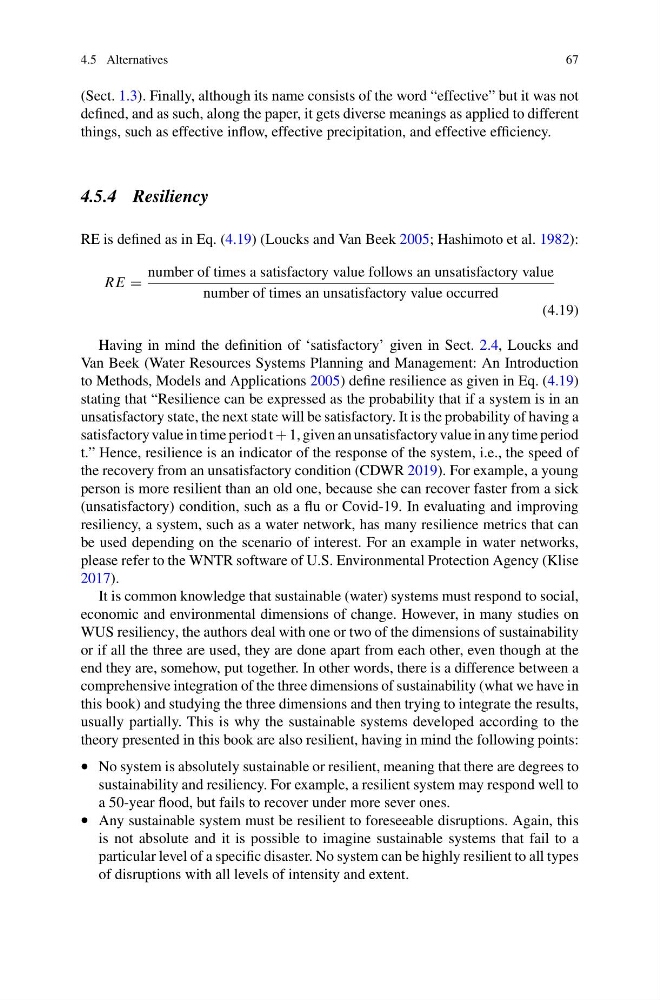
RE is defined as in Eq. (4.19) (Loucks and Van Beek 2005; Hashimoto et al. 1982):
R E =
number of times a satisfactory value follows an unsatisfactory value
number of times an unsatisfactory value occurred
(4.19)
Having in mind the definition of ‘satisfactory’ given in Sect. 2.4, Loucks and
Van Beek (Water Resources Systems Planning and Management: An Introduction
to Methods, Models and Applications 2005) define resilience as given in Eq. (4.19)
stating that “Resilience can be expressed as the probability that if a system is in an
unsatisfactory state, the next state will be satisfactory. It is the probability of having a
satisfactory value in time period t + 1, given an unsatisfactory value in any time period
t.” Hence, resilience is an indicator of the response of the system, i.e., the speed of
the recovery from an unsatisfactory condition (CDWR 2019). For example, a young
person is more resilient than an old one, because she can recover faster from a sick
(unsatisfactory) condition, such as a flu or Covid-19. In evaluating and improving
resiliency, a system, such as a water network, has many resilience metrics that can
be used depending on the scenario of interest. For an example in water networks,
please refer to the WNTR software of U.S. Environmental Protection Agency (Klise
2017).
It is common knowledge that sustainable (water) systems must respond to social,
economic and environmental dimensions of change. However, in many studies on
WUS resiliency, the authors deal with one or two of the dimensions of sustainability
or if all the three are used, they are done apart from each other, even though at the
end they are, somehow, put together. In other words, there is a difference between a
comprehensive integration of the three dimensions of sustainability (what we have in
this book) and studying the three dimensions and then trying to integrate the results,
usually partially. This is why the sustainable systems developed according to the
theory presented in this book are also resilient, having in mind the following points:
• No system is absolutely sustainable or resilient, meaning that there are degrees to
sustainability and resiliency. For example, a resilient system may respond well to
a 50-year flood, but fails to recover under more sever ones.
• Any sustainable system must be resilient to foreseeable disruptions. Again, this
is not absolute and it is possible to imagine sustainable systems that fail to a
particular level of a specific disaster. No system can be highly resilient to all types
of disruptions with all levels of intensity and extent.
67
(Sect. 1.3). Finally, although its name consists of the word “effective” but it was not
defined, and as such, along the paper, it gets diverse meanings as applied to different
things, such as effective inflow, effective precipitation, and effective efficiency.
4.5.4 Resiliency
RE is defined as in Eq. (4.19) (Loucks and Van Beek 2005; Hashimoto et al. 1982):
R E =
number of times a satisfactory value follows an unsatisfactory value
number of times an unsatisfactory value occurred
(4.19)
Having in mind the definition of ‘satisfactory’ given in Sect. 2.4, Loucks and
Van Beek (Water Resources Systems Planning and Management: An Introduction
to Methods, Models and Applications 2005) define resilience as given in Eq. (4.19)
stating that “Resilience can be expressed as the probability that if a system is in an
unsatisfactory state, the next state will be satisfactory. It is the probability of having a
satisfactory value in time period t + 1, given an unsatisfactory value in any time period
t.” Hence, resilience is an indicator of the response of the system, i.e., the speed of
the recovery from an unsatisfactory condition (CDWR 2019). For example, a young
person is more resilient than an old one, because she can recover faster from a sick
(unsatisfactory) condition, such as a flu or Covid-19. In evaluating and improving
resiliency, a system, such as a water network, has many resilience metrics that can
be used depending on the scenario of interest. For an example in water networks,
please refer to the WNTR software of U.S. Environmental Protection Agency (Klise
2017).
It is common knowledge that sustainable (water) systems must respond to social,
economic and environmental dimensions of change. However, in many studies on
WUS resiliency, the authors deal with one or two of the dimensions of sustainability
or if all the three are used, they are done apart from each other, even though at the
end they are, somehow, put together. In other words, there is a difference between a
comprehensive integration of the three dimensions of sustainability (what we have in
this book) and studying the three dimensions and then trying to integrate the results,
usually partially. This is why the sustainable systems developed according to the
theory presented in this book are also resilient, having in mind the following points:
• No system is absolutely sustainable or resilient, meaning that there are degrees to
sustainability and resiliency. For example, a resilient system may respond well to
a 50-year flood, but fails to recover under more sever ones.
• Any sustainable system must be resilient to foreseeable disruptions. Again, this
is not absolute and it is possible to imagine sustainable systems that fail to a
particular level of a specific disaster. No system can be highly resilient to all types
of disruptions with all levels of intensity and extent.