

66
4 Sefficiency (Sustainable Efficiency)
consequently much care should be exercised not to confuse its concept with efficiency indicators (in %) used in this book. Equation (4.17) applied to one specific
WUS has the following examples:
• ‘production’ can be yield (kg), mass of production (kg), monetary value (e),
amount of product—different from water (m
3 ), etc.
• ‘water quantity’ can be water applied (VA in m
3 ), evapotranspiration (ET in mm),
etc.
WaP as a ratio of output to input is similar to CE and equally a flawed indicator for
water management due to the issues given for CE, and various other reasons given
by some experts and organisations (Wichelns 2014; FAO & WWC 2015). There
are also variations to Eq. (4.17), such as 1/WaP and all are flawed. For example,
Coca Cola Company uses it under the name Water Efficiency meaning amount of
water used (litre) per amount of product made (litre) (Coca-Cola Company 2018). In
general, production depends on many inputs including water in a nonlinear fashion,
and as an input becomes scarcer, production becomes more dependent on that scarce
input. Under what combination of inputs, the productivity of the system (i.e., all
input considered) is good-enough? The answer to this question erroneously narrows
down to one (not many) input depending on the expert. For example, under the same
conditions for an irrigated agriculture, the answer of the water experts is proper
amount of water; the answer of the soil experts is better soil; the answer of the pest
experts is better pest control; the answer of the economic experts is about market or
land ownership, etc. Anyhow, Eq. (4.17) may prove to be valuable for agronomists and
particular industries but not for water managers who should aim for a comprehensive
and good-enough performance of a WUS.
4.5.3 Effective Efficiency
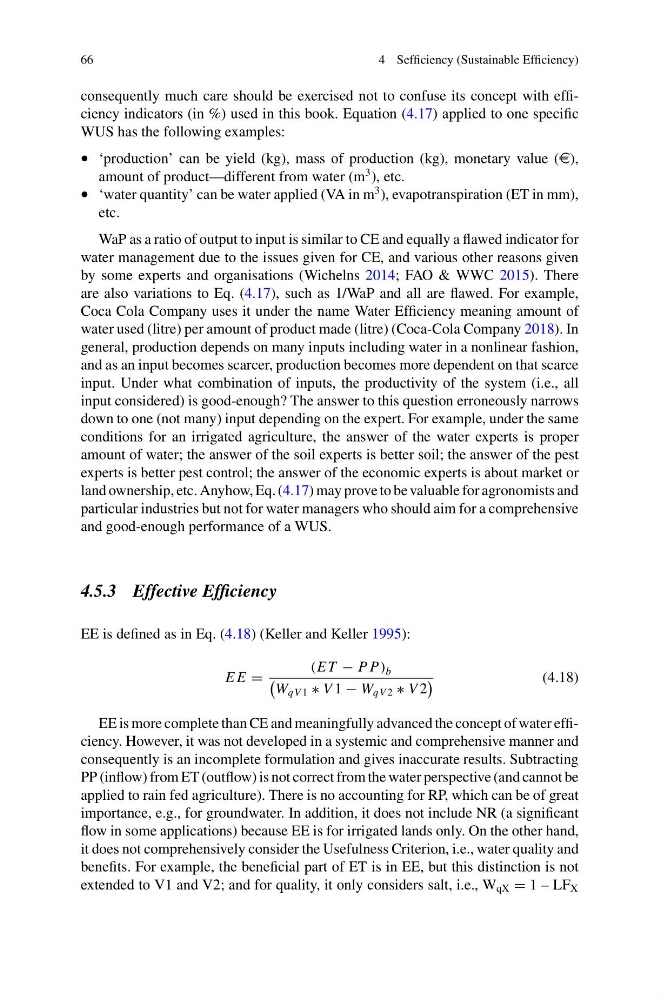
EE is defined as in Eq. (4.18) (Keller and Keller 1995):
E E =
(E T − P P) b
W qV 1 ∗ V 1 − W qV 2 ∗ V 2
(4.18)
EE is more complete than CE and meaningfully advanced the concept of water efficiency. However, it was not developed in a systemic and comprehensive manner and
consequently is an incomplete formulation and gives inaccurate results. Subtracting
PP (inflow) from ET (outflow) is not correct from the water perspective (and cannot be
applied to rain fed agriculture). There is no accounting for RP, which can be of great
importance, e.g., for groundwater. In addition, it does not include NR (a significant
flow in some applications) because EE is for irrigated lands only. On the other hand,
it does not comprehensively consider the Usefulness Criterion, i.e., water quality and
benefits. For example, the beneficial part of ET is in EE, but this distinction is not
extended to V1 and V2; and for quality, it only considers salt, i.e., W qX = 1 – LF X
4 Sefficiency (Sustainable Efficiency)
consequently much care should be exercised not to confuse its concept with efficiency indicators (in %) used in this book. Equation (4.17) applied to one specific
WUS has the following examples:
• ‘production’ can be yield (kg), mass of production (kg), monetary value (e),
amount of product—different from water (m
3 ), etc.
• ‘water quantity’ can be water applied (VA in m
3 ), evapotranspiration (ET in mm),
etc.
WaP as a ratio of output to input is similar to CE and equally a flawed indicator for
water management due to the issues given for CE, and various other reasons given
by some experts and organisations (Wichelns 2014; FAO & WWC 2015). There
are also variations to Eq. (4.17), such as 1/WaP and all are flawed. For example,
Coca Cola Company uses it under the name Water Efficiency meaning amount of
water used (litre) per amount of product made (litre) (Coca-Cola Company 2018). In
general, production depends on many inputs including water in a nonlinear fashion,
and as an input becomes scarcer, production becomes more dependent on that scarce
input. Under what combination of inputs, the productivity of the system (i.e., all
input considered) is good-enough? The answer to this question erroneously narrows
down to one (not many) input depending on the expert. For example, under the same
conditions for an irrigated agriculture, the answer of the water experts is proper
amount of water; the answer of the soil experts is better soil; the answer of the pest
experts is better pest control; the answer of the economic experts is about market or
land ownership, etc. Anyhow, Eq. (4.17) may prove to be valuable for agronomists and
particular industries but not for water managers who should aim for a comprehensive
and good-enough performance of a WUS.
4.5.3 Effective Efficiency
EE is defined as in Eq. (4.18) (Keller and Keller 1995):
E E =
(E T − P P) b
W qV 1 ∗ V 1 − W qV 2 ∗ V 2
(4.18)
EE is more complete than CE and meaningfully advanced the concept of water efficiency. However, it was not developed in a systemic and comprehensive manner and
consequently is an incomplete formulation and gives inaccurate results. Subtracting
PP (inflow) from ET (outflow) is not correct from the water perspective (and cannot be
applied to rain fed agriculture). There is no accounting for RP, which can be of great
importance, e.g., for groundwater. In addition, it does not include NR (a significant
flow in some applications) because EE is for irrigated lands only. On the other hand,
it does not comprehensively consider the Usefulness Criterion, i.e., water quality and
benefits. For example, the beneficial part of ET is in EE, but this distinction is not
extended to V1 and V2; and for quality, it only considers salt, i.e., W qX = 1 – LF X