

60
4 Sefficiency (Sustainable Efficiency)
• CE does not obey water balance, one of the most important laws in studying and
designing water systems.
• Partial consideration of Usefulness Criterion, i.e., lack of a comprehensive concern
for applying water quality and benefits. For example, the numerator considers
the beneficial part, but this distinction is not extended to the denominator.
Furthermore, CE is a quantity indicator, with little or no consideration for water
quality.
Many experts state that increasing CE by decreasing the total water (denominator)
saves water for downstream. However, in most cases such a water saving is actually
negligible and close to zero. Please see a common example about this myth in Chap. 6.
For now, let us focus on the application of CE in agriculture and urban areas.
In irrigated agriculture, CE is mostly defined as CE = ET b /VA (Seckler et al.
2003), meaning the ratio of beneficial ET to water applied. Various other names are
given to CE, such as, irrigation efficiency and water use efficiency. As just mentioned
CE is flawed and many authors, including Willardson, et al. (1994) and Haie and
Keller (2012) have discussed its problems. Additionally, various authors have defined
CE with some variations but all are flawed. For example, efficiency is shown as 1/CE
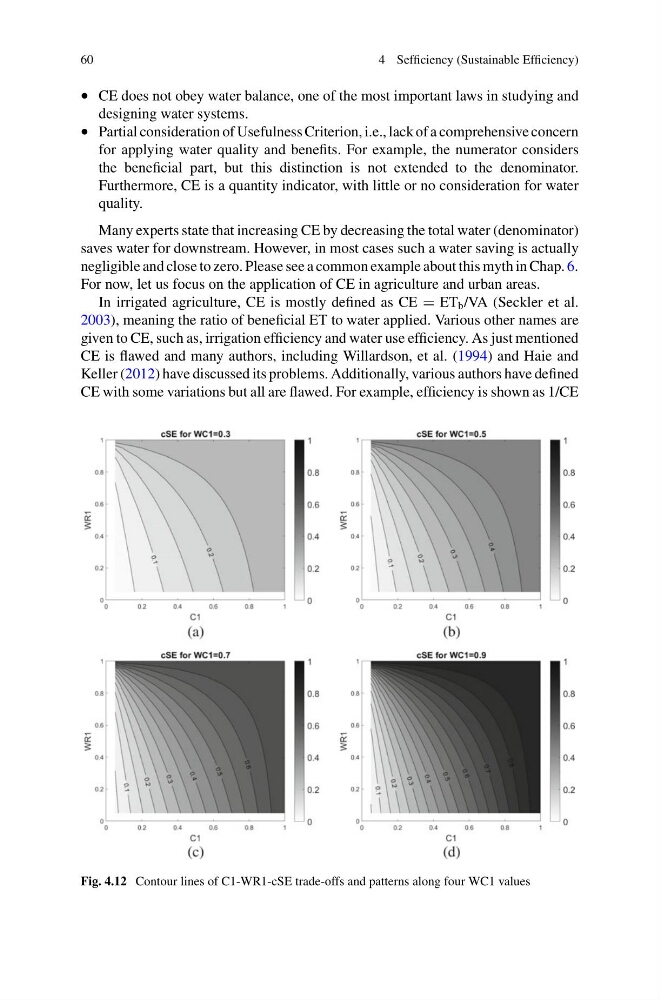
Fig. 4.12 Contour lines of C1-WR1-cSE trade-offs and patterns along four WC1 values
4 Sefficiency (Sustainable Efficiency)
• CE does not obey water balance, one of the most important laws in studying and
designing water systems.
• Partial consideration of Usefulness Criterion, i.e., lack of a comprehensive concern
for applying water quality and benefits. For example, the numerator considers
the beneficial part, but this distinction is not extended to the denominator.
Furthermore, CE is a quantity indicator, with little or no consideration for water
quality.
Many experts state that increasing CE by decreasing the total water (denominator)
saves water for downstream. However, in most cases such a water saving is actually
negligible and close to zero. Please see a common example about this myth in Chap. 6.
For now, let us focus on the application of CE in agriculture and urban areas.
In irrigated agriculture, CE is mostly defined as CE = ET b /VA (Seckler et al.
2003), meaning the ratio of beneficial ET to water applied. Various other names are
given to CE, such as, irrigation efficiency and water use efficiency. As just mentioned
CE is flawed and many authors, including Willardson, et al. (1994) and Haie and
Keller (2012) have discussed its problems. Additionally, various authors have defined
CE with some variations but all are flawed. For example, efficiency is shown as 1/CE
Fig. 4.12 Contour lines of C1-WR1-cSE trade-offs and patterns along four WC1 values