

4.5 Alternatives
59
4.5.1 Classical Efficiency
All sectors, including urban and agriculture, have been employing Classical
Efficiency (CE) for decades with Eq. (4.16) giving its generic form.
C E =
Bene f icial water
T otal water
(4.16)
This is to say that CE is the ratio of beneficial water to total water (applied).
Examples of the word ‘water’ in Eq. (4.16) are as follows:
• Numerator (beneficial water): beneficial water use, consumption or required
• Denominator (total water): total water applied, abstracted, allocated or required
With such a definition, CE is a flawed indicator, having in mind the following
issues:
• Incompleteness of water flows, particularly the lack of the inclusion of returns in
the equation, which also makes it inadequate for any multi-objective WUS.
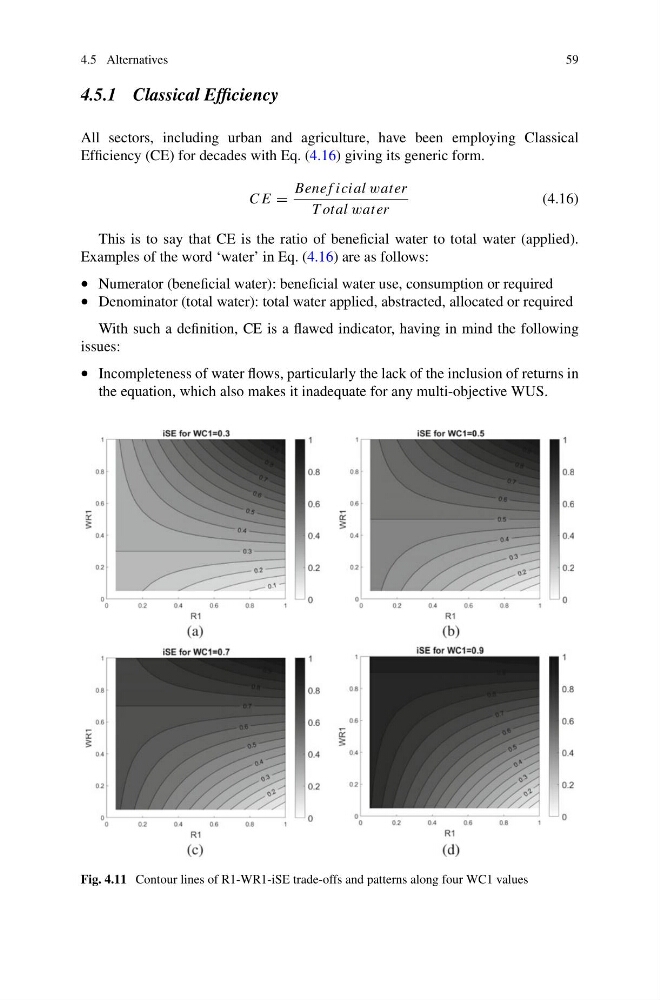
Fig. 4.11 Contour lines of R1-WR1-iSE trade-offs and patterns along four WC1 values
59
4.5.1 Classical Efficiency
All sectors, including urban and agriculture, have been employing Classical
Efficiency (CE) for decades with Eq. (4.16) giving its generic form.
C E =
Bene f icial water
T otal water
(4.16)
This is to say that CE is the ratio of beneficial water to total water (applied).
Examples of the word ‘water’ in Eq. (4.16) are as follows:
• Numerator (beneficial water): beneficial water use, consumption or required
• Denominator (total water): total water applied, abstracted, allocated or required
With such a definition, CE is a flawed indicator, having in mind the following
issues:
• Incompleteness of water flows, particularly the lack of the inclusion of returns in
the equation, which also makes it inadequate for any multi-objective WUS.
Fig. 4.11 Contour lines of R1-WR1-iSE trade-offs and patterns along four WC1 values