

4.5 Alternatives
61
and given a different name, or leaching fraction is applied to VA (see Sect. 1.3),
or PP b (also called effective precipitation) is subtracted from ET b , or change in
storage is subtracted from VA (in practice never used, e.g., Burt et al. (1997)), etc.
In reality, CE is a fraction, which conveys very little information (Willardson et al.
1994) and not a scientific and logical performance indicator. However, CE is, to some
extent, legitimate from the perspective of the crop but not water, meaning that for
agronomists, CE may advance some information but for water managers, it is not
suitable at all. These two perspectives create confusion in the mind of many experts,
making it another example of why this book insists on the centrality of water in
managing it.
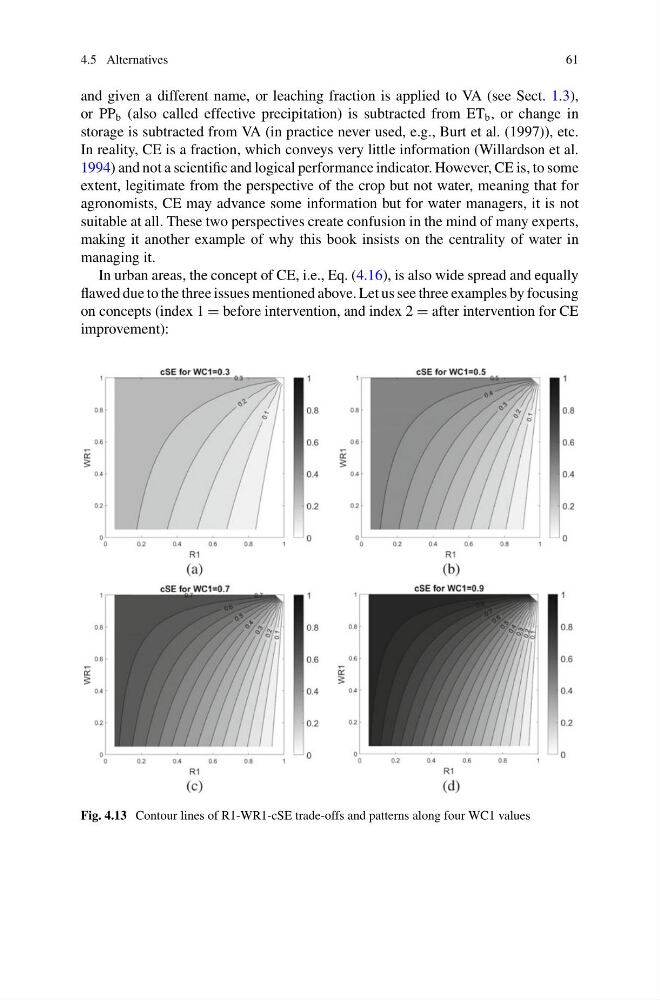
In urban areas, the concept of CE, i.e., Eq. (4.16), is also wide spread and equally
flawed due to the three issues mentioned above. Let us see three examples by focusing
on concepts (index 1 = before intervention, and index 2 = after intervention for CE
improvement):
Fig. 4.13 Contour lines of R1-WR1-cSE trade-offs and patterns along four WC1 values
61
and given a different name, or leaching fraction is applied to VA (see Sect. 1.3),
or PP b (also called effective precipitation) is subtracted from ET b , or change in
storage is subtracted from VA (in practice never used, e.g., Burt et al. (1997)), etc.
In reality, CE is a fraction, which conveys very little information (Willardson et al.
1994) and not a scientific and logical performance indicator. However, CE is, to some
extent, legitimate from the perspective of the crop but not water, meaning that for
agronomists, CE may advance some information but for water managers, it is not
suitable at all. These two perspectives create confusion in the mind of many experts,
making it another example of why this book insists on the centrality of water in
managing it.
In urban areas, the concept of CE, i.e., Eq. (4.16), is also wide spread and equally
flawed due to the three issues mentioned above. Let us see three examples by focusing
on concepts (index 1 = before intervention, and index 2 = after intervention for CE
improvement):
Fig. 4.13 Contour lines of R1-WR1-cSE trade-offs and patterns along four WC1 values