

amplify the signal to enhance sensitivity. Specifically, the short thiolated MSAs are
immobilized on the surface of the QCM as the capture probe, and the MSAs are
linked to the Au-NPs as the linking probe. The two components can form a sandwich
structure of the T-Hg(II)-T type in the presence of Hg(II) ions. This leads to change
in the mass on the QCM and a change in the resonance frequency. Hg(II) can be
determined with a detection limit of 0.24 Æ 0.06 nM, which is three orders of
magnitude better than previous methods. The sensor can be regenerated by
disrupting the T-Hg(II)-T base pairs with a solution of cysteine. The water can
contain also phosphates, nitrates, ammonia, and their mixtures that can leach into the
groundwater. Those chemicals cause a number of health issues, such as kidney
problems and cancer. These risks are high for pregnant and nursing women, infants,
and the elderly. Those contaminants are not so easy to detect with QCM, and
strategies are necessary to recognize them. Ayad et al. [57] used a thin-film
polyaniline (PANI) as the sensing materials. The adsorption of the compound onto
the PANI-coated QCM resulted in increasing the frequency shift due to hydrophilic
nature of the film and electrostatic interactions.
However, QCM might be appropriate for the development of potential
bio-analytical systems that are based on the use of various sensing technologies
into a single system. It is possible to integrate QCM with SPR (surface plasmon
resonance) and with electrochemical detection to extend the range of applications.
The reuse of the crystal is another concern for low-cost applications. Following
various cleaning procedures, it is possible to regenerate the electrodes for 3–4 times.
QCMs have been widely used in a broad range of analytical applications as
the sensing procedure is simple, cost-effective, non-hazardous, real time, and less
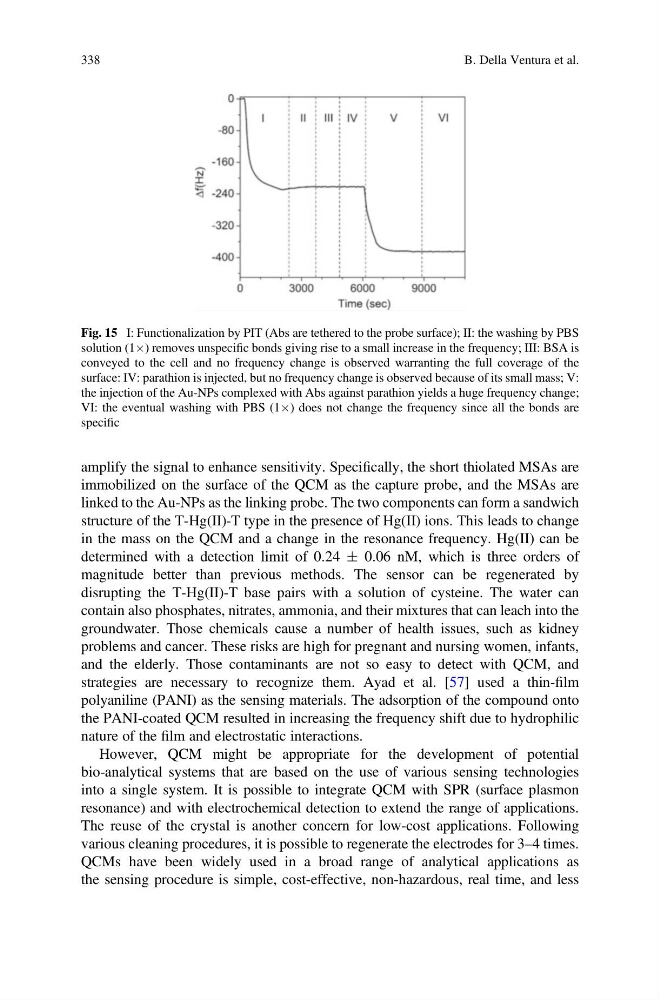
Fig. 15 I: Functionalization by PIT (Abs are tethered to the probe surface); II: the washing by PBS
solution (1Â) removes unspecific bonds giving rise to a small increase in the frequency; III: BSA is
conveyed to the cell and no frequency change is observed warranting the full coverage of the
surface: IV: parathion is injected, but no frequency change is observed because of its small mass; V:
the injection of the Au-NPs complexed with Abs against parathion yields a huge frequency change;
VI: the eventual washing with PBS (1Â) does not change the frequency since all the bonds are
specific
338
B. Della Ventura et al.
immobilized on the surface of the QCM as the capture probe, and the MSAs are
linked to the Au-NPs as the linking probe. The two components can form a sandwich
structure of the T-Hg(II)-T type in the presence of Hg(II) ions. This leads to change
in the mass on the QCM and a change in the resonance frequency. Hg(II) can be
determined with a detection limit of 0.24 Æ 0.06 nM, which is three orders of
magnitude better than previous methods. The sensor can be regenerated by
disrupting the T-Hg(II)-T base pairs with a solution of cysteine. The water can
contain also phosphates, nitrates, ammonia, and their mixtures that can leach into the
groundwater. Those chemicals cause a number of health issues, such as kidney
problems and cancer. These risks are high for pregnant and nursing women, infants,
and the elderly. Those contaminants are not so easy to detect with QCM, and
strategies are necessary to recognize them. Ayad et al. [57] used a thin-film
polyaniline (PANI) as the sensing materials. The adsorption of the compound onto
the PANI-coated QCM resulted in increasing the frequency shift due to hydrophilic
nature of the film and electrostatic interactions.
However, QCM might be appropriate for the development of potential
bio-analytical systems that are based on the use of various sensing technologies
into a single system. It is possible to integrate QCM with SPR (surface plasmon
resonance) and with electrochemical detection to extend the range of applications.
The reuse of the crystal is another concern for low-cost applications. Following
various cleaning procedures, it is possible to regenerate the electrodes for 3–4 times.
QCMs have been widely used in a broad range of analytical applications as
the sensing procedure is simple, cost-effective, non-hazardous, real time, and less
Fig. 15 I: Functionalization by PIT (Abs are tethered to the probe surface); II: the washing by PBS
solution (1Â) removes unspecific bonds giving rise to a small increase in the frequency; III: BSA is
conveyed to the cell and no frequency change is observed warranting the full coverage of the
surface: IV: parathion is injected, but no frequency change is observed because of its small mass; V:
the injection of the Au-NPs complexed with Abs against parathion yields a huge frequency change;
VI: the eventual washing with PBS (1Â) does not change the frequency since all the bonds are
specific
338
B. Della Ventura et al.