

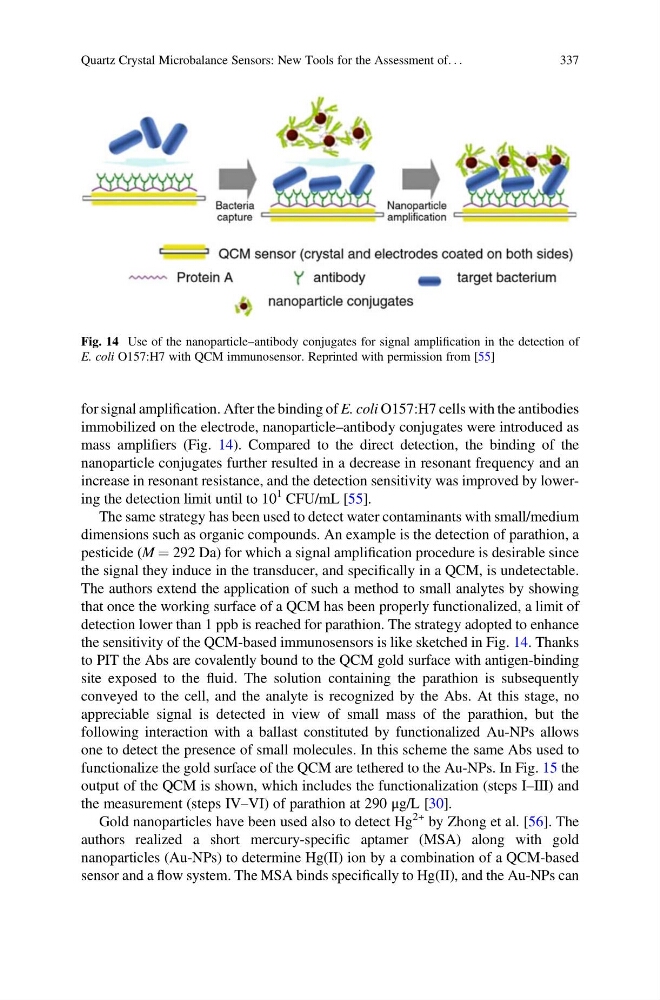
for signal amplification. After the binding of E. coli O157:H7 cells with the antibodies
immobilized on the electrode, nanoparticle–antibody conjugates were introduced as
mass amplifiers (Fig. 14). Compared to the direct detection, the binding of the
nanoparticle conjugates further resulted in a decrease in resonant frequency and an
increase in resonant resistance, and the detection sensitivity was improved by lowering the detection limit until to 10
1 CFU/mL [55].
The same strategy has been used to detect water contaminants with small/medium
dimensions such as organic compounds. An example is the detection of parathion, a
pesticide (M ¼ 292 Da) for which a signal amplification procedure is desirable since
the signal they induce in the transducer, and specifically in a QCM, is undetectable.
The authors extend the application of such a method to small analytes by showing
that once the working surface of a QCM has been properly functionalized, a limit of
detection lower than 1 ppb is reached for parathion. The strategy adopted to enhance
the sensitivity of the QCM-based immunosensors is like sketched in Fig. 14. Thanks
to PIT the Abs are covalently bound to the QCM gold surface with antigen-binding
site exposed to the fluid. The solution containing the parathion is subsequently
conveyed to the cell, and the analyte is recognized by the Abs. At this stage, no
appreciable signal is detected in view of small mass of the parathion, but the
following interaction with a ballast constituted by functionalized Au-NPs allows
one to detect the presence of small molecules. In this scheme the same Abs used to
functionalize the gold surface of the QCM are tethered to the Au-NPs. In Fig. 15 the
output of the QCM is shown, which includes the functionalization (steps I–III) and
the measurement (steps IV–VI) of parathion at 290 μg/L [30].
Gold nanoparticles have been used also to detect Hg
2+ by Zhong et al. [56]. The
authors realized a short mercury-specific aptamer (MSA) along with gold
nanoparticles (Au-NPs) to determine Hg(II) ion by a combination of a QCM-based
sensor and a flow system. The MSA binds specifically to Hg(II), and the Au-NPs can
Fig. 14 Use of the nanoparticle–antibody conjugates for signal amplification in the detection of
E. coli O157:H7 with QCM immunosensor. Reprinted with permission from [55]
Quartz Crystal Microbalance Sensors: New Tools for the Assessment of. . .
337
immobilized on the electrode, nanoparticle–antibody conjugates were introduced as
mass amplifiers (Fig. 14). Compared to the direct detection, the binding of the
nanoparticle conjugates further resulted in a decrease in resonant frequency and an
increase in resonant resistance, and the detection sensitivity was improved by lowering the detection limit until to 10
1 CFU/mL [55].
The same strategy has been used to detect water contaminants with small/medium
dimensions such as organic compounds. An example is the detection of parathion, a
pesticide (M ¼ 292 Da) for which a signal amplification procedure is desirable since
the signal they induce in the transducer, and specifically in a QCM, is undetectable.
The authors extend the application of such a method to small analytes by showing
that once the working surface of a QCM has been properly functionalized, a limit of
detection lower than 1 ppb is reached for parathion. The strategy adopted to enhance
the sensitivity of the QCM-based immunosensors is like sketched in Fig. 14. Thanks
to PIT the Abs are covalently bound to the QCM gold surface with antigen-binding
site exposed to the fluid. The solution containing the parathion is subsequently
conveyed to the cell, and the analyte is recognized by the Abs. At this stage, no
appreciable signal is detected in view of small mass of the parathion, but the
following interaction with a ballast constituted by functionalized Au-NPs allows
one to detect the presence of small molecules. In this scheme the same Abs used to
functionalize the gold surface of the QCM are tethered to the Au-NPs. In Fig. 15 the
output of the QCM is shown, which includes the functionalization (steps I–III) and
the measurement (steps IV–VI) of parathion at 290 μg/L [30].
Gold nanoparticles have been used also to detect Hg
2+ by Zhong et al. [56]. The
authors realized a short mercury-specific aptamer (MSA) along with gold
nanoparticles (Au-NPs) to determine Hg(II) ion by a combination of a QCM-based
sensor and a flow system. The MSA binds specifically to Hg(II), and the Au-NPs can
Fig. 14 Use of the nanoparticle–antibody conjugates for signal amplification in the detection of
E. coli O157:H7 with QCM immunosensor. Reprinted with permission from [55]
Quartz Crystal Microbalance Sensors: New Tools for the Assessment of. . .
337