

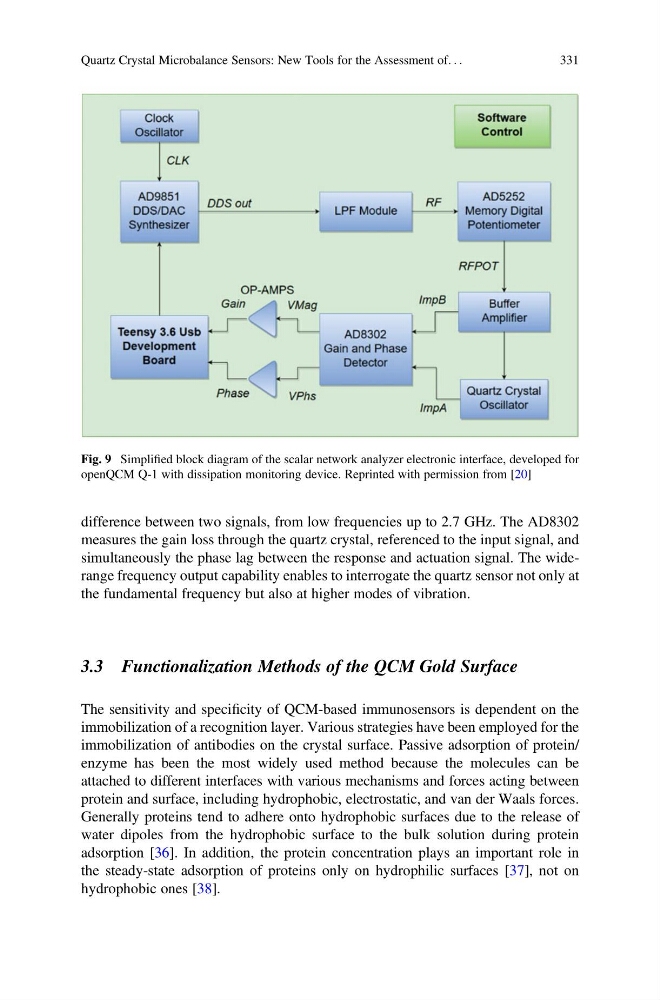
difference between two signals, from low frequencies up to 2.7 GHz. The AD8302
measures the gain loss through the quartz crystal, referenced to the input signal, and
simultaneously the phase lag between the response and actuation signal. The widerange frequency output capability enables to interrogate the quartz sensor not only at
the fundamental frequency but also at higher modes of vibration.
3.3 Functionalization Methods of the QCM Gold Surface
The sensitivity and specificity of QCM-based immunosensors is dependent on the
immobilization of a recognition layer. Various strategies have been employed for the
immobilization of antibodies on the crystal surface. Passive adsorption of protein/
enzyme has been the most widely used method because the molecules can be
attached to different interfaces with various mechanisms and forces acting between
protein and surface, including hydrophobic, electrostatic, and van der Waals forces.
Generally proteins tend to adhere onto hydrophobic surfaces due to the release of
water dipoles from the hydrophobic surface to the bulk solution during protein
adsorption [36]. In addition, the protein concentration plays an important role in
the steady-state adsorption of proteins only on hydrophilic surfaces [37], not on
hydrophobic ones [38].
Fig. 9 Simplified block diagram of the scalar network analyzer electronic interface, developed for
openQCM Q-1 with dissipation monitoring device. Reprinted with permission from [20]
Quartz Crystal Microbalance Sensors: New Tools for the Assessment of. . .
331
measures the gain loss through the quartz crystal, referenced to the input signal, and
simultaneously the phase lag between the response and actuation signal. The widerange frequency output capability enables to interrogate the quartz sensor not only at
the fundamental frequency but also at higher modes of vibration.
3.3 Functionalization Methods of the QCM Gold Surface
The sensitivity and specificity of QCM-based immunosensors is dependent on the
immobilization of a recognition layer. Various strategies have been employed for the
immobilization of antibodies on the crystal surface. Passive adsorption of protein/
enzyme has been the most widely used method because the molecules can be
attached to different interfaces with various mechanisms and forces acting between
protein and surface, including hydrophobic, electrostatic, and van der Waals forces.
Generally proteins tend to adhere onto hydrophobic surfaces due to the release of
water dipoles from the hydrophobic surface to the bulk solution during protein
adsorption [36]. In addition, the protein concentration plays an important role in
the steady-state adsorption of proteins only on hydrophilic surfaces [37], not on
hydrophobic ones [38].
Fig. 9 Simplified block diagram of the scalar network analyzer electronic interface, developed for
openQCM Q-1 with dissipation monitoring device. Reprinted with permission from [20]
Quartz Crystal Microbalance Sensors: New Tools for the Assessment of. . .
331