

Proteins can undergo conformational changes and unfold due to different forces
acting during the adsorption process, affecting their biological activity. “Hard”
proteins (lysozyme, β-lactoglobulin, α-chymotrypsin, etc.) upon adsorption retain
their dissolved state without spreading. In contrast, “soft” proteins (bovine serum
albumin (BSA), IgG, fibrinogen, or α-lactoglobulin) can spread on the surface upon
adsorption. “Soft” proteins tend to adsorb onto various surfaces as compared to
“hard” proteins that adsorb onto hydrophilic surfaces only when there is electrostatic
attraction between protein molecules and the surface.
The surface roughness also affects adsorption and the morphology of adsorbed
protein. For example, larger amounts are adsorbed to the hydrophobic surfaces as
compared to the hydrophilic ones. Only on smooth hydrophilic or hydrophobic
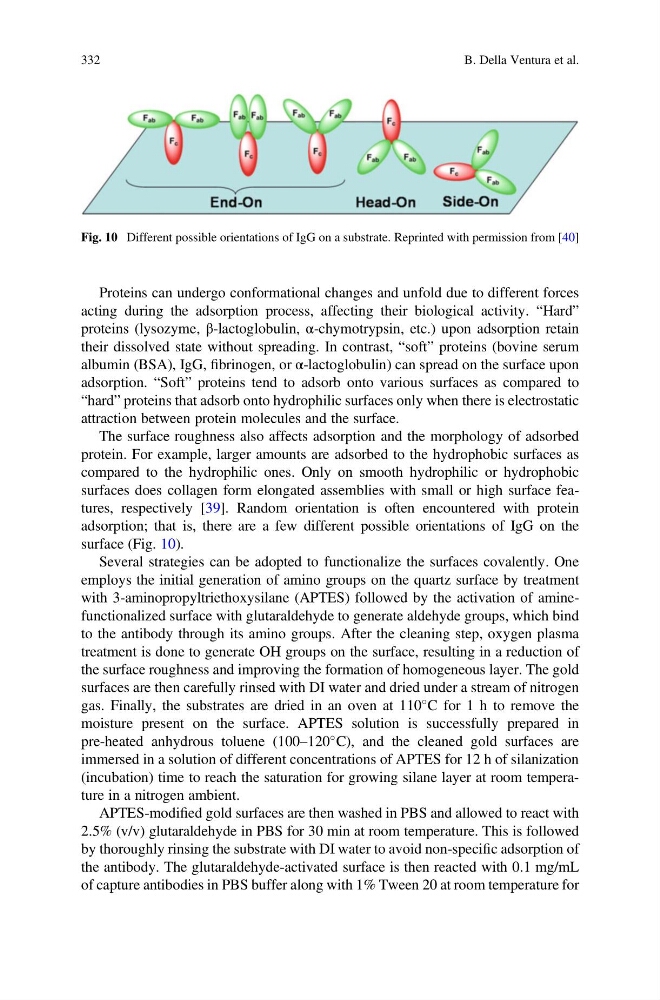
surfaces does collagen form elongated assemblies with small or high surface features, respectively [39]. Random orientation is often encountered with protein
adsorption; that is, there are a few different possible orientations of IgG on the
surface (Fig. 10).
Several strategies can be adopted to functionalize the surfaces covalently. One
employs the initial generation of amino groups on the quartz surface by treatment
with 3-aminopropyltriethoxysilane (APTES) followed by the activation of aminefunctionalized surface with glutaraldehyde to generate aldehyde groups, which bind
to the antibody through its amino groups. After the cleaning step, oxygen plasma
treatment is done to generate OH groups on the surface, resulting in a reduction of
the surface roughness and improving the formation of homogeneous layer. The gold
surfaces are then carefully rinsed with DI water and dried under a stream of nitrogen
gas. Finally, the substrates are dried in an oven at 110
C for 1 h to remove the
moisture present on the surface. APTES solution is successfully prepared in
pre-heated anhydrous toluene (100–120
C), and the cleaned gold surfaces are
immersed in a solution of different concentrations of APTES for 12 h of silanization
(incubation) time to reach the saturation for growing silane layer at room temperature in a nitrogen ambient.
APTES-modified gold surfaces are then washed in PBS and allowed to react with
2.5% (v/v) glutaraldehyde in PBS for 30 min at room temperature. This is followed
by thoroughly rinsing the substrate with DI water to avoid non-specific adsorption of
the antibody. The glutaraldehyde-activated surface is then reacted with 0.1 mg/mL
of capture antibodies in PBS buffer along with 1% Tween 20 at room temperature for
Fig. 10 Different possible orientations of IgG on a substrate. Reprinted with permission from [40]
332
B. Della Ventura et al.
acting during the adsorption process, affecting their biological activity. “Hard”
proteins (lysozyme, β-lactoglobulin, α-chymotrypsin, etc.) upon adsorption retain
their dissolved state without spreading. In contrast, “soft” proteins (bovine serum
albumin (BSA), IgG, fibrinogen, or α-lactoglobulin) can spread on the surface upon
adsorption. “Soft” proteins tend to adsorb onto various surfaces as compared to
“hard” proteins that adsorb onto hydrophilic surfaces only when there is electrostatic
attraction between protein molecules and the surface.
The surface roughness also affects adsorption and the morphology of adsorbed
protein. For example, larger amounts are adsorbed to the hydrophobic surfaces as
compared to the hydrophilic ones. Only on smooth hydrophilic or hydrophobic
surfaces does collagen form elongated assemblies with small or high surface features, respectively [39]. Random orientation is often encountered with protein
adsorption; that is, there are a few different possible orientations of IgG on the
surface (Fig. 10).
Several strategies can be adopted to functionalize the surfaces covalently. One
employs the initial generation of amino groups on the quartz surface by treatment
with 3-aminopropyltriethoxysilane (APTES) followed by the activation of aminefunctionalized surface with glutaraldehyde to generate aldehyde groups, which bind
to the antibody through its amino groups. After the cleaning step, oxygen plasma
treatment is done to generate OH groups on the surface, resulting in a reduction of
the surface roughness and improving the formation of homogeneous layer. The gold
surfaces are then carefully rinsed with DI water and dried under a stream of nitrogen
gas. Finally, the substrates are dried in an oven at 110
C for 1 h to remove the
moisture present on the surface. APTES solution is successfully prepared in
pre-heated anhydrous toluene (100–120
C), and the cleaned gold surfaces are
immersed in a solution of different concentrations of APTES for 12 h of silanization
(incubation) time to reach the saturation for growing silane layer at room temperature in a nitrogen ambient.
APTES-modified gold surfaces are then washed in PBS and allowed to react with
2.5% (v/v) glutaraldehyde in PBS for 30 min at room temperature. This is followed
by thoroughly rinsing the substrate with DI water to avoid non-specific adsorption of
the antibody. The glutaraldehyde-activated surface is then reacted with 0.1 mg/mL
of capture antibodies in PBS buffer along with 1% Tween 20 at room temperature for
Fig. 10 Different possible orientations of IgG on a substrate. Reprinted with permission from [40]
332
B. Della Ventura et al.