

relatively short time, nor does it allow for the simultaneous interrogation of multiple
sensors with the same interface.
Researchers have implemented various solutions by developing compact network
analyzer electronic interfaces, in order to take advantage of the potentiality of the
conventional bulky devices. Researchers developed a voltage divider-based network
analyzer, whose basic principle is to drive the quartz crystal in voltage divider circuit
made by the quartz itself and a series resistor of known value. By measuring the
overall voltage of the divider, the voltage across the quartz crystal and phase shift
between them, it is possible to calculate the unknown impedance of the quartz
crystal.
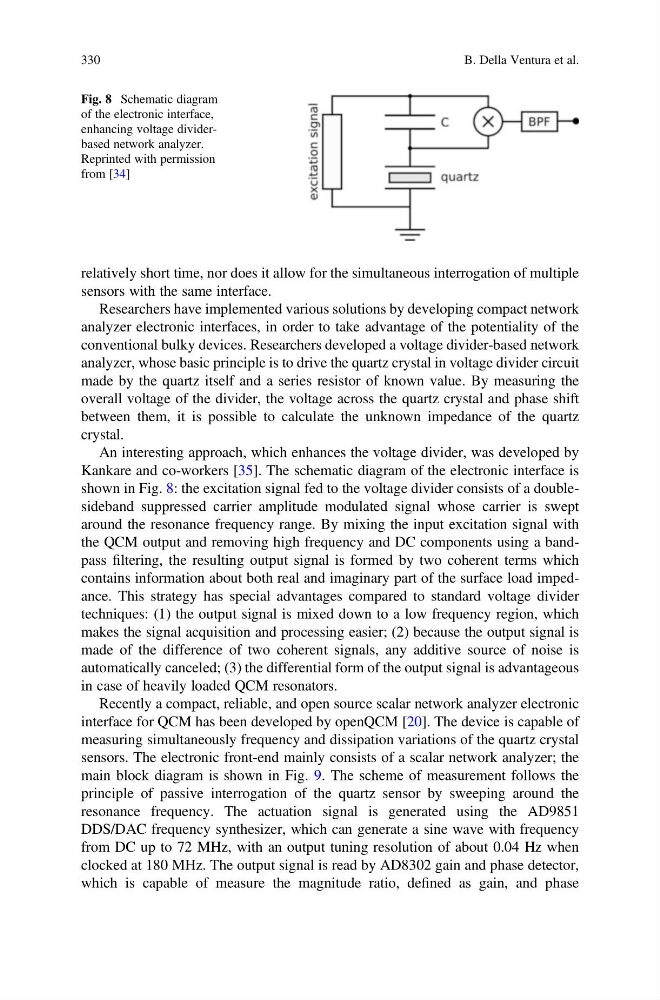
An interesting approach, which enhances the voltage divider, was developed by
Kankare and co-workers [35]. The schematic diagram of the electronic interface is
shown in Fig. 8: the excitation signal fed to the voltage divider consists of a doublesideband suppressed carrier amplitude modulated signal whose carrier is swept
around the resonance frequency range. By mixing the input excitation signal with
the QCM output and removing high frequency and DC components using a bandpass filtering, the resulting output signal is formed by two coherent terms which
contains information about both real and imaginary part of the surface load impedance. This strategy has special advantages compared to standard voltage divider
techniques: (1) the output signal is mixed down to a low frequency region, which
makes the signal acquisition and processing easier; (2) because the output signal is
made of the difference of two coherent signals, any additive source of noise is
automatically canceled; (3) the differential form of the output signal is advantageous
in case of heavily loaded QCM resonators.
Recently a compact, reliable, and open source scalar network analyzer electronic
interface for QCM has been developed by openQCM [20]. The device is capable of
measuring simultaneously frequency and dissipation variations of the quartz crystal
sensors. The electronic front-end mainly consists of a scalar network analyzer; the
main block diagram is shown in Fig. 9. The scheme of measurement follows the
principle of passive interrogation of the quartz sensor by sweeping around the
resonance frequency. The actuation signal is generated using the AD9851
DDS/DAC frequency synthesizer, which can generate a sine wave with frequency
from DC up to 72 MHz, with an output tuning resolution of about 0.04 Hz when
clocked at 180 MHz. The output signal is read by AD8302 gain and phase detector,
which is capable of measure the magnitude ratio, defined as gain, and phase
Fig. 8 Schematic diagram
of the electronic interface,
enhancing voltage dividerbased network analyzer.
Reprinted with permission
from [34]
330
B. Della Ventura et al.
sensors with the same interface.
Researchers have implemented various solutions by developing compact network
analyzer electronic interfaces, in order to take advantage of the potentiality of the
conventional bulky devices. Researchers developed a voltage divider-based network
analyzer, whose basic principle is to drive the quartz crystal in voltage divider circuit
made by the quartz itself and a series resistor of known value. By measuring the
overall voltage of the divider, the voltage across the quartz crystal and phase shift
between them, it is possible to calculate the unknown impedance of the quartz
crystal.
An interesting approach, which enhances the voltage divider, was developed by
Kankare and co-workers [35]. The schematic diagram of the electronic interface is
shown in Fig. 8: the excitation signal fed to the voltage divider consists of a doublesideband suppressed carrier amplitude modulated signal whose carrier is swept
around the resonance frequency range. By mixing the input excitation signal with
the QCM output and removing high frequency and DC components using a bandpass filtering, the resulting output signal is formed by two coherent terms which
contains information about both real and imaginary part of the surface load impedance. This strategy has special advantages compared to standard voltage divider
techniques: (1) the output signal is mixed down to a low frequency region, which
makes the signal acquisition and processing easier; (2) because the output signal is
made of the difference of two coherent signals, any additive source of noise is
automatically canceled; (3) the differential form of the output signal is advantageous
in case of heavily loaded QCM resonators.
Recently a compact, reliable, and open source scalar network analyzer electronic
interface for QCM has been developed by openQCM [20]. The device is capable of
measuring simultaneously frequency and dissipation variations of the quartz crystal
sensors. The electronic front-end mainly consists of a scalar network analyzer; the
main block diagram is shown in Fig. 9. The scheme of measurement follows the
principle of passive interrogation of the quartz sensor by sweeping around the
resonance frequency. The actuation signal is generated using the AD9851
DDS/DAC frequency synthesizer, which can generate a sine wave with frequency
from DC up to 72 MHz, with an output tuning resolution of about 0.04 Hz when
clocked at 180 MHz. The output signal is read by AD8302 gain and phase detector,
which is capable of measure the magnitude ratio, defined as gain, and phase
Fig. 8 Schematic diagram
of the electronic interface,
enhancing voltage dividerbased network analyzer.
Reprinted with permission
from [34]
330
B. Della Ventura et al.