

Photochemical Immobilization Technique, which is capable of detecting pesticide like
parathion in water with a limit of detection (LOD) approximately equal to 0.8 μg/L.
The Pierce standard oscillator has the disadvantage of not being able to have one
face of the resonator grounded and does not guarantee stable oscillations for heavy
loads or highly viscous media.
A variety of modifications to the standard oscillators have been proposed in QCM
applications [31]. As suggested by Barnes, an oscillator integrating an Automatic
Gain Control (AGC) system should be developed for QCM applications. The AGC
system aims to keep constant the output amplitude of the oscillator. For this purpose,
an input voltage is supplied to the system in order to modify the gain of the amplifier
so that the signal is kept constant with respect to a reference. In addition, the AGC
design claims also a proportionality between the supplied voltage and the variation
of the motional resistance, which is related to the dissipation variation [32, 33].
3.2 Network or Impedance Analysis
The aim of the network or impedance analysis is to monitor the amplitude variations
and the phase response of a quartz crystal resonator in order to completely characterize its electrical parameters. The network analysis principle is based on the passive
interrogation of the quartz crystal sensor by sweeping the frequency around the
resonance and analyzes its impedance/admittance behavior.
Unlike oscillator circuits, the network analysis has the advantage of passively
interrogating the quartz sensor so that the circuit interface can’t alter the electrical
parameters of the quartz resonator. Thanks to the passive operation of the quartz
crystal; it is also possible to minimize parasitic influences and exclude their effects
by means of a calibration procedure.
The main disadvantages of the standard network analysis are the high costs and
the large dimensions, which do not consent the development of a portable and
integrable QCM device. Furthermore, the passive quartz stimulation scheme does
not allow for a multi-scan analysis of fundamental frequencies and overtones in a
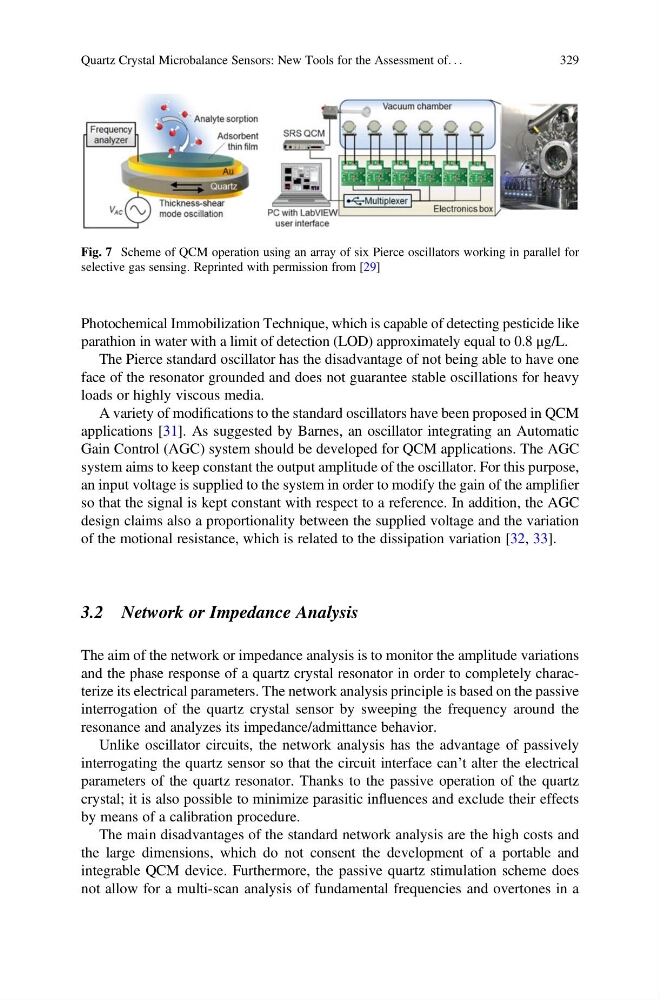
Fig. 7 Scheme of QCM operation using an array of six Pierce oscillators working in parallel for
selective gas sensing. Reprinted with permission from [29]
Quartz Crystal Microbalance Sensors: New Tools for the Assessment of. . .
329
parathion in water with a limit of detection (LOD) approximately equal to 0.8 μg/L.
The Pierce standard oscillator has the disadvantage of not being able to have one
face of the resonator grounded and does not guarantee stable oscillations for heavy
loads or highly viscous media.
A variety of modifications to the standard oscillators have been proposed in QCM
applications [31]. As suggested by Barnes, an oscillator integrating an Automatic
Gain Control (AGC) system should be developed for QCM applications. The AGC
system aims to keep constant the output amplitude of the oscillator. For this purpose,
an input voltage is supplied to the system in order to modify the gain of the amplifier
so that the signal is kept constant with respect to a reference. In addition, the AGC
design claims also a proportionality between the supplied voltage and the variation
of the motional resistance, which is related to the dissipation variation [32, 33].
3.2 Network or Impedance Analysis
The aim of the network or impedance analysis is to monitor the amplitude variations
and the phase response of a quartz crystal resonator in order to completely characterize its electrical parameters. The network analysis principle is based on the passive
interrogation of the quartz crystal sensor by sweeping the frequency around the
resonance and analyzes its impedance/admittance behavior.
Unlike oscillator circuits, the network analysis has the advantage of passively
interrogating the quartz sensor so that the circuit interface can’t alter the electrical
parameters of the quartz resonator. Thanks to the passive operation of the quartz
crystal; it is also possible to minimize parasitic influences and exclude their effects
by means of a calibration procedure.
The main disadvantages of the standard network analysis are the high costs and
the large dimensions, which do not consent the development of a portable and
integrable QCM device. Furthermore, the passive quartz stimulation scheme does
not allow for a multi-scan analysis of fundamental frequencies and overtones in a
Fig. 7 Scheme of QCM operation using an array of six Pierce oscillators working in parallel for
selective gas sensing. Reprinted with permission from [29]
Quartz Crystal Microbalance Sensors: New Tools for the Assessment of. . .
329