

• the motional resistance, which is the value of the resistor in the motional branch
of the BVD model, should be monitored;
• the parallel capacitance is a key parameter in determining the oscillation
frequency.
Standard electronic oscillators have been widely used in QCM applications under
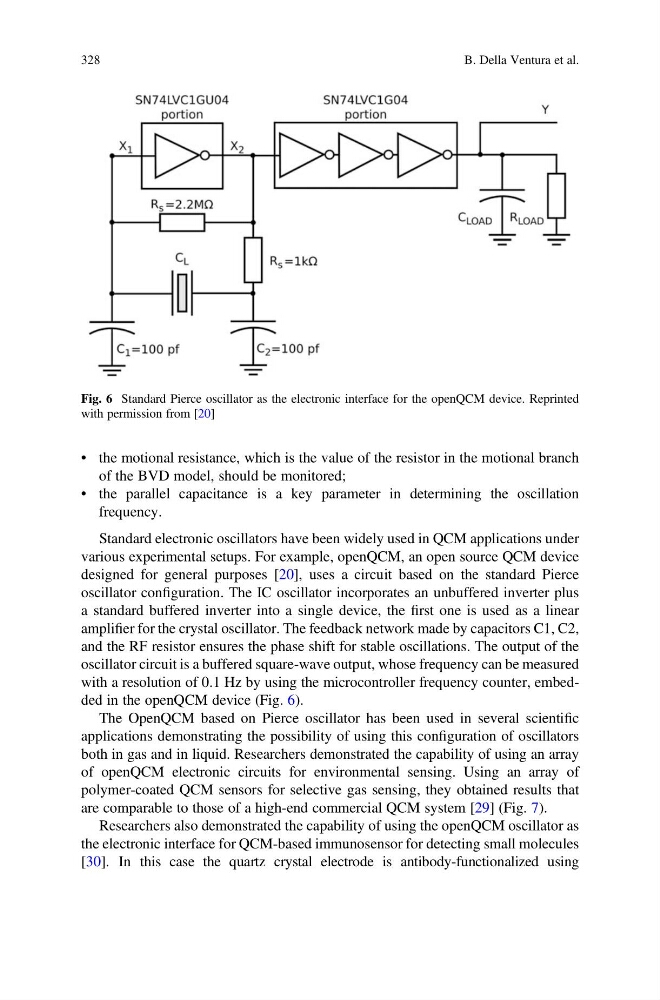
various experimental setups. For example, openQCM, an open source QCM device
designed for general purposes [20], uses a circuit based on the standard Pierce
oscillator configuration. The IC oscillator incorporates an unbuffered inverter plus
a standard buffered inverter into a single device, the first one is used as a linear
amplifier for the crystal oscillator. The feedback network made by capacitors C1, C2,
and the RF resistor ensures the phase shift for stable oscillations. The output of the
oscillator circuit is a buffered square-wave output, whose frequency can be measured
with a resolution of 0.1 Hz by using the microcontroller frequency counter, embedded in the openQCM device (Fig. 6).
The OpenQCM based on Pierce oscillator has been used in several scientific
applications demonstrating the possibility of using this configuration of oscillators
both in gas and in liquid. Researchers demonstrated the capability of using an array
of openQCM electronic circuits for environmental sensing. Using an array of
polymer-coated QCM sensors for selective gas sensing, they obtained results that
are comparable to those of a high-end commercial QCM system [29] (Fig. 7).
Researchers also demonstrated the capability of using the openQCM oscillator as
the electronic interface for QCM-based immunosensor for detecting small molecules
[30]. In this case the quartz crystal electrode is antibody-functionalized using
Fig. 6 Standard Pierce oscillator as the electronic interface for the openQCM device. Reprinted
with permission from [20]
328
B. Della Ventura et al.
of the BVD model, should be monitored;
• the parallel capacitance is a key parameter in determining the oscillation
frequency.
Standard electronic oscillators have been widely used in QCM applications under
various experimental setups. For example, openQCM, an open source QCM device
designed for general purposes [20], uses a circuit based on the standard Pierce
oscillator configuration. The IC oscillator incorporates an unbuffered inverter plus
a standard buffered inverter into a single device, the first one is used as a linear
amplifier for the crystal oscillator. The feedback network made by capacitors C1, C2,
and the RF resistor ensures the phase shift for stable oscillations. The output of the
oscillator circuit is a buffered square-wave output, whose frequency can be measured
with a resolution of 0.1 Hz by using the microcontroller frequency counter, embedded in the openQCM device (Fig. 6).
The OpenQCM based on Pierce oscillator has been used in several scientific
applications demonstrating the possibility of using this configuration of oscillators
both in gas and in liquid. Researchers demonstrated the capability of using an array
of openQCM electronic circuits for environmental sensing. Using an array of
polymer-coated QCM sensors for selective gas sensing, they obtained results that
are comparable to those of a high-end commercial QCM system [29] (Fig. 7).
Researchers also demonstrated the capability of using the openQCM oscillator as
the electronic interface for QCM-based immunosensor for detecting small molecules
[30]. In this case the quartz crystal electrode is antibody-functionalized using
Fig. 6 Standard Pierce oscillator as the electronic interface for the openQCM device. Reprinted
with permission from [20]
328
B. Della Ventura et al.