

3.1 Quartz Oscillators
The application of oscillator circuits as an electronic interface for QCM devices is
one of the most commonly used methods for recovering frequency variations with a
high accuracy. Since a quartz crystal is a resonant element, it can be driven at a stable
amplitude with an appropriate electronic circuit. It should be noted that the quartz
itself is an integral part of the oscillator circuit and particular attention must be paid
in the circuit design. Application of quartz crystal oscillators in liquid phase or in
contact with heavy-load layers causes a drastic decrease in both the quality factor Q
and phase slope so that a suitable electronic configuration should be developed and
electronic components selected.
The advantages of the oscillator circuit scheme consist mainly in the capability of
continuous data monitoring and in the fact that frequency measurements can be
made with very high accuracy. In addition, the integration capability and low-cost
electronic circuitry makes this detection scheme ideal for air–vacuum applications
and suitable for the most common chemical applications.
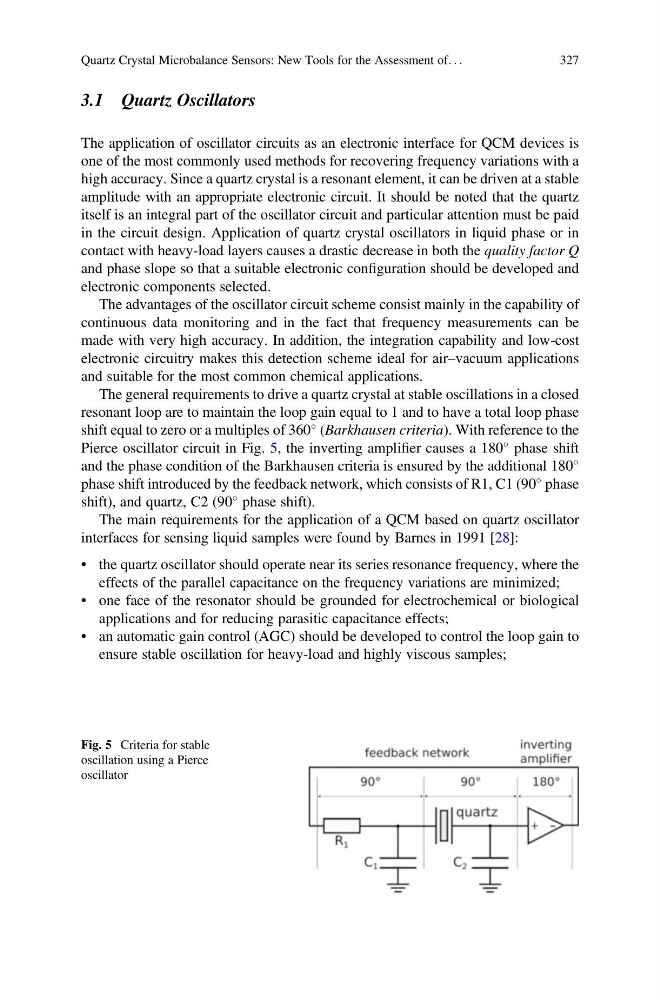
The general requirements to drive a quartz crystal at stable oscillations in a closed
resonant loop are to maintain the loop gain equal to 1 and to have a total loop phase
shift equal to zero or a multiples of 360
(Barkhausen criteria). With reference to the
Pierce oscillator circuit in Fig. 5, the inverting amplifier causes a 180
phase shift
and the phase condition of the Barkhausen criteria is ensured by the additional 180
phase shift introduced by the feedback network, which consists of R1, C1 (90
phase
shift), and quartz, C2 (90
phase shift).
The main requirements for the application of a QCM based on quartz oscillator
interfaces for sensing liquid samples were found by Barnes in 1991 [28]:
• the quartz oscillator should operate near its series resonance frequency, where the
effects of the parallel capacitance on the frequency variations are minimized;
• one face of the resonator should be grounded for electrochemical or biological
applications and for reducing parasitic capacitance effects;
• an automatic gain control (AGC) should be developed to control the loop gain to
ensure stable oscillation for heavy-load and highly viscous samples;
Fig. 5 Criteria for stable
oscillation using a Pierce
oscillator
Quartz Crystal Microbalance Sensors: New Tools for the Assessment of. . .
327
The application of oscillator circuits as an electronic interface for QCM devices is
one of the most commonly used methods for recovering frequency variations with a
high accuracy. Since a quartz crystal is a resonant element, it can be driven at a stable
amplitude with an appropriate electronic circuit. It should be noted that the quartz
itself is an integral part of the oscillator circuit and particular attention must be paid
in the circuit design. Application of quartz crystal oscillators in liquid phase or in
contact with heavy-load layers causes a drastic decrease in both the quality factor Q
and phase slope so that a suitable electronic configuration should be developed and
electronic components selected.
The advantages of the oscillator circuit scheme consist mainly in the capability of
continuous data monitoring and in the fact that frequency measurements can be
made with very high accuracy. In addition, the integration capability and low-cost
electronic circuitry makes this detection scheme ideal for air–vacuum applications
and suitable for the most common chemical applications.
The general requirements to drive a quartz crystal at stable oscillations in a closed
resonant loop are to maintain the loop gain equal to 1 and to have a total loop phase
shift equal to zero or a multiples of 360
(Barkhausen criteria). With reference to the
Pierce oscillator circuit in Fig. 5, the inverting amplifier causes a 180
phase shift
and the phase condition of the Barkhausen criteria is ensured by the additional 180
phase shift introduced by the feedback network, which consists of R1, C1 (90
phase
shift), and quartz, C2 (90
phase shift).
The main requirements for the application of a QCM based on quartz oscillator
interfaces for sensing liquid samples were found by Barnes in 1991 [28]:
• the quartz oscillator should operate near its series resonance frequency, where the
effects of the parallel capacitance on the frequency variations are minimized;
• one face of the resonator should be grounded for electrochemical or biological
applications and for reducing parasitic capacitance effects;
• an automatic gain control (AGC) should be developed to control the loop gain to
ensure stable oscillation for heavy-load and highly viscous samples;
Fig. 5 Criteria for stable
oscillation using a Pierce
oscillator
Quartz Crystal Microbalance Sensors: New Tools for the Assessment of. . .
327