

2.8 Viscoelastic Layer in Liquid
The small load approximation is used to quantify the variation of the complex
resonance frequency of a QCM in contact with a viscoelastic film and immersed in
a liquid. In this case the wave is made of a transverse shear wave inside the quartz
crystal, a shear wave transmitted in the viscoelastic layer and then reflected at the
separation surfaces of the crystal–viscoelastic layer and viscoelastic layer–liquid,
and finally a propagation wave that travels within the liquid far from the surface of
the viscoelastic layer.
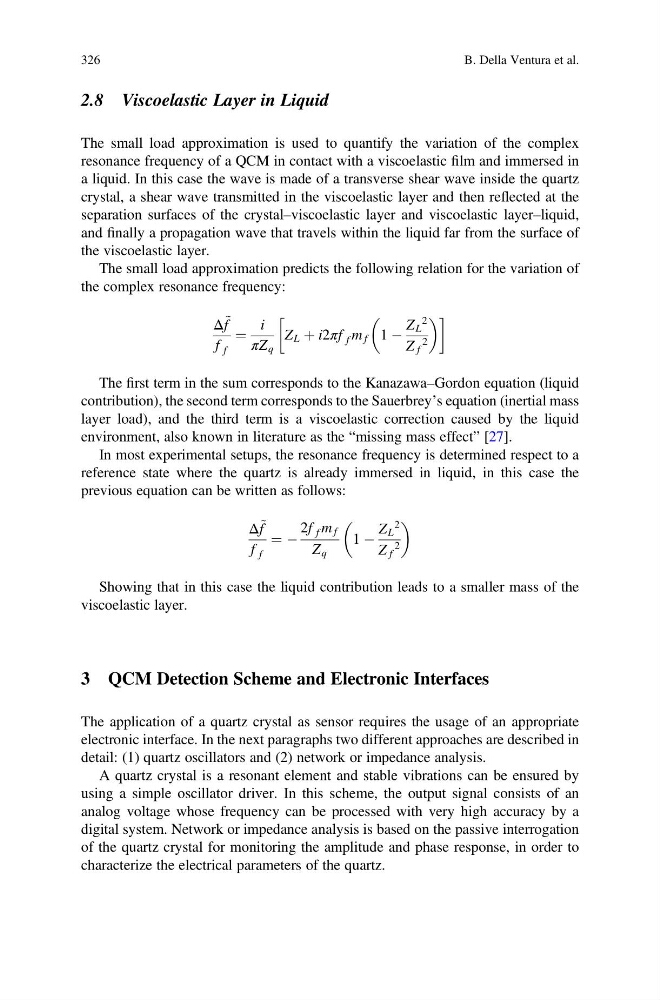
The small load approximation predicts the following relation for the variation of
the complex resonance frequency:
Δ ~
f
f f
¼
i
πZ q
Z L þ i2πf f m f 1 À
Z L
2
Z f
2
!
The first term in the sum corresponds to the Kanazawa–Gordon equation (liquid
contribution), the second term corresponds to the Sauerbrey’s equation (inertial mass
layer load), and the third term is a viscoelastic correction caused by the liquid
environment, also known in literature as the “missing mass effect” [27].
In most experimental setups, the resonance frequency is determined respect to a
reference state where the quartz is already immersed in liquid, in this case the
previous equation can be written as follows:
Δ ~
f
f f
¼ À
2f f m f
Z q
1 À
Z L
2
Z f
2
Showing that in this case the liquid contribution leads to a smaller mass of the
viscoelastic layer.
3 QCM Detection Scheme and Electronic Interfaces
The application of a quartz crystal as sensor requires the usage of an appropriate
electronic interface. In the next paragraphs two different approaches are described in
detail: (1) quartz oscillators and (2) network or impedance analysis.
A quartz crystal is a resonant element and stable vibrations can be ensured by
using a simple oscillator driver. In this scheme, the output signal consists of an
analog voltage whose frequency can be processed with very high accuracy by a
digital system. Network or impedance analysis is based on the passive interrogation
of the quartz crystal for monitoring the amplitude and phase response, in order to
characterize the electrical parameters of the quartz.
326
B. Della Ventura et al.
The small load approximation is used to quantify the variation of the complex
resonance frequency of a QCM in contact with a viscoelastic film and immersed in
a liquid. In this case the wave is made of a transverse shear wave inside the quartz
crystal, a shear wave transmitted in the viscoelastic layer and then reflected at the
separation surfaces of the crystal–viscoelastic layer and viscoelastic layer–liquid,
and finally a propagation wave that travels within the liquid far from the surface of
the viscoelastic layer.
The small load approximation predicts the following relation for the variation of
the complex resonance frequency:
Δ ~
f
f f
¼
i
πZ q
Z L þ i2πf f m f 1 À
Z L
2
Z f
2
!
The first term in the sum corresponds to the Kanazawa–Gordon equation (liquid
contribution), the second term corresponds to the Sauerbrey’s equation (inertial mass
layer load), and the third term is a viscoelastic correction caused by the liquid
environment, also known in literature as the “missing mass effect” [27].
In most experimental setups, the resonance frequency is determined respect to a
reference state where the quartz is already immersed in liquid, in this case the
previous equation can be written as follows:
Δ ~
f
f f
¼ À
2f f m f
Z q
1 À
Z L
2
Z f
2
Showing that in this case the liquid contribution leads to a smaller mass of the
viscoelastic layer.
3 QCM Detection Scheme and Electronic Interfaces
The application of a quartz crystal as sensor requires the usage of an appropriate
electronic interface. In the next paragraphs two different approaches are described in
detail: (1) quartz oscillators and (2) network or impedance analysis.
A quartz crystal is a resonant element and stable vibrations can be ensured by
using a simple oscillator driver. In this scheme, the output signal consists of an
analog voltage whose frequency can be processed with very high accuracy by a
digital system. Network or impedance analysis is based on the passive interrogation
of the quartz crystal for monitoring the amplitude and phase response, in order to
characterize the electrical parameters of the quartz.
326
B. Della Ventura et al.