

2.6 Purely Inertial Layer: Sauerbrey’s Equation
For the case of QCM in contact with a purely inertial load, the viscoelasticity can be
ignored. One can derive the frequency shiftÀmass proportionality of the Sauerbrey’s
equation in the small load approximation. The stress induced by a very thin layer is
only caused by inertia and it is given as follows:
σ ¼ Àω
2 u 0 m f
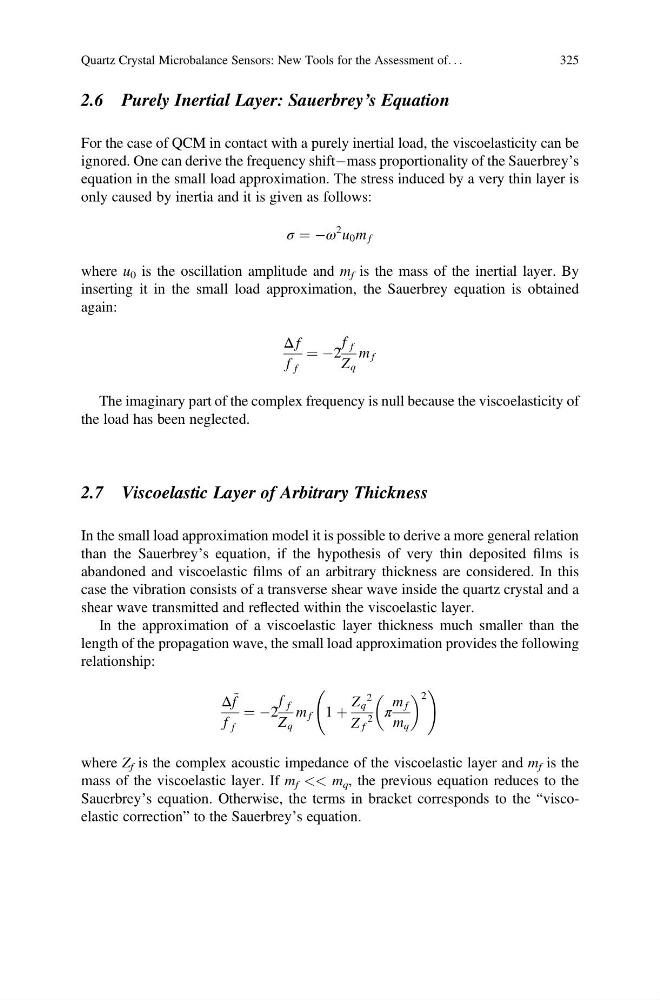
where u 0 is the oscillation amplitude and m f is the mass of the inertial layer. By
inserting it in the small load approximation, the Sauerbrey equation is obtained
again:
Δ f
f f
¼ À2
f f
Z q
m f
The imaginary part of the complex frequency is null because the viscoelasticity of
the load has been neglected.
2.7 Viscoelastic Layer of Arbitrary Thickness
In the small load approximation model it is possible to derive a more general relation
than the Sauerbrey’s equation, if the hypothesis of very thin deposited films is
abandoned and viscoelastic films of an arbitrary thickness are considered. In this
case the vibration consists of a transverse shear wave inside the quartz crystal and a
shear wave transmitted and reflected within the viscoelastic layer.
In the approximation of a viscoelastic layer thickness much smaller than the
length of the propagation wave, the small load approximation provides the following
relationship:
Δ ~
f
f f
¼ À2
f f
Z q
m f 1 þ
Z q
2
Z f
2
π
m f
m q
2
!
where Z f is the complex acoustic impedance of the viscoelastic layer and m f is the
mass of the viscoelastic layer. If m f << m q , the previous equation reduces to the
Sauerbrey’s equation. Otherwise, the terms in bracket corresponds to the “viscoelastic correction” to the Sauerbrey’s equation.
Quartz Crystal Microbalance Sensors: New Tools for the Assessment of. . .
325
For the case of QCM in contact with a purely inertial load, the viscoelasticity can be
ignored. One can derive the frequency shiftÀmass proportionality of the Sauerbrey’s
equation in the small load approximation. The stress induced by a very thin layer is
only caused by inertia and it is given as follows:
σ ¼ Àω
2 u 0 m f
where u 0 is the oscillation amplitude and m f is the mass of the inertial layer. By
inserting it in the small load approximation, the Sauerbrey equation is obtained
again:
Δ f
f f
¼ À2
f f
Z q
m f
The imaginary part of the complex frequency is null because the viscoelasticity of
the load has been neglected.
2.7 Viscoelastic Layer of Arbitrary Thickness
In the small load approximation model it is possible to derive a more general relation
than the Sauerbrey’s equation, if the hypothesis of very thin deposited films is
abandoned and viscoelastic films of an arbitrary thickness are considered. In this
case the vibration consists of a transverse shear wave inside the quartz crystal and a
shear wave transmitted and reflected within the viscoelastic layer.
In the approximation of a viscoelastic layer thickness much smaller than the
length of the propagation wave, the small load approximation provides the following
relationship:
Δ ~
f
f f
¼ À2
f f
Z q
m f 1 þ
Z q
2
Z f
2
π
m f
m q
2
!
where Z f is the complex acoustic impedance of the viscoelastic layer and m f is the
mass of the viscoelastic layer. If m f << m q , the previous equation reduces to the
Sauerbrey’s equation. Otherwise, the terms in bracket corresponds to the “viscoelastic correction” to the Sauerbrey’s equation.
Quartz Crystal Microbalance Sensors: New Tools for the Assessment of. . .
325