

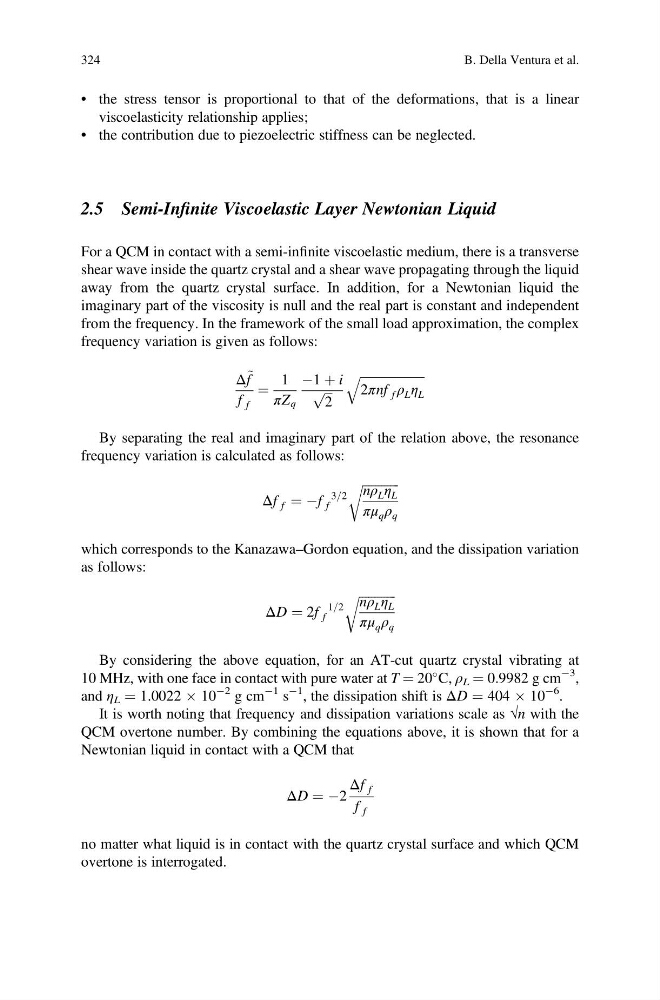
• the stress tensor is proportional to that of the deformations, that is a linear
viscoelasticity relationship applies;
• the contribution due to piezoelectric stiffness can be neglected.
2.5 Semi-Infinite Viscoelastic Layer Newtonian Liquid
For a QCM in contact with a semi-infinite viscoelastic medium, there is a transverse
shear wave inside the quartz crystal and a shear wave propagating through the liquid
away from the quartz crystal surface. In addition, for a Newtonian liquid the
imaginary part of the viscosity is null and the real part is constant and independent
from the frequency. In the framework of the small load approximation, the complex
frequency variation is given as follows:
Δ ~
f
f f
¼
1
πZ q
À1 þ i
ffiffi ffi
2
p
ffiffiffiffiffiffiffiffiffiffiffiffiffiffiffiffiffiffiffiffiffi
2πnf f ρ L η L
q
By separating the real and imaginary part of the relation above, the resonance
frequency variation is calculated as follows:
Δf f ¼ Àf f
3=2
ffiffiffiffiffiffiffiffiffiffiffi ffi
nρ L η L
πμ q ρ q
r
which corresponds to the Kanazawa–Gordon equation, and the dissipation variation
as follows:
ΔD ¼ 2f f
1=2
ffiffiffiffiffiffiffiffiffiffiffi ffi
nρ L η L
πμ q ρ q
r
By considering the above equation, for an AT-cut quartz crystal vibrating at
10 MHz, with one face in contact with pure water at T ¼ 20
C, ρ L ¼ 0.9982 g cm
À3 ,
and η L ¼ 1.0022 Â 10
À2 g cm
À1 s
À1 , the dissipation shift is ΔD ¼ 404 Â 10
À6 .
It is worth noting that frequency and dissipation variations scale as √n with the
QCM overtone number. By combining the equations above, it is shown that for a
Newtonian liquid in contact with a QCM that
ΔD ¼ À2
Δf f
f f
no matter what liquid is in contact with the quartz crystal surface and which QCM
overtone is interrogated.
324
B. Della Ventura et al.
viscoelasticity relationship applies;
• the contribution due to piezoelectric stiffness can be neglected.
2.5 Semi-Infinite Viscoelastic Layer Newtonian Liquid
For a QCM in contact with a semi-infinite viscoelastic medium, there is a transverse
shear wave inside the quartz crystal and a shear wave propagating through the liquid
away from the quartz crystal surface. In addition, for a Newtonian liquid the
imaginary part of the viscosity is null and the real part is constant and independent
from the frequency. In the framework of the small load approximation, the complex
frequency variation is given as follows:
Δ ~
f
f f
¼
1
πZ q
À1 þ i
ffiffi ffi
2
p
ffiffiffiffiffiffiffiffiffiffiffiffiffiffiffiffiffiffiffiffiffi
2πnf f ρ L η L
q
By separating the real and imaginary part of the relation above, the resonance
frequency variation is calculated as follows:
Δf f ¼ Àf f
3=2
ffiffiffiffiffiffiffiffiffiffiffi ffi
nρ L η L
πμ q ρ q
r
which corresponds to the Kanazawa–Gordon equation, and the dissipation variation
as follows:
ΔD ¼ 2f f
1=2
ffiffiffiffiffiffiffiffiffiffiffi ffi
nρ L η L
πμ q ρ q
r
By considering the above equation, for an AT-cut quartz crystal vibrating at
10 MHz, with one face in contact with pure water at T ¼ 20
C, ρ L ¼ 0.9982 g cm
À3 ,
and η L ¼ 1.0022 Â 10
À2 g cm
À1 s
À1 , the dissipation shift is ΔD ¼ 404 Â 10
À6 .
It is worth noting that frequency and dissipation variations scale as √n with the
QCM overtone number. By combining the equations above, it is shown that for a
Newtonian liquid in contact with a QCM that
ΔD ¼ À2
Δf f
f f
no matter what liquid is in contact with the quartz crystal surface and which QCM
overtone is interrogated.
324
B. Della Ventura et al.