

Here a brief description on SMOS and SMAP satellites is given, as those two are
dedicated soil moisture missions for long-term soil moisture monitoring.
SMOS is the first dedicated soil moisture satellite using fully polarised passive
microwave signals at the L-band, with a spatial resolution of 35–50 km
[58, 72]. SMOS retrieves the thermal emission from Earth in both horizontal and
vertical polarisations with a wide range of incidence angles from 0
to 60
. It has a
Y-shaped antenna structure, which comprises 69 small antennas (a diameter of
16.5 cm) and 4.5-m-long arms to perform interferometry and synthesise an aperture
of ~7.5 m [73, 74]. The projection of the synthesised beam on Earth surface is
generally presented as an ellipse whose axis ratio and orientation depend on the
observed point position [74]. As satellite progresses, any given location on Earth’s
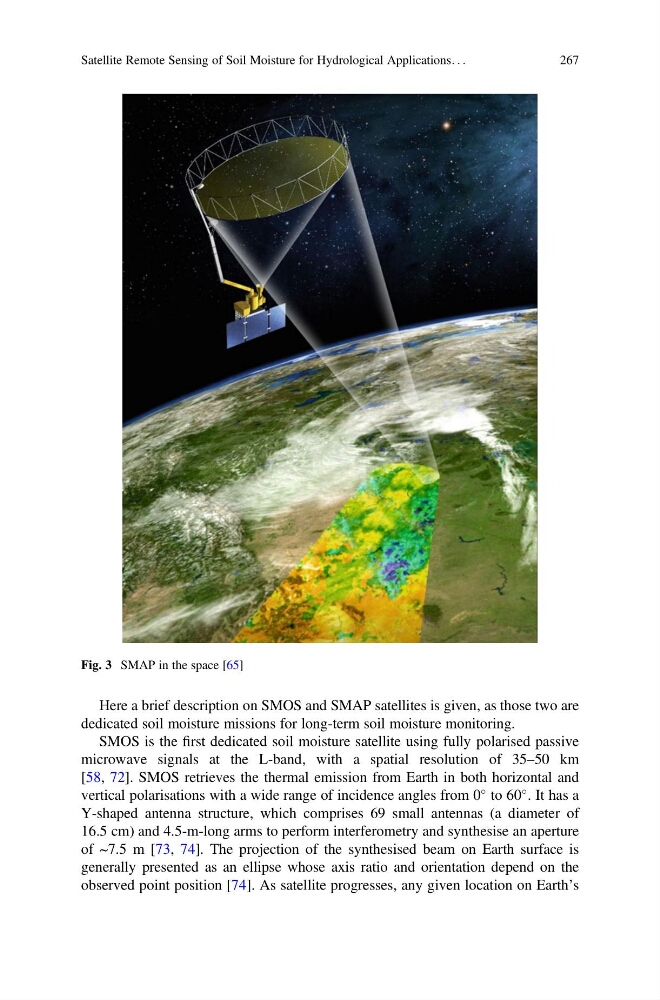
Fig. 3 SMAP in the space [65]
Satellite Remote Sensing of Soil Moisture for Hydrological Applications. . .
267
dedicated soil moisture missions for long-term soil moisture monitoring.
SMOS is the first dedicated soil moisture satellite using fully polarised passive
microwave signals at the L-band, with a spatial resolution of 35–50 km
[58, 72]. SMOS retrieves the thermal emission from Earth in both horizontal and
vertical polarisations with a wide range of incidence angles from 0
to 60
. It has a
Y-shaped antenna structure, which comprises 69 small antennas (a diameter of
16.5 cm) and 4.5-m-long arms to perform interferometry and synthesise an aperture
of ~7.5 m [73, 74]. The projection of the synthesised beam on Earth surface is
generally presented as an ellipse whose axis ratio and orientation depend on the
observed point position [74]. As satellite progresses, any given location on Earth’s
Fig. 3 SMAP in the space [65]
Satellite Remote Sensing of Soil Moisture for Hydrological Applications. . .
267