

L-band wavelength (21 cm), which is able to probe about 5 cm into the ground)
[57]. Comparatively, microwave bands have more advantages in soil moisture
estimation than other spectral bands. With the modern microwave satellites
such as the Special Sensor Microwave/Imager (SSM/I) passive microwave radiometer (19.35–85.5 GHz; [60]), on board the Defense Meteorological Satellite
Program (DMSP) series satellites since 1987, the Advanced Microwave Scanning
Radiometer for EOS (AMSR-E) (from 6.9 to 89.0 GHz; [61]) which operated on
the AQUA satellite between 2002 and 2011, the Advanced Scatterometer (ASCAT)
(radar instrument measuring radar backscatter at 5.255 GHz; [62]) on board the
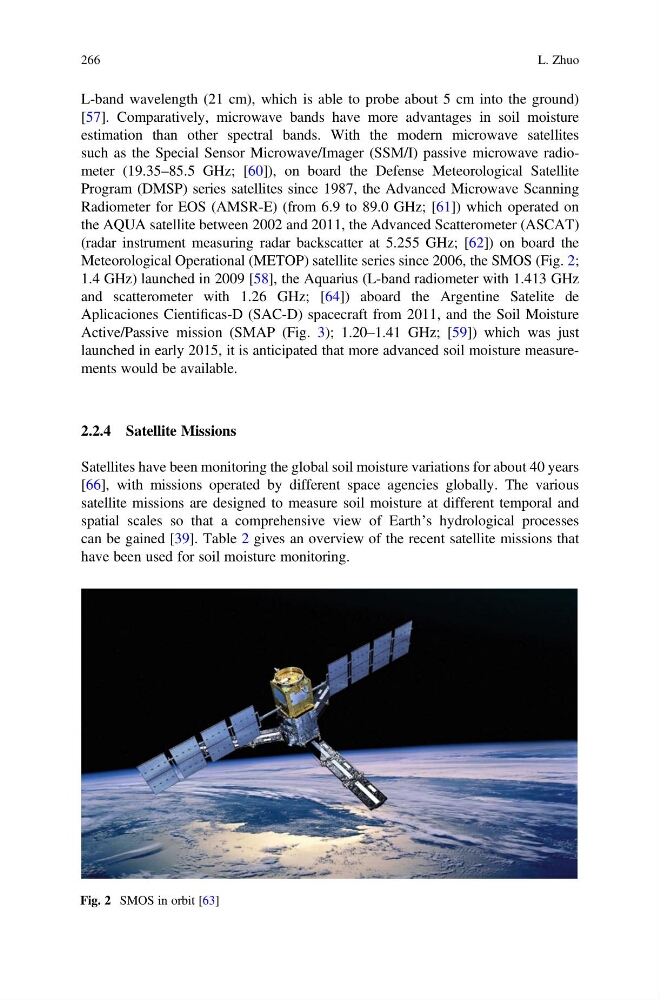
Meteorological Operational (METOP) satellite series since 2006, the SMOS (Fig. 2;
1.4 GHz) launched in 2009 [58], the Aquarius (L-band radiometer with 1.413 GHz
and scatterometer with 1.26 GHz; [64]) aboard the Argentine Satelite de
Aplicaciones Cientificas-D (SAC-D) spacecraft from 2011, and the Soil Moisture
Active/Passive mission (SMAP (Fig. 3); 1.20–1.41 GHz; [59]) which was just
launched in early 2015, it is anticipated that more advanced soil moisture measurements would be available.
2.2.4 Satellite Missions
Satellites have been monitoring the global soil moisture variations for about 40 years
[66], with missions operated by different space agencies globally. The various
satellite missions are designed to measure soil moisture at different temporal and
spatial scales so that a comprehensive view of Earth’s hydrological processes
can be gained [39]. Table 2 gives an overview of the recent satellite missions that
have been used for soil moisture monitoring.
Fig. 2 SMOS in orbit [63]
266
L. Zhuo
[57]. Comparatively, microwave bands have more advantages in soil moisture
estimation than other spectral bands. With the modern microwave satellites
such as the Special Sensor Microwave/Imager (SSM/I) passive microwave radiometer (19.35–85.5 GHz; [60]), on board the Defense Meteorological Satellite
Program (DMSP) series satellites since 1987, the Advanced Microwave Scanning
Radiometer for EOS (AMSR-E) (from 6.9 to 89.0 GHz; [61]) which operated on
the AQUA satellite between 2002 and 2011, the Advanced Scatterometer (ASCAT)
(radar instrument measuring radar backscatter at 5.255 GHz; [62]) on board the
Meteorological Operational (METOP) satellite series since 2006, the SMOS (Fig. 2;
1.4 GHz) launched in 2009 [58], the Aquarius (L-band radiometer with 1.413 GHz
and scatterometer with 1.26 GHz; [64]) aboard the Argentine Satelite de
Aplicaciones Cientificas-D (SAC-D) spacecraft from 2011, and the Soil Moisture
Active/Passive mission (SMAP (Fig. 3); 1.20–1.41 GHz; [59]) which was just
launched in early 2015, it is anticipated that more advanced soil moisture measurements would be available.
2.2.4 Satellite Missions
Satellites have been monitoring the global soil moisture variations for about 40 years
[66], with missions operated by different space agencies globally. The various
satellite missions are designed to measure soil moisture at different temporal and
spatial scales so that a comprehensive view of Earth’s hydrological processes
can be gained [39]. Table 2 gives an overview of the recent satellite missions that
have been used for soil moisture monitoring.
Fig. 2 SMOS in orbit [63]
266
L. Zhuo