

Vegetation Index (NDVI) from the Moderate Resolution Imaging Spectroradiometer
(MODIS) satellite). Since soil water content governs the thermal properties (i.e. the
soil thermal conductivity and the soil heat capacity) of the soil, it should be expected
that regions with wetter soil are usually cooler during the day and warmer at night
[50]. Driven by this concept, a considerable number of studies have shown good
accuracy of soil moisture measurements by this technique, such as through the
simple thermal inertia approach [51] and the ‘Universal Triangle’ method [52, 53].
While these approaches are powerful and have thorough physical meanings, they are
still restricted by various factors, similar to those in the optical wavebands. Therefore
their accuracy varies across time and meteorological conditions (e.g. wind speed, air
temperature and humidity) [54, 55].
2.2.3 Passive and Active Microwaves
The primary theory of microwave soil moisture estimation is based on the large
contrast between the dielectric properties of water (~80) and dry soil (<5). Therefore
when the soil becomes moist, the dielectric constant of the soil-water mixture rises,
and this emission fluctuation is recorded by microwave sensors [56, 57]. For passive
sensors, the retrieved emission from Earth surface is proportional to the product
of surface temperature and surface emissivity, which is commonly referred to as
the microwave brightness temperature [58]. For active sensors, a microwave pulse
is first sent and then received. The power of the two signals is then compared to
determine the backscattering coefficient of the surface, which has been proven to be
sensitive to soil moisture [59]. For both sensor types, the measurement efficacy is
related to wavelength, where longer wavelengths (>10 cm) penetrate deeper
into the soil and have more ability to pass through cloud and some vegetation
cover (such as the Soil Moisture and Ocean Salinity (SMOS) satellite with the
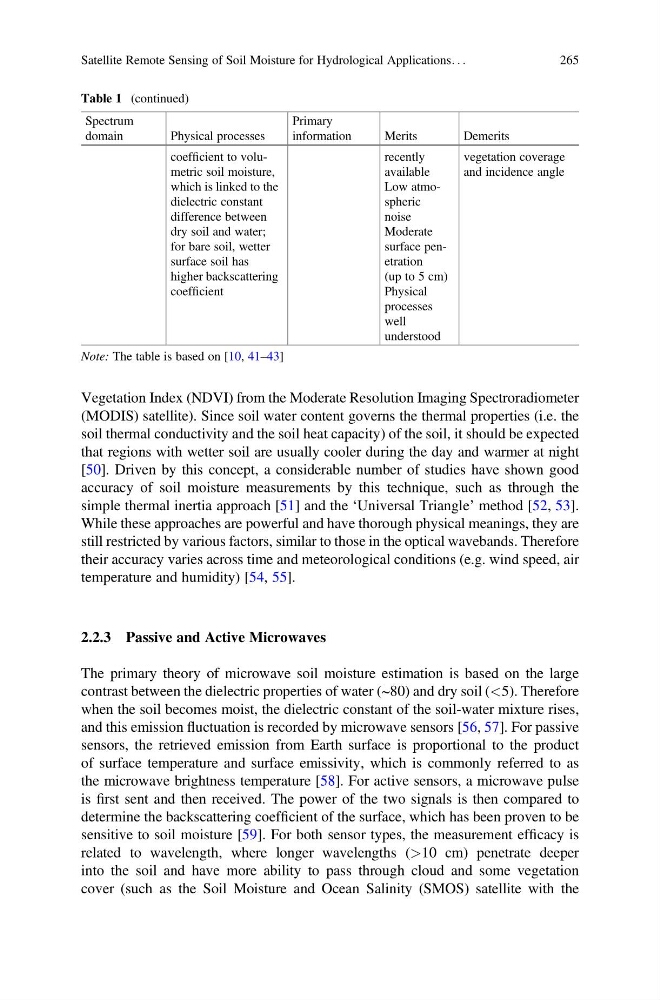
Table 1 (continued)
Spectrum
domain
Physical processes
Primary
information
Merits
Demerits
coefficient to volumetric soil moisture,
which is linked to the
dielectric constant
difference between
dry soil and water;
for bare soil, wetter
surface soil has
higher backscattering
coefficient
recently
available
Low atmospheric
noise
Moderate
surface penetration
(up to 5 cm)
Physical
processes
well
understood
vegetation coverage
and incidence angle
Note: The table is based on [10, 41–43]
Satellite Remote Sensing of Soil Moisture for Hydrological Applications. . .
265
(MODIS) satellite). Since soil water content governs the thermal properties (i.e. the
soil thermal conductivity and the soil heat capacity) of the soil, it should be expected
that regions with wetter soil are usually cooler during the day and warmer at night
[50]. Driven by this concept, a considerable number of studies have shown good
accuracy of soil moisture measurements by this technique, such as through the
simple thermal inertia approach [51] and the ‘Universal Triangle’ method [52, 53].
While these approaches are powerful and have thorough physical meanings, they are
still restricted by various factors, similar to those in the optical wavebands. Therefore
their accuracy varies across time and meteorological conditions (e.g. wind speed, air
temperature and humidity) [54, 55].
2.2.3 Passive and Active Microwaves
The primary theory of microwave soil moisture estimation is based on the large
contrast between the dielectric properties of water (~80) and dry soil (<5). Therefore
when the soil becomes moist, the dielectric constant of the soil-water mixture rises,
and this emission fluctuation is recorded by microwave sensors [56, 57]. For passive
sensors, the retrieved emission from Earth surface is proportional to the product
of surface temperature and surface emissivity, which is commonly referred to as
the microwave brightness temperature [58]. For active sensors, a microwave pulse
is first sent and then received. The power of the two signals is then compared to
determine the backscattering coefficient of the surface, which has been proven to be
sensitive to soil moisture [59]. For both sensor types, the measurement efficacy is
related to wavelength, where longer wavelengths (>10 cm) penetrate deeper
into the soil and have more ability to pass through cloud and some vegetation
cover (such as the Soil Moisture and Ocean Salinity (SMOS) satellite with the
Table 1 (continued)
Spectrum
domain
Physical processes
Primary
information
Merits
Demerits
coefficient to volumetric soil moisture,
which is linked to the
dielectric constant
difference between
dry soil and water;
for bare soil, wetter
surface soil has
higher backscattering
coefficient
recently
available
Low atmospheric
noise
Moderate
surface penetration
(up to 5 cm)
Physical
processes
well
understood
vegetation coverage
and incidence angle
Note: The table is based on [10, 41–43]
Satellite Remote Sensing of Soil Moisture for Hydrological Applications. . .
265