

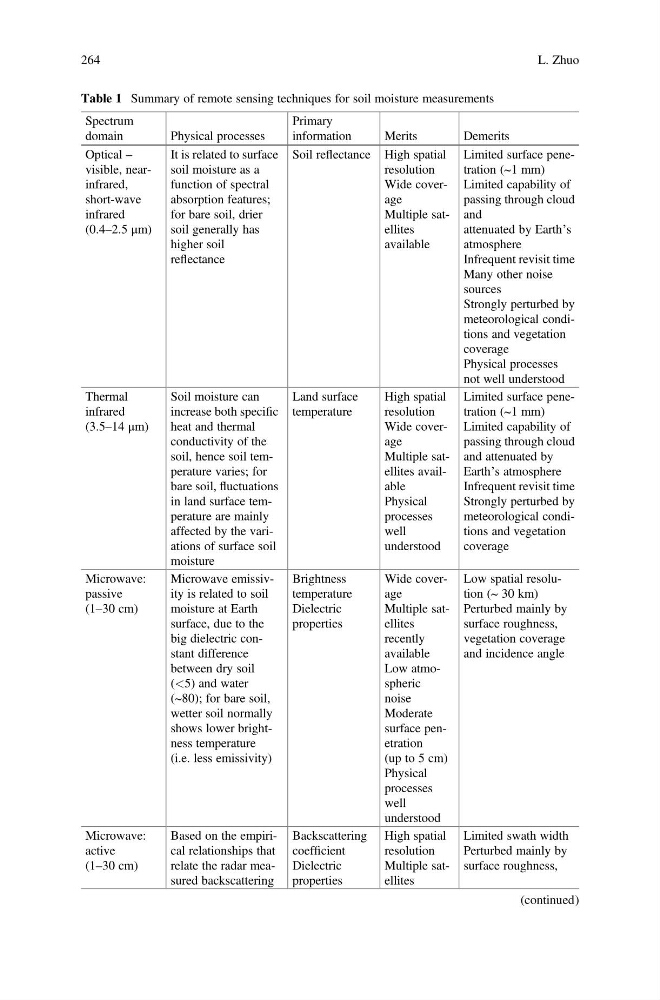
Table 1 Summary of remote sensing techniques for soil moisture measurements
Spectrum
domain
Physical processes
Primary
information
Merits
Demerits
Optical –
visible, nearinfrared,
short-wave
infrared
(0.4–2.5 μm)
It is related to surface
soil moisture as a
function of spectral
absorption features;
for bare soil, drier
soil generally has
higher soil
reflectance
Soil reflectance High spatial
resolution
Wide coverage
Multiple satellites
available
Limited surface penetration (~1 mm)
Limited capability of
passing through cloud
and
attenuated by Earth’s
atmosphere
Infrequent revisit time
Many other noise
sources
Strongly perturbed by
meteorological conditions and vegetation
coverage
Physical processes
not well understood
Thermal
infrared
(3.5–14 μm)
Soil moisture can
increase both specific
heat and thermal
conductivity of the
soil, hence soil temperature varies; for
bare soil, fluctuations
in land surface temperature are mainly
affected by the variations of surface soil
moisture
Land surface
temperature
High spatial
resolution
Wide coverage
Multiple satellites available
Physical
processes
well
understood
Limited surface penetration (~1 mm)
Limited capability of
passing through cloud
and attenuated by
Earth’s atmosphere
Infrequent revisit time
Strongly perturbed by
meteorological conditions and vegetation
coverage
Microwave:
passive
(1–30 cm)
Microwave emissivity is related to soil
moisture at Earth
surface, due to the
big dielectric constant difference
between dry soil
(<5) and water
(~80); for bare soil,
wetter soil normally
shows lower brightness temperature
(i.e. less emissivity)
Brightness
temperature
Dielectric
properties
Wide coverage
Multiple satellites
recently
available
Low atmospheric
noise
Moderate
surface penetration
(up to 5 cm)
Physical
processes
well
understood
Low spatial resolution (~ 30 km)
Perturbed mainly by
surface roughness,
vegetation coverage
and incidence angle
Microwave:
active
(1–30 cm)
Based on the empirical relationships that
relate the radar measured backscattering
Backscattering
coefficient
Dielectric
properties
High spatial
resolution
Multiple satellites
Limited swath width
Perturbed mainly by
surface roughness,
(continued)
264
L. Zhuo
Spectrum
domain
Physical processes
Primary
information
Merits
Demerits
Optical –
visible, nearinfrared,
short-wave
infrared
(0.4–2.5 μm)
It is related to surface
soil moisture as a
function of spectral
absorption features;
for bare soil, drier
soil generally has
higher soil
reflectance
Soil reflectance High spatial
resolution
Wide coverage
Multiple satellites
available
Limited surface penetration (~1 mm)
Limited capability of
passing through cloud
and
attenuated by Earth’s
atmosphere
Infrequent revisit time
Many other noise
sources
Strongly perturbed by
meteorological conditions and vegetation
coverage
Physical processes
not well understood
Thermal
infrared
(3.5–14 μm)
Soil moisture can
increase both specific
heat and thermal
conductivity of the
soil, hence soil temperature varies; for
bare soil, fluctuations
in land surface temperature are mainly
affected by the variations of surface soil
moisture
Land surface
temperature
High spatial
resolution
Wide coverage
Multiple satellites available
Physical
processes
well
understood
Limited surface penetration (~1 mm)
Limited capability of
passing through cloud
and attenuated by
Earth’s atmosphere
Infrequent revisit time
Strongly perturbed by
meteorological conditions and vegetation
coverage
Microwave:
passive
(1–30 cm)
Microwave emissivity is related to soil
moisture at Earth
surface, due to the
big dielectric constant difference
between dry soil
(<5) and water
(~80); for bare soil,
wetter soil normally
shows lower brightness temperature
(i.e. less emissivity)
Brightness
temperature
Dielectric
properties
Wide coverage
Multiple satellites
recently
available
Low atmospheric
noise
Moderate
surface penetration
(up to 5 cm)
Physical
processes
well
understood
Low spatial resolution (~ 30 km)
Perturbed mainly by
surface roughness,
vegetation coverage
and incidence angle
Microwave:
active
(1–30 cm)
Based on the empirical relationships that
relate the radar measured backscattering
Backscattering
coefficient
Dielectric
properties
High spatial
resolution
Multiple satellites
Limited swath width
Perturbed mainly by
surface roughness,
(continued)
264
L. Zhuo