

matrices, which change according to the model type and structure. The system and
measurement error w t is assumed to be normally distributed with zero mean and
covariance R. In the application considered in this chapter, the matrix R is time
dependent as the error in the measurement is assumed variable because of the
varying behaviour in time and space of the crowdsourcing observations.
A key issue in the implementation of the Kalman filter is the determination of
model errors. In fact, an overestimation of model errors can reduce the confidence in
the model bringing the KF closer to the observations and vice versa [86]. In this
study, the modified version of KF, which accounts for the intermittency of
crowdsourced observations in between two model time steps, proposed in Mazzoleni
et al. [62] is used.
4.2 Ensemble Kalman Filter
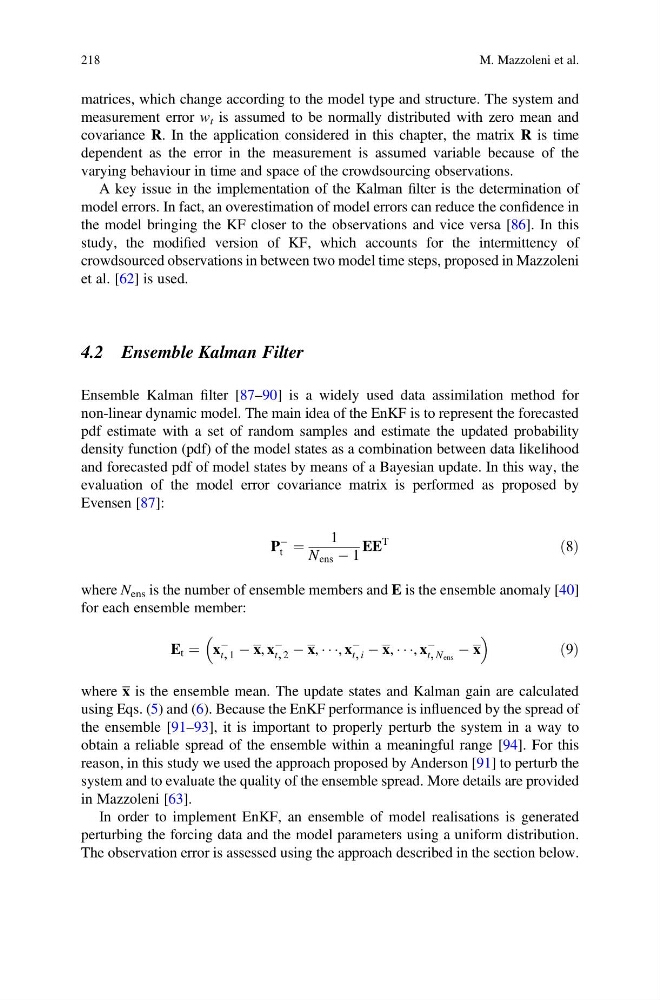
Ensemble Kalman filter [87–90] is a widely used data assimilation method for
non-linear dynamic model. The main idea of the EnKF is to represent the forecasted
pdf estimate with a set of random samples and estimate the updated probability
density function (pdf) of the model states as a combination between data likelihood
and forecasted pdf of model states by means of a Bayesian update. In this way, the
evaluation of the model error covariance matrix is performed as proposed by
Evensen [87]:
P
À
t ¼
1
N ens À 1
EE
T
ð8Þ
where N ens is the number of ensemble members and E is the ensemble anomaly [40]
for each ensemble member:
E t ¼ x
À
t, 1 À x, x
À
t, 2 À x, Á Á Á, x
À
t, i À x, Á Á Á, x
À
t, N ens
À x
ð9Þ
where x is the ensemble mean. The update states and Kalman gain are calculated
using Eqs. (5) and (6). Because the EnKF performance is influenced by the spread of
the ensemble [91–93], it is important to properly perturb the system in a way to
obtain a reliable spread of the ensemble within a meaningful range [94]. For this
reason, in this study we used the approach proposed by Anderson [91] to perturb the
system and to evaluate the quality of the ensemble spread. More details are provided
in Mazzoleni [63].
In order to implement EnKF, an ensemble of model realisations is generated
perturbing the forcing data and the model parameters using a uniform distribution.
The observation error is assessed using the approach described in the section below.
218
M. Mazzoleni et al.
measurement error w t is assumed to be normally distributed with zero mean and
covariance R. In the application considered in this chapter, the matrix R is time
dependent as the error in the measurement is assumed variable because of the
varying behaviour in time and space of the crowdsourcing observations.
A key issue in the implementation of the Kalman filter is the determination of
model errors. In fact, an overestimation of model errors can reduce the confidence in
the model bringing the KF closer to the observations and vice versa [86]. In this
study, the modified version of KF, which accounts for the intermittency of
crowdsourced observations in between two model time steps, proposed in Mazzoleni
et al. [62] is used.
4.2 Ensemble Kalman Filter
Ensemble Kalman filter [87–90] is a widely used data assimilation method for
non-linear dynamic model. The main idea of the EnKF is to represent the forecasted
pdf estimate with a set of random samples and estimate the updated probability
density function (pdf) of the model states as a combination between data likelihood
and forecasted pdf of model states by means of a Bayesian update. In this way, the
evaluation of the model error covariance matrix is performed as proposed by
Evensen [87]:
P
À
t ¼
1
N ens À 1
EE
T
ð8Þ
where N ens is the number of ensemble members and E is the ensemble anomaly [40]
for each ensemble member:
E t ¼ x
À
t, 1 À x, x
À
t, 2 À x, Á Á Á, x
À
t, i À x, Á Á Á, x
À
t, N ens
À x
ð9Þ
where x is the ensemble mean. The update states and Kalman gain are calculated
using Eqs. (5) and (6). Because the EnKF performance is influenced by the spread of
the ensemble [91–93], it is important to properly perturb the system in a way to
obtain a reliable spread of the ensemble within a meaningful range [94]. For this
reason, in this study we used the approach proposed by Anderson [91] to perturb the
system and to evaluate the quality of the ensemble spread. More details are provided
in Mazzoleni [63].
In order to implement EnKF, an ensemble of model realisations is generated
perturbing the forcing data and the model parameters using a uniform distribution.
The observation error is assessed using the approach described in the section below.
218
M. Mazzoleni et al.