

hydrodynamic models utilise input variables, which are either measured or estimated
(e.g. areal precipitation, air temperature, potential evapotranspiration), into a set of
equations that contain state variables and parameters. Typically, the parameters
remain constant, while the state variables vary in time, even if there are different
examples of parameter updating approaches such as Moradkhani et al. [77, 78],
Salomon and Feyen [79] and Lü et al. [80]. The feedback process of assimilating the
new available information into the forecasting procedure is referred to as updating
[75] or DA [76].
The assimilation methods can be divided according to the variables modified
during the updating process. In the frequently cited WMO report [76], updating is
understood in a wide sense, and input, parameters, states and output updating
techniques are distinguished. Recently, Liu et al. [34] provided a detailed review
of the status, progresses, challenges and opportunities in advancing DA in operational hydrological forecasting. There are many data assimilation techniques that can
be used to integrate hydrological observations within water-related models. In this
chapter we will focus mainly on Kalman filter and ensemble Kalman filter.
4.1 Kalman Filter
Kalman filter (KF, [81]) is an approach which allows to optimally estimate the state
of a dynamic uncertain model as response of real-time (noisy) observations [3, 14,
77, 82–85]. KF update model states considering only the last available observation
allowing for a faster computation. However, KF is optimal only in the case of linear
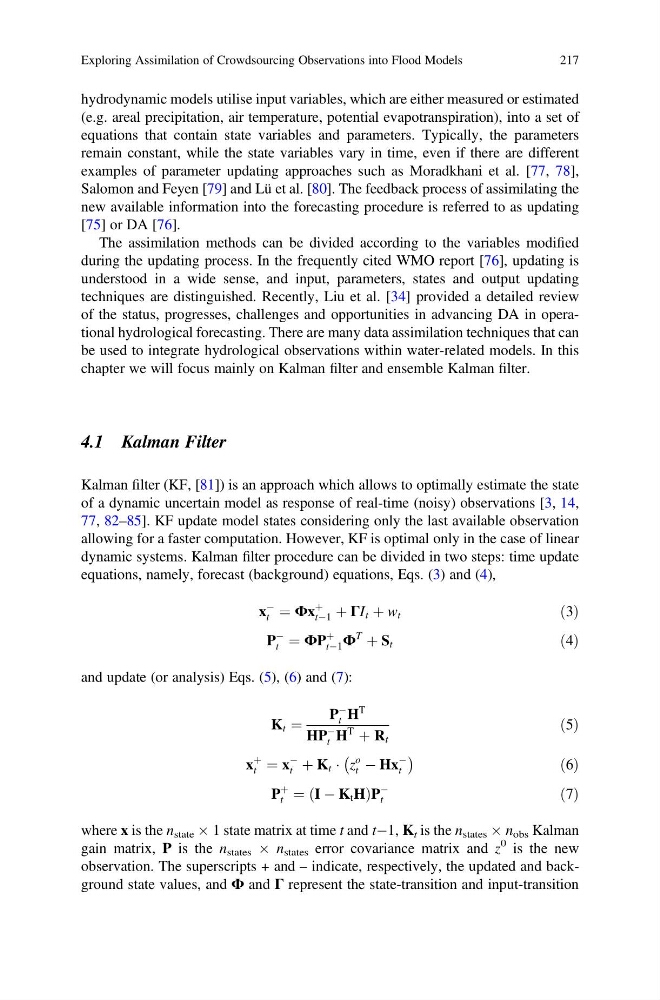
dynamic systems. Kalman filter procedure can be divided in two steps: time update
equations, namely, forecast (background) equations, Eqs. (3) and (4),
x
À
t ¼ Φx
þ
tÀ1 þ ΓI t þ w t
ð3Þ
P
À
t ¼ ΦP
þ
tÀ1 Φ
T
þ S t
ð4Þ
and update (or analysis) Eqs. (5), (6) and (7):
K t ¼
P
À
t H
T
HP
À
t H
T
þ R t
ð5Þ
x
þ
t ¼ x
À
t þ K t Á z
o
t À Hx
À
t
À
Á
ð6Þ
P
þ
t ¼ I À K t H
ð
Þ P
À
t
ð7Þ
where x is the n state  1 state matrix at time t and tÀ1, K t is the n states  n obs Kalman
gain matrix, P is the n states  n states error covariance matrix and z
0 is the new
observation. The superscripts + and – indicate, respectively, the updated and background state values, and Φ and Γ represent the state-transition and input-transition
Exploring Assimilation of Crowdsourcing Observations into Flood Models
217
(e.g. areal precipitation, air temperature, potential evapotranspiration), into a set of
equations that contain state variables and parameters. Typically, the parameters
remain constant, while the state variables vary in time, even if there are different
examples of parameter updating approaches such as Moradkhani et al. [77, 78],
Salomon and Feyen [79] and Lü et al. [80]. The feedback process of assimilating the
new available information into the forecasting procedure is referred to as updating
[75] or DA [76].
The assimilation methods can be divided according to the variables modified
during the updating process. In the frequently cited WMO report [76], updating is
understood in a wide sense, and input, parameters, states and output updating
techniques are distinguished. Recently, Liu et al. [34] provided a detailed review
of the status, progresses, challenges and opportunities in advancing DA in operational hydrological forecasting. There are many data assimilation techniques that can
be used to integrate hydrological observations within water-related models. In this
chapter we will focus mainly on Kalman filter and ensemble Kalman filter.
4.1 Kalman Filter
Kalman filter (KF, [81]) is an approach which allows to optimally estimate the state
of a dynamic uncertain model as response of real-time (noisy) observations [3, 14,
77, 82–85]. KF update model states considering only the last available observation
allowing for a faster computation. However, KF is optimal only in the case of linear
dynamic systems. Kalman filter procedure can be divided in two steps: time update
equations, namely, forecast (background) equations, Eqs. (3) and (4),
x
À
t ¼ Φx
þ
tÀ1 þ ΓI t þ w t
ð3Þ
P
À
t ¼ ΦP
þ
tÀ1 Φ
T
þ S t
ð4Þ
and update (or analysis) Eqs. (5), (6) and (7):
K t ¼
P
À
t H
T
HP
À
t H
T
þ R t
ð5Þ
x
þ
t ¼ x
À
t þ K t Á z
o
t À Hx
À
t
À
Á
ð6Þ
P
þ
t ¼ I À K t H
ð
Þ P
À
t
ð7Þ
where x is the n state  1 state matrix at time t and tÀ1, K t is the n states  n obs Kalman
gain matrix, P is the n states  n states error covariance matrix and z
0 is the new
observation. The superscripts + and – indicate, respectively, the updated and background state values, and Φ and Γ represent the state-transition and input-transition
Exploring Assimilation of Crowdsourcing Observations into Flood Models
217