

73
on the addition and calculation of the enrichment in the dissolved N 2 pool, it has
become relative standard practice to determine this directly e.g. by Membrane Inlet
Mass Spectrometry (MIMS) for deriving accurate rates (White et al. 2020).
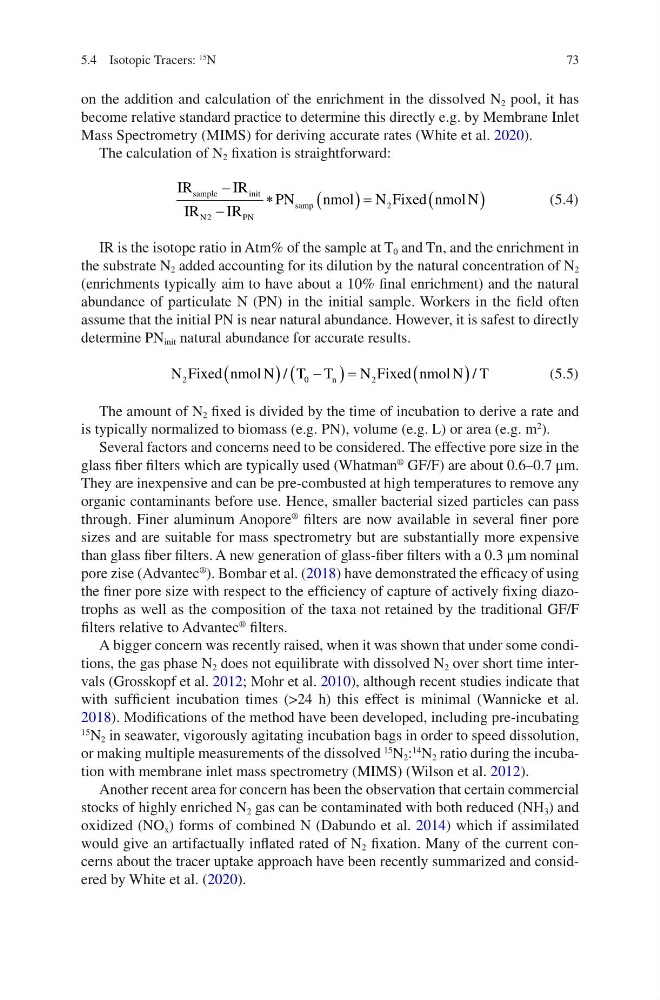
The calculation of N 2 fixation is straightforward:
IR
IR
IR
IR
PN
nmol N Fixed nmol N
sample
init
N
P N
samp
–
2
2
-
*
(
)=
(
)
(5.4)
IR is the isotope ratio in Atm% of the sample at T 0 and Tn, and the enrichment in
the substrate N 2 added accounting for its dilution by the natural concentration of N 2
(enrichments typically aim to have about a 10% final enrichment) and the natural
abundance of particulate N (PN) in the initial sample. Workers in the field often
assume that the initial PN is near natural abundance. However, it is safest to directly
determine PN init natural abundance for accurate results.
N Fixed nmol N T T
N Fixed nmol N T
n
2
0
2
(
)
-
(
)=
(
)
/
/
(5.5)
The amount of N 2 fixed is divided by the time of incubation to derive a rate and
is typically normalized to biomass (e.g. PN), volume (e.g. L) or area (e.g. m
2
).
Several factors and concerns need to be considered. The effective pore size in the
glass fiber filters which are typically used (Whatman
®
GF/F) are about 0.6–0.7 μm.
They are inexpensive and can be pre-combusted at high temperatures to remove any
organic contaminants before use. Hence, smaller bacterial sized particles can pass
through. Finer aluminum Anopore
®
filters are now available in several finer pore
sizes and are suitable for mass spectrometry but are substantially more expensive
than glass fiber filters. A new generation of glass-fiber filters with a 0.3 μm nominal
pore zise (Advantec
®
). Bombar et al. (2018) have demonstrated the efficacy of using
the finer pore size with respect to the efficiency of capture of actively fixing diazotrophs as well as the composition of the taxa not retained by the traditional GF/F
filters relative to Advantec
®
filters.
A bigger concern was recently raised, when it was shown that under some conditions, the gas phase N 2 does not equilibrate with dissolved N 2 over short time intervals (Grosskopf et al. 2012; Mohr et al. 2010), although recent studies indicate that
with sufficient incubation times (>24 h) this effect is minimal (Wannicke et al.
2018). Modifications of the method have been developed, including pre-incubating
15
N 2 in seawater, vigorously agitating incubation bags in order to speed dissolution,
or making multiple measurements of the dissolved
15
N 2 :
14
N 2 ratio during the incubation with membrane inlet mass spectrometry (MIMS) (Wilson et al. 2012).
Another recent area for concern has been the observation that certain commercial
stocks of highly enriched N 2 gas can be contaminated with both reduced (NH 3 ) and
oxidized (NO x ) forms of combined N (Dabundo et al. 2014) which if assimilated
would give an artifactually inflated rated of N 2 fixation. Many of the current concerns about the tracer uptake approach have been recently summarized and considered by White et al. (2020).
5.4 Isotopic Tracers:
15 N
on the addition and calculation of the enrichment in the dissolved N 2 pool, it has
become relative standard practice to determine this directly e.g. by Membrane Inlet
Mass Spectrometry (MIMS) for deriving accurate rates (White et al. 2020).
The calculation of N 2 fixation is straightforward:
IR
IR
IR
IR
PN
nmol N Fixed nmol N
sample
init
N
P N
samp
–
2
2
-
*
(
)=
(
)
(5.4)
IR is the isotope ratio in Atm% of the sample at T 0 and Tn, and the enrichment in
the substrate N 2 added accounting for its dilution by the natural concentration of N 2
(enrichments typically aim to have about a 10% final enrichment) and the natural
abundance of particulate N (PN) in the initial sample. Workers in the field often
assume that the initial PN is near natural abundance. However, it is safest to directly
determine PN init natural abundance for accurate results.
N Fixed nmol N T T
N Fixed nmol N T
n
2
0
2
(
)
-
(
)=
(
)
/
/
(5.5)
The amount of N 2 fixed is divided by the time of incubation to derive a rate and
is typically normalized to biomass (e.g. PN), volume (e.g. L) or area (e.g. m
2
).
Several factors and concerns need to be considered. The effective pore size in the
glass fiber filters which are typically used (Whatman
®
GF/F) are about 0.6–0.7 μm.
They are inexpensive and can be pre-combusted at high temperatures to remove any
organic contaminants before use. Hence, smaller bacterial sized particles can pass
through. Finer aluminum Anopore
®
filters are now available in several finer pore
sizes and are suitable for mass spectrometry but are substantially more expensive
than glass fiber filters. A new generation of glass-fiber filters with a 0.3 μm nominal
pore zise (Advantec
®
). Bombar et al. (2018) have demonstrated the efficacy of using
the finer pore size with respect to the efficiency of capture of actively fixing diazotrophs as well as the composition of the taxa not retained by the traditional GF/F
filters relative to Advantec
®
filters.
A bigger concern was recently raised, when it was shown that under some conditions, the gas phase N 2 does not equilibrate with dissolved N 2 over short time intervals (Grosskopf et al. 2012; Mohr et al. 2010), although recent studies indicate that
with sufficient incubation times (>24 h) this effect is minimal (Wannicke et al.
2018). Modifications of the method have been developed, including pre-incubating
15
N 2 in seawater, vigorously agitating incubation bags in order to speed dissolution,
or making multiple measurements of the dissolved
15
N 2 :
14
N 2 ratio during the incubation with membrane inlet mass spectrometry (MIMS) (Wilson et al. 2012).
Another recent area for concern has been the observation that certain commercial
stocks of highly enriched N 2 gas can be contaminated with both reduced (NH 3 ) and
oxidized (NO x ) forms of combined N (Dabundo et al. 2014) which if assimilated
would give an artifactually inflated rated of N 2 fixation. Many of the current concerns about the tracer uptake approach have been recently summarized and considered by White et al. (2020).
5.4 Isotopic Tracers:
15 N