

72
Richard Dugdale was one of the first researchers to introduce
15
N tracer methodology into the marine sciences, publishing the first two papers demonstrating
15
N 2
fixation by natural populations of Trichodesmium collected in the open ocean
(Dugdale et al. 1961, 1964). At the time, only cyanobacteria with the specialized
anaerobic cell known as the heterocyst, were recognized to be diazotrophic and
Dugdale’s report was met with some skepticism (see Chaps. 3 and 4). Soon thereafter, Stewart (1965) adapted the method for use in coastal benthic systems to demonstrate N 2 fixation by benthic cyanobacteria.
The
15
N 2 uptake method has been widely used, particularly since the discovery of
small diazotrophs in the open ocean that were not as amenable to measurements by
acetylene reduction (Church et al. 2005a, b; Dore et al. 2002; Mills et al. 2004;
Montoya et al. 2004). Many measurements have been made around the globe (Luo
et al. 2012) that are the basis of much of what we know about the distribution of N 2
fixation.
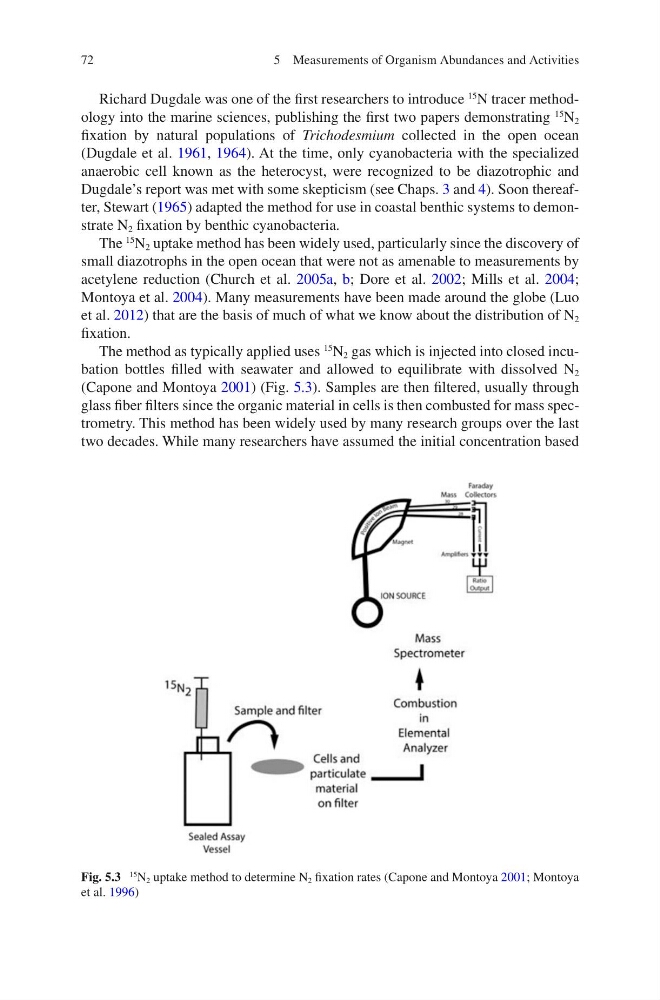
The method as typically applied uses
15
N 2 gas which is injected into closed incubation bottles filled with seawater and allowed to equilibrate with dissolved N 2
(Capone and Montoya 2001) (Fig. 5.3). Samples are then filtered, usually through
glass fiber filters since the organic material in cells is then combusted for mass spectrometry. This method has been widely used by many research groups over the last
two decades. While many researchers have assumed the initial concentration based
Fig. 5.3
15
N 2 uptake method to determine N 2 fixation rates (Capone and Montoya 2001; Montoya
et al. 1996)
5 Measurements of Organism Abundances and Activities
Richard Dugdale was one of the first researchers to introduce
15
N tracer methodology into the marine sciences, publishing the first two papers demonstrating
15
N 2
fixation by natural populations of Trichodesmium collected in the open ocean
(Dugdale et al. 1961, 1964). At the time, only cyanobacteria with the specialized
anaerobic cell known as the heterocyst, were recognized to be diazotrophic and
Dugdale’s report was met with some skepticism (see Chaps. 3 and 4). Soon thereafter, Stewart (1965) adapted the method for use in coastal benthic systems to demonstrate N 2 fixation by benthic cyanobacteria.
The
15
N 2 uptake method has been widely used, particularly since the discovery of
small diazotrophs in the open ocean that were not as amenable to measurements by
acetylene reduction (Church et al. 2005a, b; Dore et al. 2002; Mills et al. 2004;
Montoya et al. 2004). Many measurements have been made around the globe (Luo
et al. 2012) that are the basis of much of what we know about the distribution of N 2
fixation.
The method as typically applied uses
15
N 2 gas which is injected into closed incubation bottles filled with seawater and allowed to equilibrate with dissolved N 2
(Capone and Montoya 2001) (Fig. 5.3). Samples are then filtered, usually through
glass fiber filters since the organic material in cells is then combusted for mass spectrometry. This method has been widely used by many research groups over the last
two decades. While many researchers have assumed the initial concentration based
Fig. 5.3
15
N 2 uptake method to determine N 2 fixation rates (Capone and Montoya 2001; Montoya
et al. 1996)
5 Measurements of Organism Abundances and Activities