

3
1.1 The Nitrogen Cycle
As a component of life on Earth, one of the most abundant forms of nitrogen is
dinitrogen gas (N 2 ) in the atmosphere, where it is 78% of the air that we breathe.
This is fundamentally different from other biogeochemical cycles in that its largest
reservoir is in the atmosphere and dissolved in the ocean, dwarfing all pools of combined N. However it is in a form that is not readily biologically available.
The N cycle is a complex assemblage of biological reactions, with the importance of individual pathways varying within and among ecosystems. Most of the
basic components of the N cycle have been known for over a century (Baas-Becking
1934). However, over the last few decades, novel pathways have been discovered
and the roles and identities of the specific types of microorganisms involved in each
pathway have diversified (Canfield et al. 2010; Thamdrup 2012).
The N cycle moves N from the atmosphere and terrestrial rocks into and out of
organic forms, and through terrestrial, freshwater and marine environments, ultimately being recycled back to the atmosphere or deposited to the deep sea, where
due to the slow recycling times of the deep ocean, it remains for long periods of
geologic time (Fig. 1.1).
Assimilation of N (Fig. 1.2) is a large and key flux of N in terrestrial soils and
aquatic environments transforming N from inorganic to organic form. For living
systems, N-containing amino acids and nucleotides are among the most important
compounds since they are the basis of protein, RNA and DNA, the building blocks
of life. Most animals obtain the N for these compounds by consuming organisms
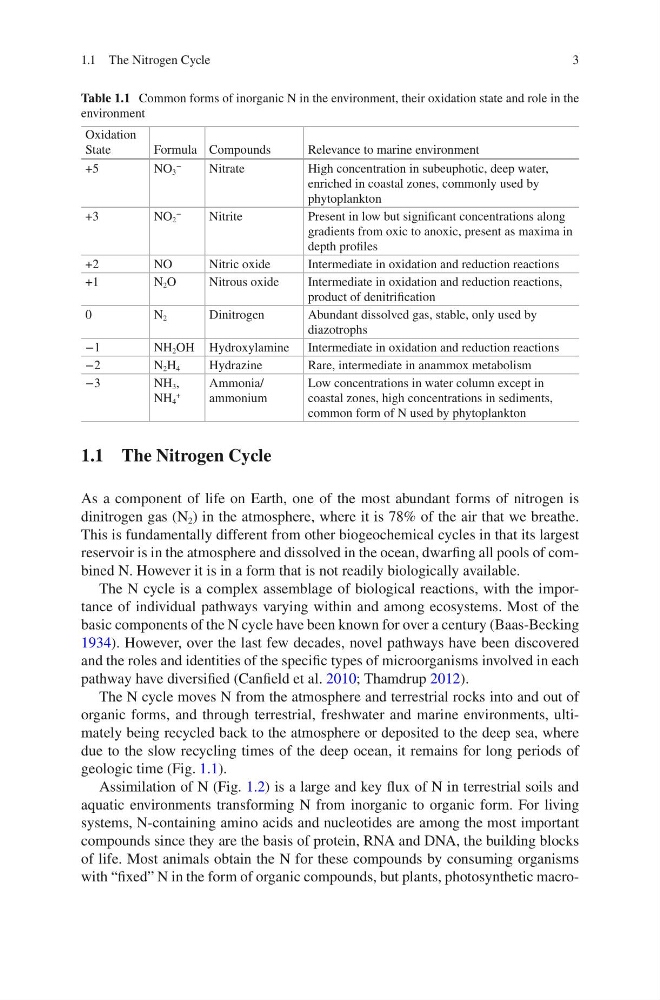
with “fixed” N in the form of organic compounds, but plants, photosynthetic macroTable 1.1 Common forms of inorganic N in the environment, their oxidation state and role in the
environment
Oxidation
State
Formula Compounds
Relevance to marine environment
+5
NO 3
−
Nitrate
High concentration in subeuphotic, deep water,
enriched in coastal zones, commonly used by
phytoplankton
+3
NO 2
−
Nitrite
Present in low but significant concentrations along
gradients from oxic to anoxic, present as maxima in
depth profiles
+2
NO
Nitric oxide
Intermediate in oxidation and reduction reactions
+1
N 2 O
Nitrous oxide
Intermediate in oxidation and reduction reactions,
product of denitrification
0
N 2
Dinitrogen
Abundant dissolved gas, stable, only used by
diazotrophs
−1
NH 2 OH Hydroxylamine Intermediate in oxidation and reduction reactions
−2
N 2 H 4
Hydrazine
Rare, intermediate in anammox metabolism
−3
NH 3 ,
NH 4
+
Ammonia/
ammonium
Low concentrations in water column except in
coastal zones, high concentrations in sediments,
common form of N used by phytoplankton
1.1 The Nitrogen Cycle
1.1 The Nitrogen Cycle
As a component of life on Earth, one of the most abundant forms of nitrogen is
dinitrogen gas (N 2 ) in the atmosphere, where it is 78% of the air that we breathe.
This is fundamentally different from other biogeochemical cycles in that its largest
reservoir is in the atmosphere and dissolved in the ocean, dwarfing all pools of combined N. However it is in a form that is not readily biologically available.
The N cycle is a complex assemblage of biological reactions, with the importance of individual pathways varying within and among ecosystems. Most of the
basic components of the N cycle have been known for over a century (Baas-Becking
1934). However, over the last few decades, novel pathways have been discovered
and the roles and identities of the specific types of microorganisms involved in each
pathway have diversified (Canfield et al. 2010; Thamdrup 2012).
The N cycle moves N from the atmosphere and terrestrial rocks into and out of
organic forms, and through terrestrial, freshwater and marine environments, ultimately being recycled back to the atmosphere or deposited to the deep sea, where
due to the slow recycling times of the deep ocean, it remains for long periods of
geologic time (Fig. 1.1).
Assimilation of N (Fig. 1.2) is a large and key flux of N in terrestrial soils and
aquatic environments transforming N from inorganic to organic form. For living
systems, N-containing amino acids and nucleotides are among the most important
compounds since they are the basis of protein, RNA and DNA, the building blocks
of life. Most animals obtain the N for these compounds by consuming organisms
with “fixed” N in the form of organic compounds, but plants, photosynthetic macroTable 1.1 Common forms of inorganic N in the environment, their oxidation state and role in the
environment
Oxidation
State
Formula Compounds
Relevance to marine environment
+5
NO 3
−
Nitrate
High concentration in subeuphotic, deep water,
enriched in coastal zones, commonly used by
phytoplankton
+3
NO 2
−
Nitrite
Present in low but significant concentrations along
gradients from oxic to anoxic, present as maxima in
depth profiles
+2
NO
Nitric oxide
Intermediate in oxidation and reduction reactions
+1
N 2 O
Nitrous oxide
Intermediate in oxidation and reduction reactions,
product of denitrification
0
N 2
Dinitrogen
Abundant dissolved gas, stable, only used by
diazotrophs
−1
NH 2 OH Hydroxylamine Intermediate in oxidation and reduction reactions
−2
N 2 H 4
Hydrazine
Rare, intermediate in anammox metabolism
−3
NH 3 ,
NH 4
+
Ammonia/
ammonium
Low concentrations in water column except in
coastal zones, high concentrations in sediments,
common form of N used by phytoplankton
1.1 The Nitrogen Cycle