

4
and micro-algae, and many protists and fungi can use fixed inorganic forms of N
such as nitrate, nitrite and ammonium. It is the availability of these forms, organic
and fixed inorganic N, that can be limiting for biological growth and productivity in
the environment. Enzymes specific for the cross-membrane transport and assimilation of inorganic and small organic molecules into organic compounds are found in
those organisms capable of using inorganic N molecules (e.g. ammonium, nitrate,
nitrite and urea and amino acid transporters, amino acid oxidases and urease, nitrate
reductase, glutamine synthetase/glutamate oxoglutarate aminotransferase). N 2 fixation is a special case of assimilation and occurs in a wide range of prokaryotes but
not in eukaryotes, except where symbiotic associations have developed. The first
product of N 2 fixation is ammonia, and N 2 -fixing organisms link it directly to ammonia assimilation.
Upon the death of organisms, both macro- and microscopic, organic N is returned
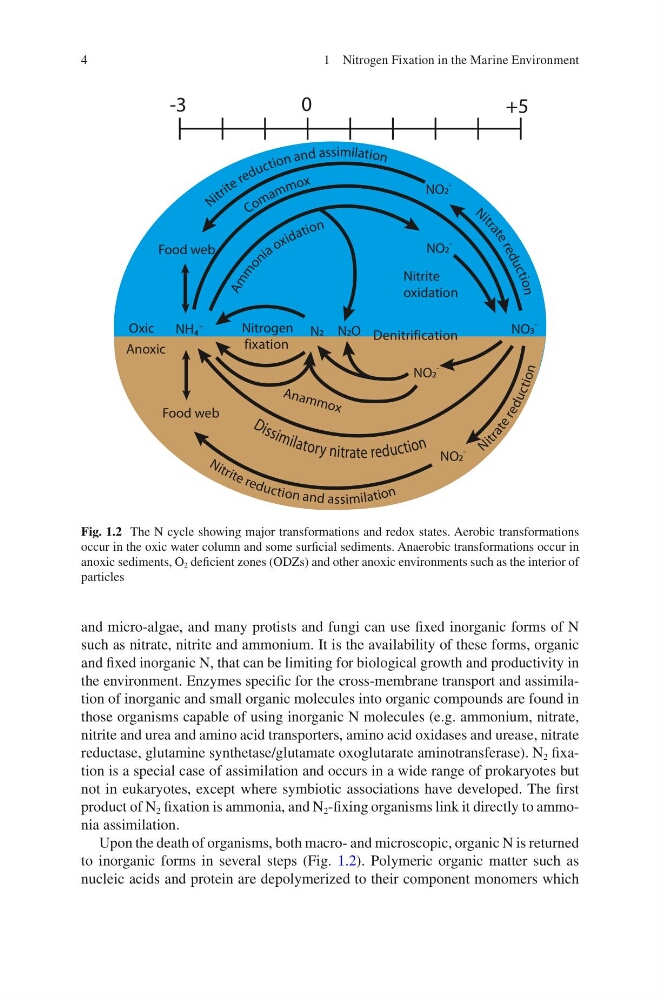
to inorganic forms in several steps (Fig. 1.2). Polymeric organic matter such as
nucleic acids and protein are depolymerized to their component monomers which
N O
NO
N
NH
+
NO
NO
Food web
Food web
NO
NO
Nitrite
oxidation
Oxic
Anoxic
Nitrogen
fixation
Denitrification
-3
0
+5
A m m
o
n i a o x id a t io n
N i
t r a t e r e d u c t io n
N
i t r a t e r e d u c t io n
D i s s i m il a to ry nit rate red uc ti o n
N i t r it e r e d u c ti on an d assimil at io n
A n a m m o x
C o m a m m o x
N i t r i t e r e d u c t io n an d assimilati on
Fig. 1.2 The N cycle showing major transformations and redox states. Aerobic transformations
occur in the oxic water column and some surficial sediments. Anaerobic transformations occur in
anoxic sediments, O 2 deficient zones (ODZs) and other anoxic environments such as the interior of
particles
1 Nitrogen Fixation in the Marine Environment
and micro-algae, and many protists and fungi can use fixed inorganic forms of N
such as nitrate, nitrite and ammonium. It is the availability of these forms, organic
and fixed inorganic N, that can be limiting for biological growth and productivity in
the environment. Enzymes specific for the cross-membrane transport and assimilation of inorganic and small organic molecules into organic compounds are found in
those organisms capable of using inorganic N molecules (e.g. ammonium, nitrate,
nitrite and urea and amino acid transporters, amino acid oxidases and urease, nitrate
reductase, glutamine synthetase/glutamate oxoglutarate aminotransferase). N 2 fixation is a special case of assimilation and occurs in a wide range of prokaryotes but
not in eukaryotes, except where symbiotic associations have developed. The first
product of N 2 fixation is ammonia, and N 2 -fixing organisms link it directly to ammonia assimilation.
Upon the death of organisms, both macro- and microscopic, organic N is returned
to inorganic forms in several steps (Fig. 1.2). Polymeric organic matter such as
nucleic acids and protein are depolymerized to their component monomers which
N O
NO
N
NH
+
NO
NO
Food web
Food web
NO
NO
Nitrite
oxidation
Oxic
Anoxic
Nitrogen
fixation
Denitrification
-3
0
+5
A m m
o
n i a o x id a t io n
N i
t r a t e r e d u c t io n
N
i t r a t e r e d u c t io n
D i s s i m il a to ry nit rate red uc ti o n
N i t r it e r e d u c ti on an d assimil at io n
A n a m m o x
C o m a m m o x
N i t r i t e r e d u c t io n an d assimilati on
Fig. 1.2 The N cycle showing major transformations and redox states. Aerobic transformations
occur in the oxic water column and some surficial sediments. Anaerobic transformations occur in
anoxic sediments, O 2 deficient zones (ODZs) and other anoxic environments such as the interior of
particles
1 Nitrogen Fixation in the Marine Environment