

2
control the oxidation and reduction of many molecules in biogeochemical reactions
in those environments.
Since individual C, H, N, S, P and O biogeochemical cycles are partially independent, the concentration and availability of different compounds in space and
time can result in constraints on biological productivity by one or more nutrients or
trace elements, referred to as limiting nutrients (Moore et al. 2013). The availability
of N in a form that can be used by most organisms is commonly limiting in availability relative to other nutrients in many terrestrial and aquatic environments.
Indeed, N 2 fixation can be a key factor in regulating primary production, the formation of new organic matter, and therefore C cycling in many terrestrial and aquatic
environments (Galloway et al. 2004; Zehr and Capone 2020).
Forms of N exist in many different chemical compounds with bonds to C, O and
H (Table 1.1) and at different oxidation or “redox” states. Thus, N transformations
in the N cycle are important in the functioning of ecosystems, as well as the cycling
of N compounds.
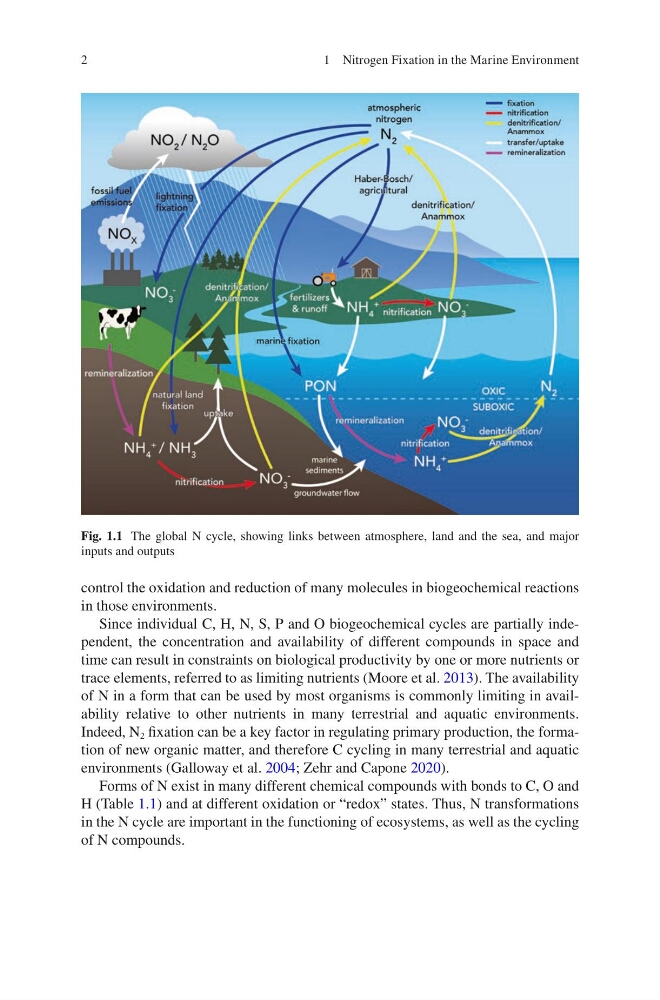
Fig. 1.1 The global N cycle, showing links between atmosphere, land and the sea, and major
inputs and outputs
1 Nitrogen Fixation in the Marine Environment
control the oxidation and reduction of many molecules in biogeochemical reactions
in those environments.
Since individual C, H, N, S, P and O biogeochemical cycles are partially independent, the concentration and availability of different compounds in space and
time can result in constraints on biological productivity by one or more nutrients or
trace elements, referred to as limiting nutrients (Moore et al. 2013). The availability
of N in a form that can be used by most organisms is commonly limiting in availability relative to other nutrients in many terrestrial and aquatic environments.
Indeed, N 2 fixation can be a key factor in regulating primary production, the formation of new organic matter, and therefore C cycling in many terrestrial and aquatic
environments (Galloway et al. 2004; Zehr and Capone 2020).
Forms of N exist in many different chemical compounds with bonds to C, O and
H (Table 1.1) and at different oxidation or “redox” states. Thus, N transformations
in the N cycle are important in the functioning of ecosystems, as well as the cycling
of N compounds.
Fig. 1.1 The global N cycle, showing links between atmosphere, land and the sea, and major
inputs and outputs
1 Nitrogen Fixation in the Marine Environment