

Gene
N 17-20 PAM
N 17-20 PAM
5’ coding region CRISPOR
Sol Genomics
Network
(d) Identification of gene knockout plant lines
and crossing them to wild-type
Flow
cytometry
ICE
analysis
T-DNA
integration
T0
T-DNA + -
/
T1
T-DNA -
/
-
x WT
Cas
gRNA(s)
one to twelve
gRNA(s)
Rhizogenic
Agrobacterium
Agrobacterium
tumefaciens
or
(a) Target selection
for gRNA(s)
ICE
analysis
T-DNA
integration
T2
T-DNA -
/
-
F1
T-DNA -
/
-
T-DNA + -
/
2C
4C
(b) Vector construction
and delivery
(c) Identification of gene knockout
hairy root lines
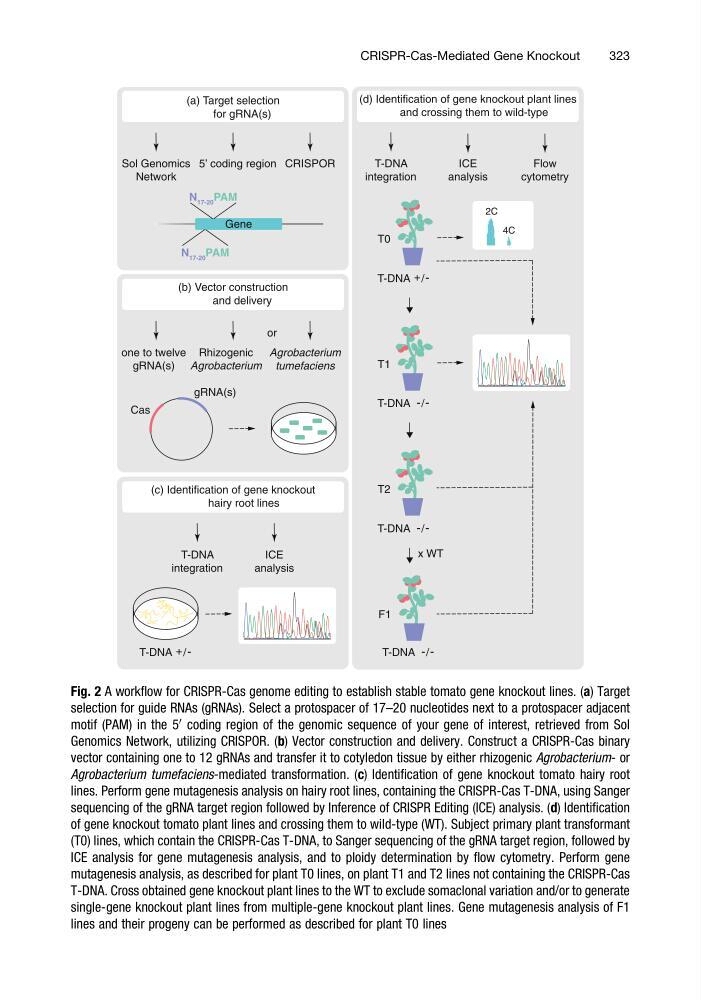
Fig. 2 A workflow for CRISPR-Cas genome editing to establish stable tomato gene knockout lines. (a) Target
selection for guide RNAs (gRNAs). Select a protospacer of 17–20 nucleotides next to a protospacer adjacent
motif (PAM) in the 5
0 coding region of the genomic sequence of your gene of interest, retrieved from Sol
Genomics Network, utilizing CRISPOR. (b) Vector construction and delivery. Construct a CRISPR-Cas binary
vector containing one to 12 gRNAs and transfer it to cotyledon tissue by either rhizogenic Agrobacterium- or
Agrobacterium tumefaciens-mediated transformation. (c) Identification of gene knockout tomato hairy root
lines. Perform gene mutagenesis analysis on hairy root lines, containing the CRISPR-Cas T-DNA, using Sanger
sequencing of the gRNA target region followed by Inference of CRISPR Editing (ICE) analysis. (d) Identification
of gene knockout tomato plant lines and crossing them to wild-type (WT). Subject primary plant transformant
(T0) lines, which contain the CRISPR-Cas T-DNA, to Sanger sequencing of the gRNA target region, followed by
ICE analysis for gene mutagenesis analysis, and to ploidy determination by flow cytometry. Perform gene
mutagenesis analysis, as described for plant T0 lines, on plant T1 and T2 lines not containing the CRISPR-Cas
T-DNA. Cross obtained gene knockout plant lines to the WT to exclude somaclonal variation and/or to generate
single-gene knockout plant lines from multiple-gene knockout plant lines. Gene mutagenesis analysis of F1
lines and their progeny can be performed as described for plant T0 lines
CRISPR-Cas-Mediated Gene Knockout
323
N 17-20 PAM
N 17-20 PAM
5’ coding region CRISPOR
Sol Genomics
Network
(d) Identification of gene knockout plant lines
and crossing them to wild-type
Flow
cytometry
ICE
analysis
T-DNA
integration
T0
T-DNA + -
/
T1
T-DNA -
/
-
x WT
Cas
gRNA(s)
one to twelve
gRNA(s)
Rhizogenic
Agrobacterium
Agrobacterium
tumefaciens
or
(a) Target selection
for gRNA(s)
ICE
analysis
T-DNA
integration
T2
T-DNA -
/
-
F1
T-DNA -
/
-
T-DNA + -
/
2C
4C
(b) Vector construction
and delivery
(c) Identification of gene knockout
hairy root lines
Fig. 2 A workflow for CRISPR-Cas genome editing to establish stable tomato gene knockout lines. (a) Target
selection for guide RNAs (gRNAs). Select a protospacer of 17–20 nucleotides next to a protospacer adjacent
motif (PAM) in the 5
0 coding region of the genomic sequence of your gene of interest, retrieved from Sol
Genomics Network, utilizing CRISPOR. (b) Vector construction and delivery. Construct a CRISPR-Cas binary
vector containing one to 12 gRNAs and transfer it to cotyledon tissue by either rhizogenic Agrobacterium- or
Agrobacterium tumefaciens-mediated transformation. (c) Identification of gene knockout tomato hairy root
lines. Perform gene mutagenesis analysis on hairy root lines, containing the CRISPR-Cas T-DNA, using Sanger
sequencing of the gRNA target region followed by Inference of CRISPR Editing (ICE) analysis. (d) Identification
of gene knockout tomato plant lines and crossing them to wild-type (WT). Subject primary plant transformant
(T0) lines, which contain the CRISPR-Cas T-DNA, to Sanger sequencing of the gRNA target region, followed by
ICE analysis for gene mutagenesis analysis, and to ploidy determination by flow cytometry. Perform gene
mutagenesis analysis, as described for plant T0 lines, on plant T1 and T2 lines not containing the CRISPR-Cas
T-DNA. Cross obtained gene knockout plant lines to the WT to exclude somaclonal variation and/or to generate
single-gene knockout plant lines from multiple-gene knockout plant lines. Gene mutagenesis analysis of F1
lines and their progeny can be performed as described for plant T0 lines
CRISPR-Cas-Mediated Gene Knockout
323