

2 Materials
2.1 Bacterial Strains
and Plant Material
1. Escherichia strain: E. coli DH5α is used for vector construction.
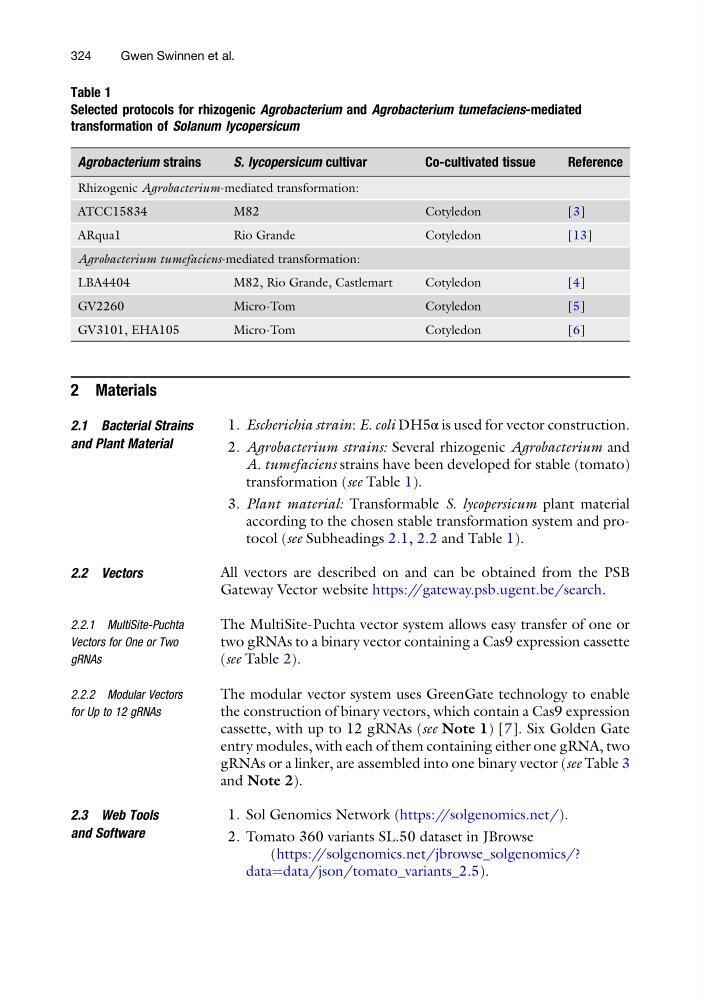
2. Agrobacterium strains: Several rhizogenic Agrobacterium and
A. tumefaciens strains have been developed for stable (tomato)
transformation (see Table 1).
3. Plant material: Transformable S. lycopersicum plant material
according to the chosen stable transformation system and protocol (see Subheadings 2.1, 2.2 and Table 1).
2.2 Vectors
All vectors are described on and can be obtained from the PSB
Gateway Vector website https://gateway.psb.ugent.be/search.
2.2.1 MultiSite-Puchta
Vectors for One or Two
gRNAs
The MultiSite-Puchta vector system allows easy transfer of one or
two gRNAs to a binary vector containing a Cas9 expression cassette
(see Table 2).
2.2.2 Modular Vectors
for Up to 12 gRNAs
The modular vector system uses GreenGate technology to enable
the construction of binary vectors, which contain a Cas9 expression
cassette, with up to 12 gRNAs (see Note 1) [7]. Six Golden Gate
entry modules, with each of them containing either one gRNA, two
gRNAs or a linker, are assembled into one binary vector (see Table 3
and Note 2).
2.3 Web Tools
and Software
1. Sol Genomics Network (https://solgenomics.net/).
2. Tomato 360 variants SL.50 dataset in JBrowse
(https://solgenomics.net/jbrowse_solgenomics/?
data¼data/json/tomato_variants_2.5).
Table 1
Selected protocols for rhizogenic Agrobacterium and Agrobacterium tumefaciens-mediated
transformation of Solanum lycopersicum
Agrobacterium strains
S. lycopersicum cultivar
Co-cultivated tissue
Reference
Rhizogenic Agrobacterium-mediated transformation:
ATCC15834
M82
Cotyledon
[3]
ARqua1
Rio Grande
Cotyledon
[13]
Agrobacterium tumefaciens-mediated transformation:
LBA4404
M82, Rio Grande, Castlemart
Cotyledon
[4]
GV2260
Micro-Tom
Cotyledon
[5]
GV3101, EHA105
Micro-Tom
Cotyledon
[6]
324
Gwen Swinnen et al.
2.1 Bacterial Strains
and Plant Material
1. Escherichia strain: E. coli DH5α is used for vector construction.
2. Agrobacterium strains: Several rhizogenic Agrobacterium and
A. tumefaciens strains have been developed for stable (tomato)
transformation (see Table 1).
3. Plant material: Transformable S. lycopersicum plant material
according to the chosen stable transformation system and protocol (see Subheadings 2.1, 2.2 and Table 1).
2.2 Vectors
All vectors are described on and can be obtained from the PSB
Gateway Vector website https://gateway.psb.ugent.be/search.
2.2.1 MultiSite-Puchta
Vectors for One or Two
gRNAs
The MultiSite-Puchta vector system allows easy transfer of one or
two gRNAs to a binary vector containing a Cas9 expression cassette
(see Table 2).
2.2.2 Modular Vectors
for Up to 12 gRNAs
The modular vector system uses GreenGate technology to enable
the construction of binary vectors, which contain a Cas9 expression
cassette, with up to 12 gRNAs (see Note 1) [7]. Six Golden Gate
entry modules, with each of them containing either one gRNA, two
gRNAs or a linker, are assembled into one binary vector (see Table 3
and Note 2).
2.3 Web Tools
and Software
1. Sol Genomics Network (https://solgenomics.net/).
2. Tomato 360 variants SL.50 dataset in JBrowse
(https://solgenomics.net/jbrowse_solgenomics/?
data¼data/json/tomato_variants_2.5).
Table 1
Selected protocols for rhizogenic Agrobacterium and Agrobacterium tumefaciens-mediated
transformation of Solanum lycopersicum
Agrobacterium strains
S. lycopersicum cultivar
Co-cultivated tissue
Reference
Rhizogenic Agrobacterium-mediated transformation:
ATCC15834
M82
Cotyledon
[3]
ARqua1
Rio Grande
Cotyledon
[13]
Agrobacterium tumefaciens-mediated transformation:
LBA4404
M82, Rio Grande, Castlemart
Cotyledon
[4]
GV2260
Micro-Tom
Cotyledon
[5]
GV3101, EHA105
Micro-Tom
Cotyledon
[6]
324
Gwen Swinnen et al.