

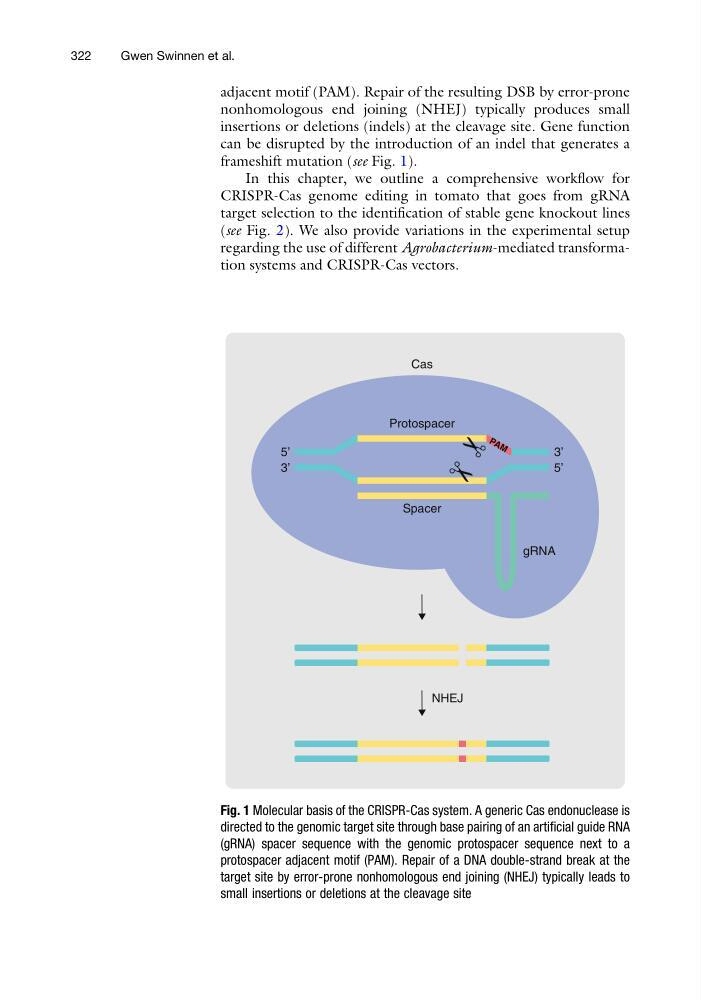
adjacent motif (PAM). Repair of the resulting DSB by error-prone
nonhomologous end joining (NHEJ) typically produces small
insertions or deletions (indels) at the cleavage site. Gene function
can be disrupted by the introduction of an indel that generates a
frameshift mutation (see Fig. 1).
In this chapter, we outline a comprehensive workflow for
CRISPR-Cas genome editing in tomato that goes from gRNA
target selection to the identification of stable gene knockout lines
(see Fig. 2). We also provide variations in the experimental setup
regarding the use of different Agrobacterium-mediated transformation systems and CRISPR-Cas vectors.
Cas
P A M
3’
5’
3’
5’
Spacer
Protospacer
gRNA
NHEJ
Fig. 1 Molecular basis of the CRISPR-Cas system. A generic Cas endonuclease is
directed to the genomic target site through base pairing of an artificial guide RNA
(gRNA) spacer sequence with the genomic protospacer sequence next to a
protospacer adjacent motif (PAM). Repair of a DNA double-strand break at the
target site by error-prone nonhomologous end joining (NHEJ) typically leads to
small insertions or deletions at the cleavage site
322
Gwen Swinnen et al.
nonhomologous end joining (NHEJ) typically produces small
insertions or deletions (indels) at the cleavage site. Gene function
can be disrupted by the introduction of an indel that generates a
frameshift mutation (see Fig. 1).
In this chapter, we outline a comprehensive workflow for
CRISPR-Cas genome editing in tomato that goes from gRNA
target selection to the identification of stable gene knockout lines
(see Fig. 2). We also provide variations in the experimental setup
regarding the use of different Agrobacterium-mediated transformation systems and CRISPR-Cas vectors.
Cas
P A M
3’
5’
3’
5’
Spacer
Protospacer
gRNA
NHEJ
Fig. 1 Molecular basis of the CRISPR-Cas system. A generic Cas endonuclease is
directed to the genomic target site through base pairing of an artificial guide RNA
(gRNA) spacer sequence with the genomic protospacer sequence next to a
protospacer adjacent motif (PAM). Repair of a DNA double-strand break at the
target site by error-prone nonhomologous end joining (NHEJ) typically leads to
small insertions or deletions at the cleavage site
322
Gwen Swinnen et al.