

5. If acetone has evaporated during homogenization in the mortar, add some (e.g., 0.5 mL) chilled acetone to the green slurry
so that you can collect it with a pipette.
6. You can check the effectiveness of extraction by eyes. After
complete extraction of pigments (carotenoids and chlorophylls) pellets have a white color (or brownish in the case of
anthocyanin accumulation). Use less volume of acetone when
you do reextraction from pellets. All extracts from the same
sample must be collected together in a larger centrifuge tube.
Write down the total volume of the extract for calculation of
pigment concentration.
7. Very rarely, leaves of some plant species contain polymers which
block nylon membrane. If there is a strong back pressure, do
not apply excessive pressure to the syringe as this could cause
the filter housing to burst.
8. Brief application of N 2 gas stream is sufficient to blow away the
air out of the sample vial. Longer exposure to dry N 2 gas will
evaporate acetone and alter the pigment concentration.
9. The concentrations of carotenoids in your samples must be
within the range of calibration.
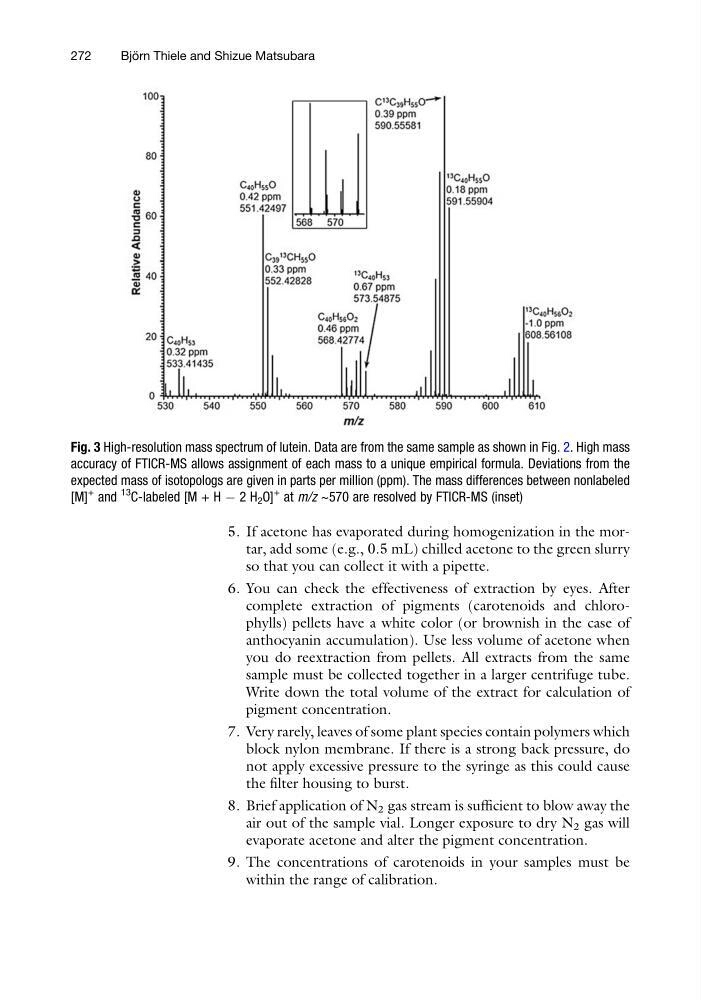
Fig. 3 High-resolution mass spectrum of lutein. Data are from the same sample as shown in Fig. 2. High mass
accuracy of FTICR-MS allows assignment of each mass to a unique empirical formula. Deviations from the
expected mass of isotopologs are given in parts per million (ppm). The mass differences between nonlabeled
[M]
+ and
13
C-labeled [M + H À 2 H 2 O]
+ at m/z ~570 are resolved by FTICR-MS (inset)
272
Bjo ¨ rn Thiele and Shizue Matsubara
so that you can collect it with a pipette.
6. You can check the effectiveness of extraction by eyes. After
complete extraction of pigments (carotenoids and chlorophylls) pellets have a white color (or brownish in the case of
anthocyanin accumulation). Use less volume of acetone when
you do reextraction from pellets. All extracts from the same
sample must be collected together in a larger centrifuge tube.
Write down the total volume of the extract for calculation of
pigment concentration.
7. Very rarely, leaves of some plant species contain polymers which
block nylon membrane. If there is a strong back pressure, do
not apply excessive pressure to the syringe as this could cause
the filter housing to burst.
8. Brief application of N 2 gas stream is sufficient to blow away the
air out of the sample vial. Longer exposure to dry N 2 gas will
evaporate acetone and alter the pigment concentration.
9. The concentrations of carotenoids in your samples must be
within the range of calibration.
Fig. 3 High-resolution mass spectrum of lutein. Data are from the same sample as shown in Fig. 2. High mass
accuracy of FTICR-MS allows assignment of each mass to a unique empirical formula. Deviations from the
expected mass of isotopologs are given in parts per million (ppm). The mass differences between nonlabeled
[M]
+ and
13
C-labeled [M + H À 2 H 2 O]
+ at m/z ~570 are resolved by FTICR-MS (inset)
272
Bjo ¨ rn Thiele and Shizue Matsubara