

3. You can use fresh leaf material which is taken from plants
directly before extraction. In many cases, however, leaves are
collected beforehand in centrifuge tubes or aluminum bags,
shock-frozen in liquid N 2 and stored at À80
C until
extraction.
4. You need to measure sample weight to calculate concentrations
of different carotenoids per unit leaf mass. For concentrations
per unit leaf area, there is no need to determine the weight but
the area of the sample must be known.
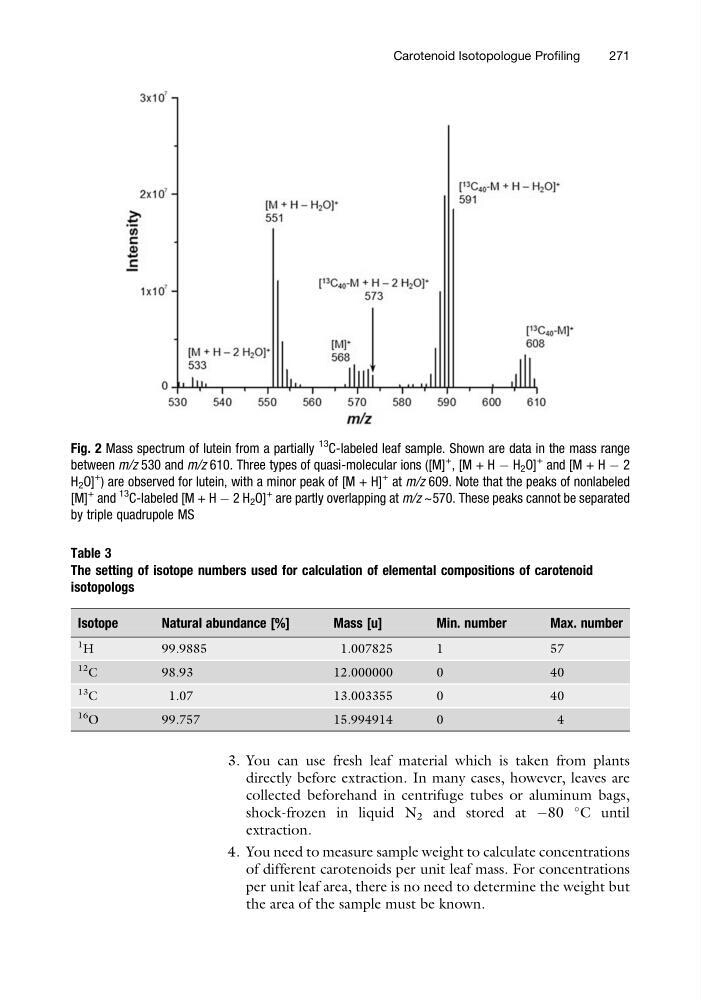
Fig. 2 Mass spectrum of lutein from a partially
13
C-labeled leaf sample. Shown are data in the mass range
between m/z 530 and m/z 610. Three types of quasi-molecular ions ([M]
+ , [M + H À H 2 O]
+ and [M + H À 2
H 2 O]
+
) are observed for lutein, with a minor peak of [M + H]
+ at m/z 609. Note that the peaks of nonlabeled
[M]
+ and
13 C-labeled [M + H À 2 H 2 O]
+ are partly overlapping at m/z ~570. These peaks cannot be separated
by triple quadrupole MS
Table 3
The setting of isotope numbers used for calculation of elemental compositions of carotenoid
isotopologs
Isotope
Natural abundance [%]
Mass [u]
Min. number
Max. number
1 H
99.9885
1.007825
1
57
12 C
98.93
12.000000
0
40
13 C
1.07
13.003355
0
40
16 O
99.757
15.994914
0
4
Carotenoid Isotopologue Profiling
271
directly before extraction. In many cases, however, leaves are
collected beforehand in centrifuge tubes or aluminum bags,
shock-frozen in liquid N 2 and stored at À80
C until
extraction.
4. You need to measure sample weight to calculate concentrations
of different carotenoids per unit leaf mass. For concentrations
per unit leaf area, there is no need to determine the weight but
the area of the sample must be known.
Fig. 2 Mass spectrum of lutein from a partially
13
C-labeled leaf sample. Shown are data in the mass range
between m/z 530 and m/z 610. Three types of quasi-molecular ions ([M]
+ , [M + H À H 2 O]
+ and [M + H À 2
H 2 O]
+
) are observed for lutein, with a minor peak of [M + H]
+ at m/z 609. Note that the peaks of nonlabeled
[M]
+ and
13 C-labeled [M + H À 2 H 2 O]
+ are partly overlapping at m/z ~570. These peaks cannot be separated
by triple quadrupole MS
Table 3
The setting of isotope numbers used for calculation of elemental compositions of carotenoid
isotopologs
Isotope
Natural abundance [%]
Mass [u]
Min. number
Max. number
1 H
99.9885
1.007825
1
57
12 C
98.93
12.000000
0
40
13 C
1.07
13.003355
0
40
16 O
99.757
15.994914
0
4
Carotenoid Isotopologue Profiling
271