

7. Calculate the base peak intensity of each isotopolog (BPI i ; see
Note 13) as shown in Tables 4 and 5. Normalize BPI i to the
sum of BPI i of all isotopologs detected in the sample to estimate the relative abundance (BPI i(norm) ). The
13
C enrichment
in an isotopolog (or degree of labeling, DoL i ) can be calculated
based on BPI i(norm) and the number of
13
C in the isotopolog
(see Note 13). The sum of DoL i of all isotopologs gives DoL of
the pigment.
8. Plot BPI i(norm) values obtained by LC-MS versus FTICR-MS
(Fig. 4). If they show a good linear correlation with a slope of
1, similar samples can be analyzed by LC-MS alone. The correlation must be checked for each pigment.
4 Notes
1. A common problem with NH 4 Ac solutions is rapid growth of
microalgae especially at room temperature. To avoid this problem, we recommend amber glass bottles or bottles wrapped
with aluminum foil to store NH 4 Ac solutions at 4
C.
2. Open the ampules containing the standards directly before use.
Once opened, the standards cannot be stored as they are prone
to degradation by oxygen and light.
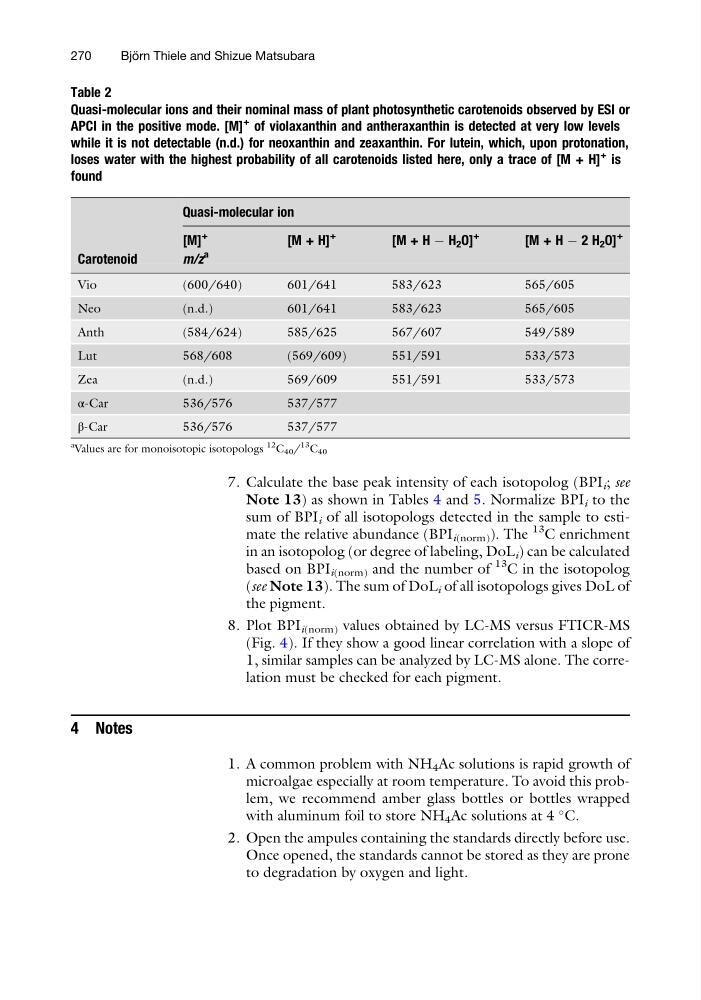
Table 2
Quasi-molecular ions and their nominal mass of plant photosynthetic carotenoids observed by ESI or
APCI in the positive mode. [M]
+ of violaxanthin and antheraxanthin is detected at very low levels
while it is not detectable (n.d.) for neoxanthin and zeaxanthin. For lutein, which, upon protonation,
loses water with the highest probability of all carotenoids listed here, only a trace of [M + H]
+ is
found
Carotenoid
Quasi-molecular ion
[M]
+
[M + H]
+
[M + H À H 2 O]
+
[M + H À 2 H 2 O]
+
m/z
a
Vio
(600/640)
601/641
583/623
565/605
Neo
(n.d.)
601/641
583/623
565/605
Anth
(584/624)
585/625
567/607
549/589
Lut
568/608
(569/609)
551/591
533/573
Zea
(n.d.)
569/609
551/591
533/573
α-Car
536/576
537/577
β-Car
536/576
537/577
a
Values are for monoisotopic isotopologs
12
C 40 /
13 C 40
270
Bjo ¨ rn Thiele and Shizue Matsubara
Note 13) as shown in Tables 4 and 5. Normalize BPI i to the
sum of BPI i of all isotopologs detected in the sample to estimate the relative abundance (BPI i(norm) ). The
13
C enrichment
in an isotopolog (or degree of labeling, DoL i ) can be calculated
based on BPI i(norm) and the number of
13
C in the isotopolog
(see Note 13). The sum of DoL i of all isotopologs gives DoL of
the pigment.
8. Plot BPI i(norm) values obtained by LC-MS versus FTICR-MS
(Fig. 4). If they show a good linear correlation with a slope of
1, similar samples can be analyzed by LC-MS alone. The correlation must be checked for each pigment.
4 Notes
1. A common problem with NH 4 Ac solutions is rapid growth of
microalgae especially at room temperature. To avoid this problem, we recommend amber glass bottles or bottles wrapped
with aluminum foil to store NH 4 Ac solutions at 4
C.
2. Open the ampules containing the standards directly before use.
Once opened, the standards cannot be stored as they are prone
to degradation by oxygen and light.
Table 2
Quasi-molecular ions and their nominal mass of plant photosynthetic carotenoids observed by ESI or
APCI in the positive mode. [M]
+ of violaxanthin and antheraxanthin is detected at very low levels
while it is not detectable (n.d.) for neoxanthin and zeaxanthin. For lutein, which, upon protonation,
loses water with the highest probability of all carotenoids listed here, only a trace of [M + H]
+ is
found
Carotenoid
Quasi-molecular ion
[M]
+
[M + H]
+
[M + H À H 2 O]
+
[M + H À 2 H 2 O]
+
m/z
a
Vio
(600/640)
601/641
583/623
565/605
Neo
(n.d.)
601/641
583/623
565/605
Anth
(584/624)
585/625
567/607
549/589
Lut
568/608
(569/609)
551/591
533/573
Zea
(n.d.)
569/609
551/591
533/573
α-Car
536/576
537/577
β-Car
536/576
537/577
a
Values are for monoisotopic isotopologs
12
C 40 /
13 C 40
270
Bjo ¨ rn Thiele and Shizue Matsubara