

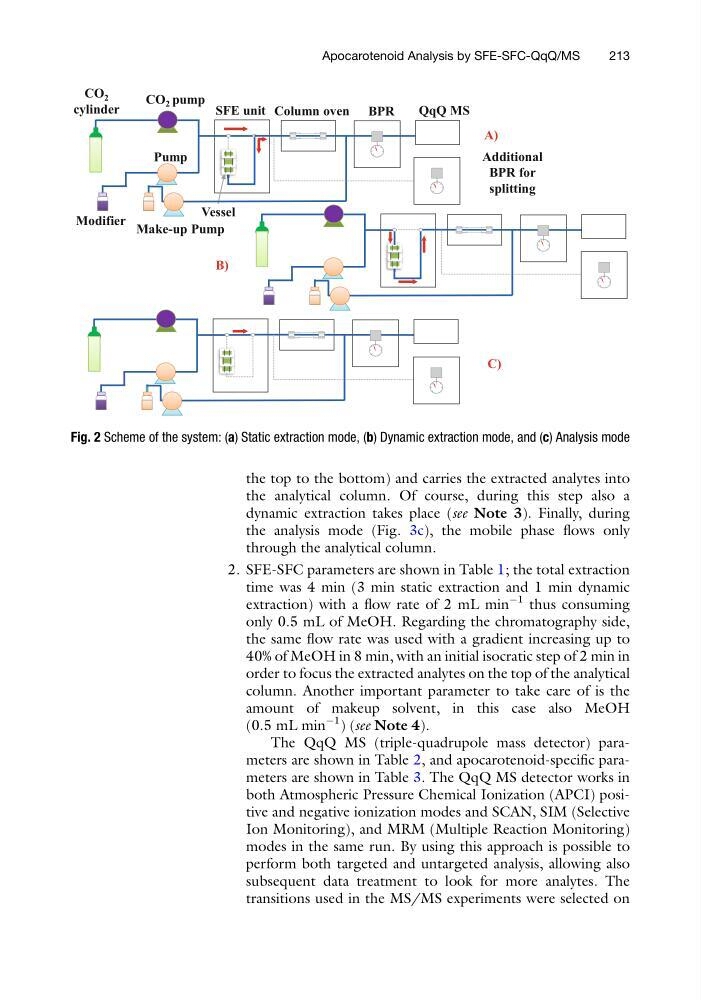
the top to the bottom) and carries the extracted analytes into
the analytical column. Of course, during this step also a
dynamic extraction takes place (see Note 3). Finally, during
the analysis mode (Fig. 3c), the mobile phase flows only
through the analytical column.
2. SFE-SFC parameters are shown in Table 1; the total extraction
time was 4 min (3 min static extraction and 1 min dynamic
extraction) with a flow rate of 2 mL min
À1 thus consuming
only 0.5 mL of MeOH. Regarding the chromatography side,
the same flow rate was used with a gradient increasing up to
40% of MeOH in 8 min, with an initial isocratic step of 2 min in
order to focus the extracted analytes on the top of the analytical
column. Another important parameter to take care of is the
amount of makeup solvent, in this case also MeOH
(0.5 mL min
À1 ) (see Note 4).
The QqQ MS (triple-quadrupole mass detector) parameters are shown in Table 2, and apocarotenoid-specific parameters are shown in Table 3. The QqQ MS detector works in
both Atmospheric Pressure Chemical Ionization (APCI) positive and negative ionization modes and SCAN, SIM (Selective
Ion Monitoring), and MRM (Multiple Reaction Monitoring)
modes in the same run. By using this approach is possible to
perform both targeted and untargeted analysis, allowing also
subsequent data treatment to look for more analytes. The
transitions used in the MS/MS experiments were selected on
CO 2
cylinder
SFE unit
Modifier
Vessel
CO 2 pump
Pump
BPR
Column oven
QqQ MS
Make-up Pump
A)
B)
C)
Additional
BPR for
splitting
Fig. 2 Scheme of the system: (a) Static extraction mode, (b) Dynamic extraction mode, and (c) Analysis mode
Apocarotenoid Analysis by SFE-SFC-QqQ/MS
213
the analytical column. Of course, during this step also a
dynamic extraction takes place (see Note 3). Finally, during
the analysis mode (Fig. 3c), the mobile phase flows only
through the analytical column.
2. SFE-SFC parameters are shown in Table 1; the total extraction
time was 4 min (3 min static extraction and 1 min dynamic
extraction) with a flow rate of 2 mL min
À1 thus consuming
only 0.5 mL of MeOH. Regarding the chromatography side,
the same flow rate was used with a gradient increasing up to
40% of MeOH in 8 min, with an initial isocratic step of 2 min in
order to focus the extracted analytes on the top of the analytical
column. Another important parameter to take care of is the
amount of makeup solvent, in this case also MeOH
(0.5 mL min
À1 ) (see Note 4).
The QqQ MS (triple-quadrupole mass detector) parameters are shown in Table 2, and apocarotenoid-specific parameters are shown in Table 3. The QqQ MS detector works in
both Atmospheric Pressure Chemical Ionization (APCI) positive and negative ionization modes and SCAN, SIM (Selective
Ion Monitoring), and MRM (Multiple Reaction Monitoring)
modes in the same run. By using this approach is possible to
perform both targeted and untargeted analysis, allowing also
subsequent data treatment to look for more analytes. The
transitions used in the MS/MS experiments were selected on
CO 2
cylinder
SFE unit
Modifier
Vessel
CO 2 pump
Pump
BPR
Column oven
QqQ MS
Make-up Pump
A)
B)
C)
Additional
BPR for
splitting
Fig. 2 Scheme of the system: (a) Static extraction mode, (b) Dynamic extraction mode, and (c) Analysis mode
Apocarotenoid Analysis by SFE-SFC-QqQ/MS
213