

Current Advances in Fungal …
131
2016; Mohamad Sukri et al. 2019; Mohanta et al. 2018; Saravanakumar et al. 2019;
Thakur et al. 2019). Recently, mycosynthesized Se-NPs, ZnO-NPs, Ag-NPs, Cu-NPs
and CuO-NPs showed antimicrobial activities against various pathogenic bacteria as
Escherichia coli, Pseudomonas aeruginosa, Klebsiella pneumoniae, Acinetobacter
calcoaceticus, Enterobacter agglomerans, Enterobacter cloacae, Staphylococcus
aureus, Bacillus subtilis, Erwinia amylovora, Citrobacter freundii and Ralstonia
solanacearum (El-Batal et al. 2018, 2020; Mohamed et al. 2019; Salem et al. 2020).
The activities of NPs as antifungal agents for different pathogenic fungi have been
widely evaluated (Guilger et al. 2017). Several studies have reported the activities
of mycosynthesized Ag-NPs as antifungal agents against Trichophyton mentagrophytes, A. flavus, Candida glabrata, A. fumigatus, Candida parapsilosis, Cryptococcus neoformans, Candida krusei, F. solani, Trichophyton rubrum, Cryptococcus
gattii, Candida tropicalis, Sporothrix schenckii, Epidermophyton floccosum, C. albicans and M. hiemalis. In the same regard, Ag-NPs showed activities against plant
pathogenic fungi such as A. niger, Colletotrichum sp., Fusarium sp., Culvularia
lunata and Rhizoctonia solani (Aziz et al. 2016; Parmar and Sharma 2020).
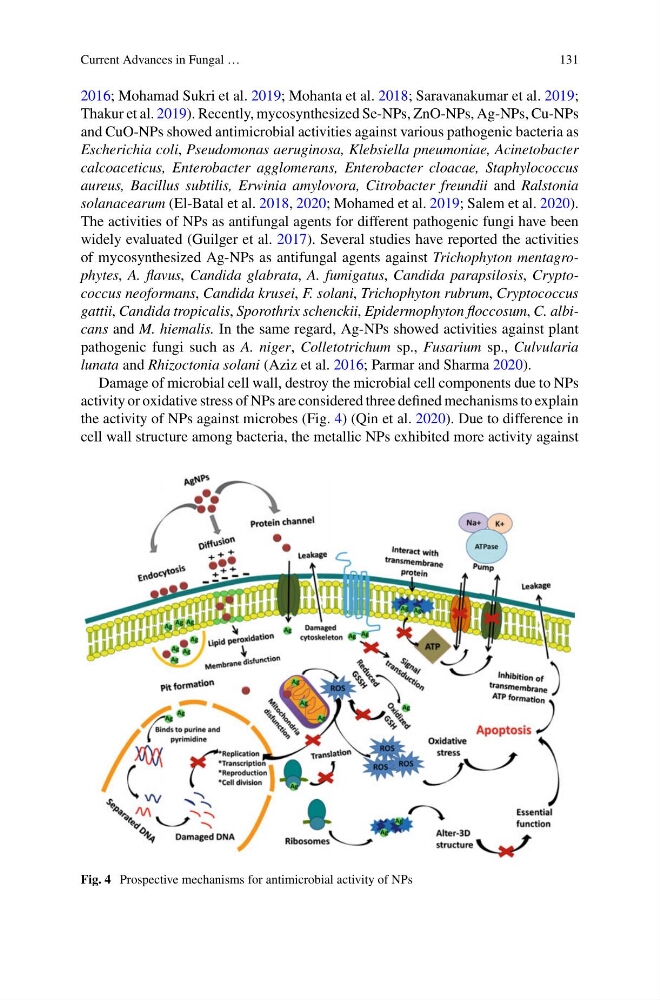
Damage of microbial cell wall, destroy the microbial cell components due to NPs
activity or oxidative stress of NPs are considered three defined mechanisms to explain
the activity of NPs against microbes (Fig. 4) (Qin et al. 2020). Due to difference in
cell wall structure among bacteria, the metallic NPs exhibited more activity against
Fig. 4 Prospective mechanisms for antimicrobial activity of NPs
131
2016; Mohamad Sukri et al. 2019; Mohanta et al. 2018; Saravanakumar et al. 2019;
Thakur et al. 2019). Recently, mycosynthesized Se-NPs, ZnO-NPs, Ag-NPs, Cu-NPs
and CuO-NPs showed antimicrobial activities against various pathogenic bacteria as
Escherichia coli, Pseudomonas aeruginosa, Klebsiella pneumoniae, Acinetobacter
calcoaceticus, Enterobacter agglomerans, Enterobacter cloacae, Staphylococcus
aureus, Bacillus subtilis, Erwinia amylovora, Citrobacter freundii and Ralstonia
solanacearum (El-Batal et al. 2018, 2020; Mohamed et al. 2019; Salem et al. 2020).
The activities of NPs as antifungal agents for different pathogenic fungi have been
widely evaluated (Guilger et al. 2017). Several studies have reported the activities
of mycosynthesized Ag-NPs as antifungal agents against Trichophyton mentagrophytes, A. flavus, Candida glabrata, A. fumigatus, Candida parapsilosis, Cryptococcus neoformans, Candida krusei, F. solani, Trichophyton rubrum, Cryptococcus
gattii, Candida tropicalis, Sporothrix schenckii, Epidermophyton floccosum, C. albicans and M. hiemalis. In the same regard, Ag-NPs showed activities against plant
pathogenic fungi such as A. niger, Colletotrichum sp., Fusarium sp., Culvularia
lunata and Rhizoctonia solani (Aziz et al. 2016; Parmar and Sharma 2020).
Damage of microbial cell wall, destroy the microbial cell components due to NPs
activity or oxidative stress of NPs are considered three defined mechanisms to explain
the activity of NPs against microbes (Fig. 4) (Qin et al. 2020). Due to difference in
cell wall structure among bacteria, the metallic NPs exhibited more activity against
Fig. 4 Prospective mechanisms for antimicrobial activity of NPs