

15
mAh-lifetime-discharged per mL, $/Wh cost, total system size, et cetera) must not
be abandoned in the peer-review process.
Turning now to the Zn shape change problem, the literature suggests its causation is by an ease of electro-dissolution and reluctance of electrodeposition along
the perimeter of the electrode, leading to permanent loss of zinc material from the
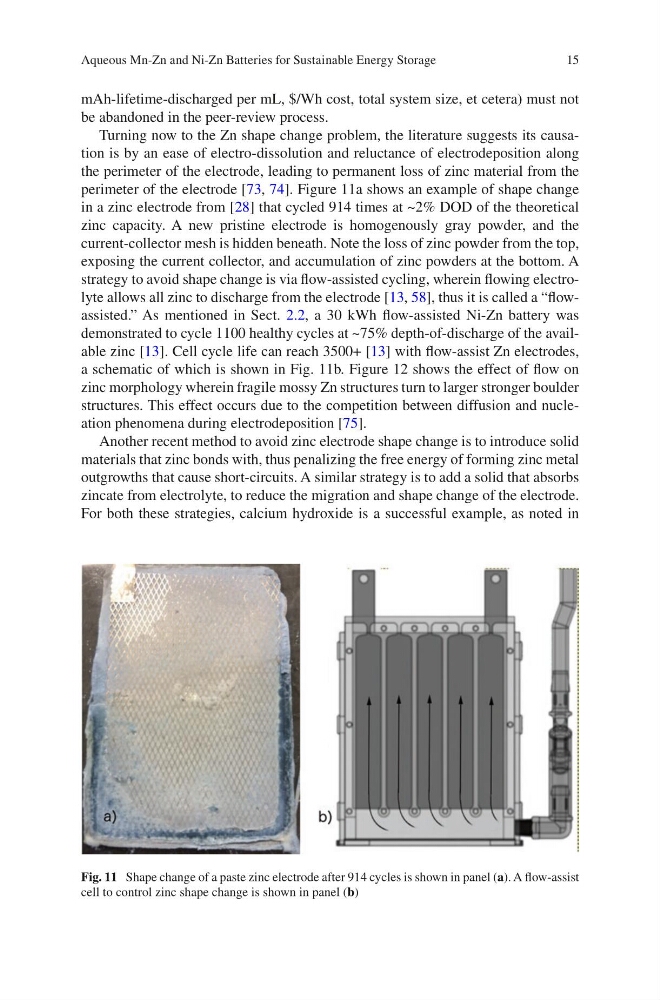
perimeter of the electrode [73, 74]. Figure 11a shows an example of shape change
in a zinc electrode from [28] that cycled 914 times at ~2% DOD of the theoretical
zinc capacity. A new pristine electrode is homogenously gray powder, and the
current- collector mesh is hidden beneath. Note the loss of zinc powder from the top,
exposing the current collector, and accumulation of zinc powders at the bottom. A
strategy to avoid shape change is via flow-assisted cycling, wherein flowing electrolyte allows all zinc to discharge from the electrode [13, 58], thus it is called a “flowassisted.” As mentioned in Sect. 2.2, a 30 kWh flow-assisted Ni-Zn battery was
demonstrated to cycle 1100 healthy cycles at ~75% depth-of-discharge of the available zinc [13]. Cell cycle life can reach 3500+ [13] with flow-assist Zn electrodes,
a schematic of which is shown in Fig. 11b. Figure 12 shows the effect of flow on
zinc morphology wherein fragile mossy Zn structures turn to larger stronger boulder
structures. This effect occurs due to the competition between diffusion and nucleation phenomena during electrodeposition [75].
Another recent method to avoid zinc electrode shape change is to introduce solid
materials that zinc bonds with, thus penalizing the free energy of forming zinc metal
outgrowths that cause short-circuits. A similar strategy is to add a solid that absorbs
zincate from electrolyte, to reduce the migration and shape change of the electrode.
For both these strategies, calcium hydroxide is a successful example, as noted in
Fig. 11 Shape change of a paste zinc electrode after 914 cycles is shown in panel (a). A flow-assist
cell to control zinc shape change is shown in panel (b)
Aqueous Mn-Zn and Ni-Zn Batteries for Sustainable Energy Storage
mAh-lifetime-discharged per mL, $/Wh cost, total system size, et cetera) must not
be abandoned in the peer-review process.
Turning now to the Zn shape change problem, the literature suggests its causation is by an ease of electro-dissolution and reluctance of electrodeposition along
the perimeter of the electrode, leading to permanent loss of zinc material from the
perimeter of the electrode [73, 74]. Figure 11a shows an example of shape change
in a zinc electrode from [28] that cycled 914 times at ~2% DOD of the theoretical
zinc capacity. A new pristine electrode is homogenously gray powder, and the
current- collector mesh is hidden beneath. Note the loss of zinc powder from the top,
exposing the current collector, and accumulation of zinc powders at the bottom. A
strategy to avoid shape change is via flow-assisted cycling, wherein flowing electrolyte allows all zinc to discharge from the electrode [13, 58], thus it is called a “flowassisted.” As mentioned in Sect. 2.2, a 30 kWh flow-assisted Ni-Zn battery was
demonstrated to cycle 1100 healthy cycles at ~75% depth-of-discharge of the available zinc [13]. Cell cycle life can reach 3500+ [13] with flow-assist Zn electrodes,
a schematic of which is shown in Fig. 11b. Figure 12 shows the effect of flow on
zinc morphology wherein fragile mossy Zn structures turn to larger stronger boulder
structures. This effect occurs due to the competition between diffusion and nucleation phenomena during electrodeposition [75].
Another recent method to avoid zinc electrode shape change is to introduce solid
materials that zinc bonds with, thus penalizing the free energy of forming zinc metal
outgrowths that cause short-circuits. A similar strategy is to add a solid that absorbs
zincate from electrolyte, to reduce the migration and shape change of the electrode.
For both these strategies, calcium hydroxide is a successful example, as noted in
Fig. 11 Shape change of a paste zinc electrode after 914 cycles is shown in panel (a). A flow-assist
cell to control zinc shape change is shown in panel (b)
Aqueous Mn-Zn and Ni-Zn Batteries for Sustainable Energy Storage