

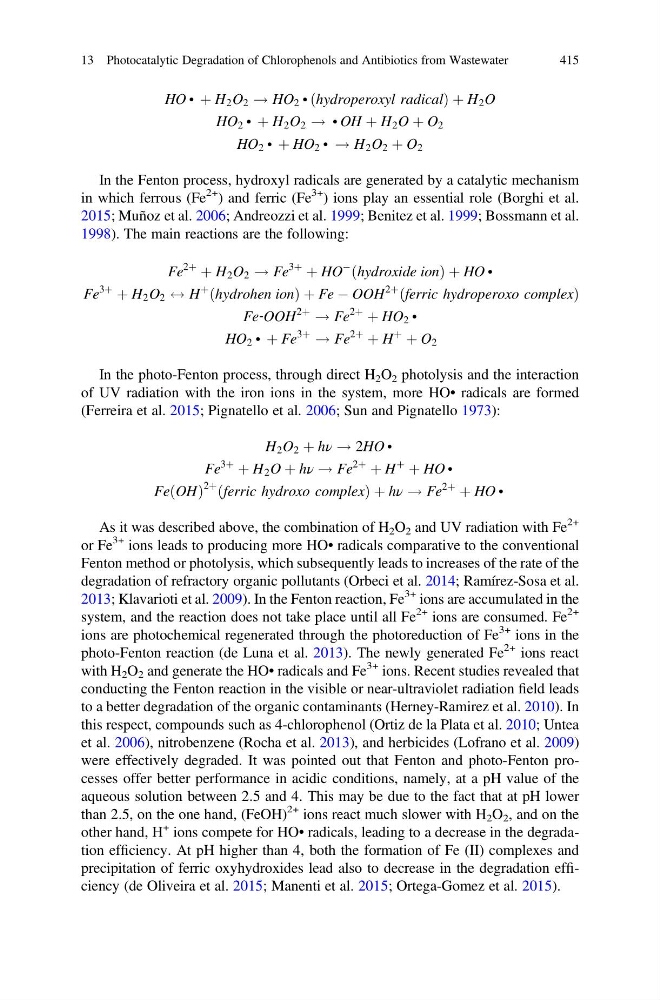
HO • þ H 2 O 2 ! HO 2 • hydroperoxyl radical
ð
Þ þ H 2 O
HO 2 • þ H 2 O 2 ! • OH þ H 2 O þ O 2
HO 2 • þ HO 2 • ! H 2 O 2 þ O 2
In the Fenton process, hydroxyl radicals are generated by a catalytic mechanism
in which ferrous (Fe
2+ ) and ferric (Fe
3+ ) ions play an essential role (Borghi et al.
2015; Muñoz et al. 2006; Andreozzi et al. 1999; Benitez et al. 1999; Bossmann et al.
1998). The main reactions are the following:
Fe
2þ
þ H 2 O 2 ! Fe
3þ
þ HO
À hydroxide ion
ð
Þ þ HO •
Fe
3þ
þ H 2 O 2 $ H
þ hydrohen ion
ð
Þ þ Fe À OOH
2þ ferric hydroperoxo complex
ð
Þ
Fe‐OOH
2þ
! Fe
2þ
þ HO 2 •
HO 2 • þ Fe
3þ
! Fe
2þ
þ H
þ
þ O 2
In the photo-Fenton process, through direct H 2 O 2 photolysis and the interaction
of UV radiation with the iron ions in the system, more HO• radicals are formed
(Ferreira et al. 2015; Pignatello et al. 2006; Sun and Pignatello 1973):
H 2 O 2 þ hν ! 2HO •
Fe
3þ
þ H 2 O þ hν ! Fe
2þ
þ H
þ
þ HO •
Fe OH
ð Þ
2þ ferric hydroxo complex
ð
Þ þ hν ! Fe
2þ
þ HO •
As it was described above, the combination of H 2 O 2 and UV radiation with Fe
2+
or Fe
3+ ions leads to producing more HO• radicals comparative to the conventional
Fenton method or photolysis, which subsequently leads to increases of the rate of the
degradation of refractory organic pollutants (Orbeci et al. 2014; Ramírez-Sosa et al.
2013; Klavarioti et al. 2009). In the Fenton reaction, Fe
3+ ions are accumulated in the
system, and the reaction does not take place until all Fe
2+ ions are consumed. Fe
2+
ions are photochemical regenerated through the photoreduction of Fe
3+ ions in the
photo-Fenton reaction (de Luna et al. 2013). The newly generated Fe
2+ ions react
with H 2 O 2 and generate the HO• radicals and Fe
3+ ions. Recent studies revealed that
conducting the Fenton reaction in the visible or near-ultraviolet radiation field leads
to a better degradation of the organic contaminants (Herney-Ramirez et al. 2010). In
this respect, compounds such as 4-chlorophenol (Ortiz de la Plata et al. 2010; Untea
et al. 2006), nitrobenzene (Rocha et al. 2013), and herbicides (Lofrano et al. 2009)
were effectively degraded. It was pointed out that Fenton and photo-Fenton processes offer better performance in acidic conditions, namely, at a pH value of the
aqueous solution between 2.5 and 4. This may be due to the fact that at pH lower
than 2.5, on the one hand, (FeOH)
2+ ions react much slower with H 2 O 2 , and on the
other hand, H
+ ions compete for HO• radicals, leading to a decrease in the degradation efficiency. At pH higher than 4, both the formation of Fe (II) complexes and
precipitation of ferric oxyhydroxides lead also to decrease in the degradation efficiency (de Oliveira et al. 2015; Manenti et al. 2015; Ortega-Gomez et al. 2015).
13 Photocatalytic Degradation of Chlorophenols and Antibiotics from Wastewater
415
ð
Þ þ H 2 O
HO 2 • þ H 2 O 2 ! • OH þ H 2 O þ O 2
HO 2 • þ HO 2 • ! H 2 O 2 þ O 2
In the Fenton process, hydroxyl radicals are generated by a catalytic mechanism
in which ferrous (Fe
2+ ) and ferric (Fe
3+ ) ions play an essential role (Borghi et al.
2015; Muñoz et al. 2006; Andreozzi et al. 1999; Benitez et al. 1999; Bossmann et al.
1998). The main reactions are the following:
Fe
2þ
þ H 2 O 2 ! Fe
3þ
þ HO
À hydroxide ion
ð
Þ þ HO •
Fe
3þ
þ H 2 O 2 $ H
þ hydrohen ion
ð
Þ þ Fe À OOH
2þ ferric hydroperoxo complex
ð
Þ
Fe‐OOH
2þ
! Fe
2þ
þ HO 2 •
HO 2 • þ Fe
3þ
! Fe
2þ
þ H
þ
þ O 2
In the photo-Fenton process, through direct H 2 O 2 photolysis and the interaction
of UV radiation with the iron ions in the system, more HO• radicals are formed
(Ferreira et al. 2015; Pignatello et al. 2006; Sun and Pignatello 1973):
H 2 O 2 þ hν ! 2HO •
Fe
3þ
þ H 2 O þ hν ! Fe
2þ
þ H
þ
þ HO •
Fe OH
ð Þ
2þ ferric hydroxo complex
ð
Þ þ hν ! Fe
2þ
þ HO •
As it was described above, the combination of H 2 O 2 and UV radiation with Fe
2+
or Fe
3+ ions leads to producing more HO• radicals comparative to the conventional
Fenton method or photolysis, which subsequently leads to increases of the rate of the
degradation of refractory organic pollutants (Orbeci et al. 2014; Ramírez-Sosa et al.
2013; Klavarioti et al. 2009). In the Fenton reaction, Fe
3+ ions are accumulated in the
system, and the reaction does not take place until all Fe
2+ ions are consumed. Fe
2+
ions are photochemical regenerated through the photoreduction of Fe
3+ ions in the
photo-Fenton reaction (de Luna et al. 2013). The newly generated Fe
2+ ions react
with H 2 O 2 and generate the HO• radicals and Fe
3+ ions. Recent studies revealed that
conducting the Fenton reaction in the visible or near-ultraviolet radiation field leads
to a better degradation of the organic contaminants (Herney-Ramirez et al. 2010). In
this respect, compounds such as 4-chlorophenol (Ortiz de la Plata et al. 2010; Untea
et al. 2006), nitrobenzene (Rocha et al. 2013), and herbicides (Lofrano et al. 2009)
were effectively degraded. It was pointed out that Fenton and photo-Fenton processes offer better performance in acidic conditions, namely, at a pH value of the
aqueous solution between 2.5 and 4. This may be due to the fact that at pH lower
than 2.5, on the one hand, (FeOH)
2+ ions react much slower with H 2 O 2 , and on the
other hand, H
+ ions compete for HO• radicals, leading to a decrease in the degradation efficiency. At pH higher than 4, both the formation of Fe (II) complexes and
precipitation of ferric oxyhydroxides lead also to decrease in the degradation efficiency (de Oliveira et al. 2015; Manenti et al. 2015; Ortega-Gomez et al. 2015).
13 Photocatalytic Degradation of Chlorophenols and Antibiotics from Wastewater
415