

The oxidative degradation process is also influenced by the presence of other
active chemical species in the system that could interact with the catalyst in different
ways. In this respect, reductive species enhance the oxidation process because these
reduce Fe
3+ to Fe
2+ and therefore intensify the formation of HO• radicals. Acid-like
species lower the pH of the system, forming stable complexes with Fe
3+ or Fe
2+ ions
which lead to a marked decrease in the oxidation process. The presence of some
inorganic ionic species in the system can modify the efficiency of the process in
different ways. In this respect, anions such as chloride (Cl
À ), sulfate (SO 4
2À ), and
dihydrogen phosphate (H 2 PO 4
À ) could, on the one hand, form ferric complexes that
are nonreactive and, on the other hand, could decrease the decomposition rate of
H 2 O 2 . Moreover, they can react with HO• radicals, forming their own radicals such
as Cl 2
À
•, SO 4
À
•, and H 2 PO 4
À
• that are less reactive than HO• radicals (Untea et al.
2006).
Photocatalysis is currently one of the most studied oxidative processes used
mainly for the decontamination of gaseous and aqueous systems. Its degradation
mechanism involves the development of a set of redox (oxidation–reduction) reactions under the action of light in the presence of a semiconductor that leads to
the degradation of organic contaminants (Ahmed et al. 2010; Zanjanchi et al. 2009).
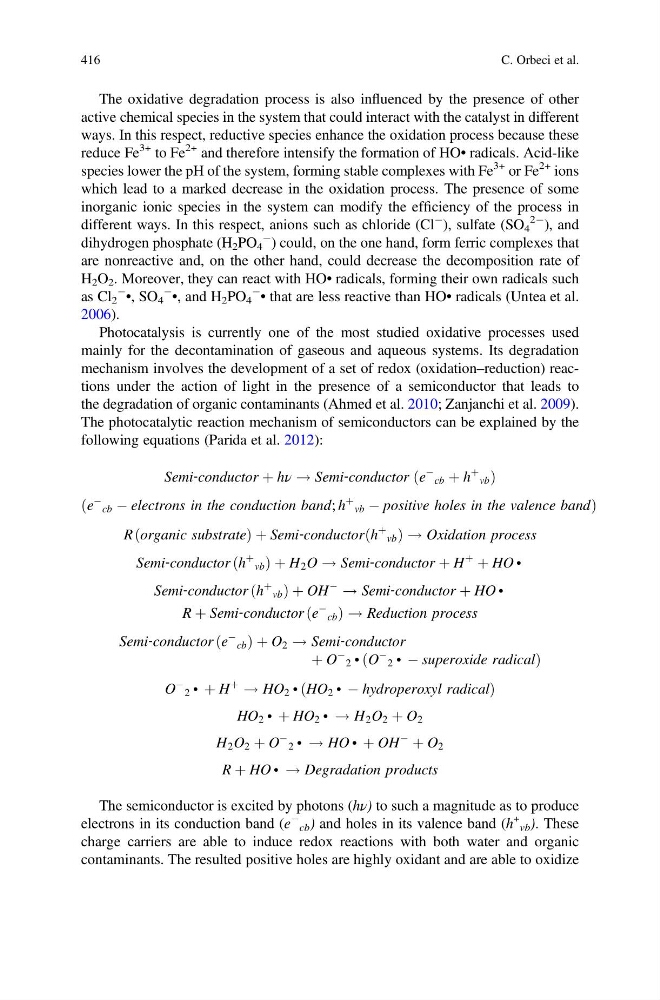
The photocatalytic reaction mechanism of semiconductors can be explained by the
following equations (Parida et al. 2012):
Semi‐conductor þ hν ! Semi‐conductor e
À
cb þ h
þ
vb
ð
Þ
e
À
cb À electrons in the conduction band; h
þ
vb À positive holes in the valence band
ð
Þ
R organic substrate
ð
Þ þ Semi‐conductor h
þ
vb
ð
Þ!Oxidation process
Semi‐conductor h
þ
vb
ð
ÞþH 2 O ! Semi‐conductor þ H
þ
þ HO •
Semi‐conductor h
þ
vb
ð
ÞþOH
À
! Semi‐conductor þ HO •
R þ Semi‐conductor e
À
cb
ð
Þ ! Reduction process
Semi‐conductor e
À
cb
ð
ÞþO 2 ! Semi‐conductor
þ O
À
2 • O
À
2 • À superoxide radical
ð
Þ
O
À
2 • þ H
þ
! HO 2 • HO 2 • À hydroperoxyl radical
ð
Þ
HO 2 • þ HO 2 • ! H 2 O 2 þ O 2
H 2 O 2 þ O
À
2 • ! HO • þ OH
À
þ O 2
R þ HO • ! Degradation products
The semiconductor is excited by photons (hν) to such a magnitude as to produce
electrons in its conduction band (e
À
cb ) and holes in its valence band (h
+
vb ). These
charge carriers are able to induce redox reactions with both water and organic
contaminants. The resulted positive holes are highly oxidant and are able to oxidize
416
C. Orbeci et al.
active chemical species in the system that could interact with the catalyst in different
ways. In this respect, reductive species enhance the oxidation process because these
reduce Fe
3+ to Fe
2+ and therefore intensify the formation of HO• radicals. Acid-like
species lower the pH of the system, forming stable complexes with Fe
3+ or Fe
2+ ions
which lead to a marked decrease in the oxidation process. The presence of some
inorganic ionic species in the system can modify the efficiency of the process in
different ways. In this respect, anions such as chloride (Cl
À ), sulfate (SO 4
2À ), and
dihydrogen phosphate (H 2 PO 4
À ) could, on the one hand, form ferric complexes that
are nonreactive and, on the other hand, could decrease the decomposition rate of
H 2 O 2 . Moreover, they can react with HO• radicals, forming their own radicals such
as Cl 2
À
•, SO 4
À
•, and H 2 PO 4
À
• that are less reactive than HO• radicals (Untea et al.
2006).
Photocatalysis is currently one of the most studied oxidative processes used
mainly for the decontamination of gaseous and aqueous systems. Its degradation
mechanism involves the development of a set of redox (oxidation–reduction) reactions under the action of light in the presence of a semiconductor that leads to
the degradation of organic contaminants (Ahmed et al. 2010; Zanjanchi et al. 2009).
The photocatalytic reaction mechanism of semiconductors can be explained by the
following equations (Parida et al. 2012):
Semi‐conductor þ hν ! Semi‐conductor e
À
cb þ h
þ
vb
ð
Þ
e
À
cb À electrons in the conduction band; h
þ
vb À positive holes in the valence band
ð
Þ
R organic substrate
ð
Þ þ Semi‐conductor h
þ
vb
ð
Þ!Oxidation process
Semi‐conductor h
þ
vb
ð
ÞþH 2 O ! Semi‐conductor þ H
þ
þ HO •
Semi‐conductor h
þ
vb
ð
ÞþOH
À
! Semi‐conductor þ HO •
R þ Semi‐conductor e
À
cb
ð
Þ ! Reduction process
Semi‐conductor e
À
cb
ð
ÞþO 2 ! Semi‐conductor
þ O
À
2 • O
À
2 • À superoxide radical
ð
Þ
O
À
2 • þ H
þ
! HO 2 • HO 2 • À hydroperoxyl radical
ð
Þ
HO 2 • þ HO 2 • ! H 2 O 2 þ O 2
H 2 O 2 þ O
À
2 • ! HO • þ OH
À
þ O 2
R þ HO • ! Degradation products
The semiconductor is excited by photons (hν) to such a magnitude as to produce
electrons in its conduction band (e
À
cb ) and holes in its valence band (h
+
vb ). These
charge carriers are able to induce redox reactions with both water and organic
contaminants. The resulted positive holes are highly oxidant and are able to oxidize
416
C. Orbeci et al.