

Antibiotics can be metabolized by humans and animals to a lesser or greater
extent depending on the organism of each individual. In this respect, they can be
eliminated in the wastewater in different quantities depending on both the dose used
and the rate of excretion thereof (Kümmerer 2009b; Alexy et al. 2004; Bound and
Voulvoulis 2004). Studies on tetracycline, ampicillin, and erythromycin have
highlighted the toxicity they have on bacteria and algae in natural systems even at
very low concentrations. Because these antibiotics have low biodegradability, and
therefore high persistence in the environment, they have high bioaccumulation
potential (Alaton et al. 2004). In addition, these can favor the emergence of
antibiotic-resistant microorganisms, which can lead to an increase in the number
of infections for which new and more powerful antibiotics are needed (Rozas et al.
2010).
13.3 Advanced Oxidation Process Fundamentals
Advanced oxidation processes are based on the nonselective reaction of hydroxyl
free radicals (HO•) with organic contaminants, leading to their degradation (Petrovic
et al. 2011; Pera-Titus et al. 2004).
Although there are several ways by which the strong oxidant HO• radicals can be
generated in situ in the system, the photochemical or photocatalytic processes are the
most used of them. Often, it is not necessary a complete mineralization of the organic
contaminants, but only a transformation of them into biodegradable organic intermediates which, further, can be degraded in a biological process (Wang and Wang
2007).
Advanced oxidation processes can be classified as non-photochemical, such as
Fenton or Fenton-like processes, ozone, and ozone/hydrogen peroxide, and photochemical involving different combinations between ozone (O 3 ) and hydrogen peroxide (H 2 O 2 ), on the one hand, and ultraviolet (UV) radiation and various
semiconductors, on the other hand. Depending on the type of phases involved in
the photocatalytic process, they can also be classified into homogeneous and heterogeneous (Ortiz de la Plata et al. 2010; Papić et al. 2009).
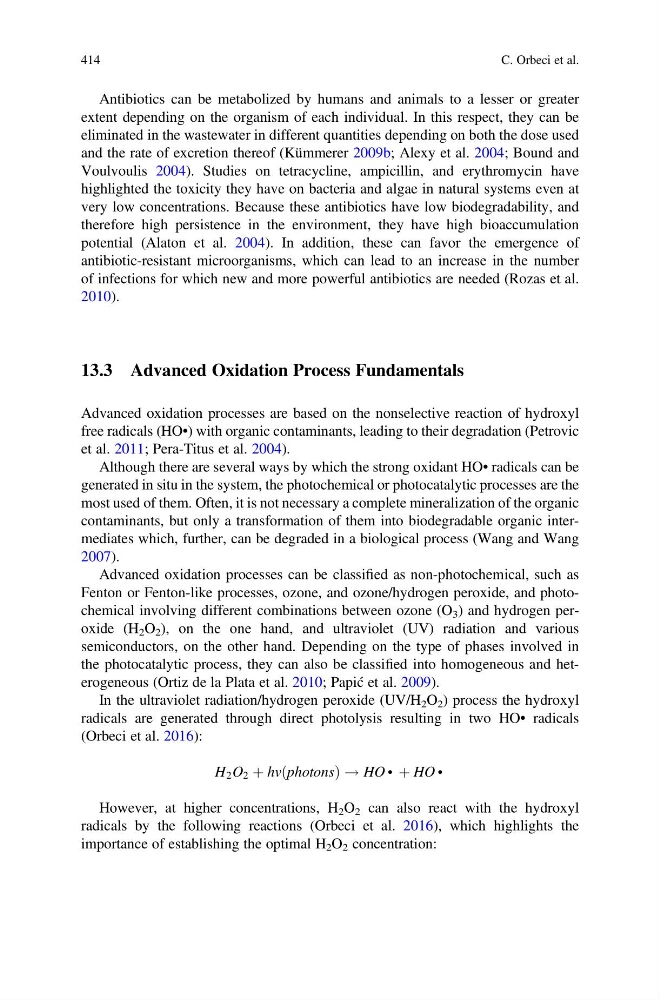
In the ultraviolet radiation/hydrogen peroxide (UV/H 2 O 2 ) process the hydroxyl
radicals are generated through direct photolysis resulting in two HO• radicals
(Orbeci et al. 2016):
H 2 O 2 þ hv photons
ð
Þ!HO • þ HO •
However, at higher concentrations, H 2 O 2 can also react with the hydroxyl
radicals by the following reactions (Orbeci et al. 2016), which highlights the
importance of establishing the optimal H 2 O 2 concentration:
414
C. Orbeci et al.
extent depending on the organism of each individual. In this respect, they can be
eliminated in the wastewater in different quantities depending on both the dose used
and the rate of excretion thereof (Kümmerer 2009b; Alexy et al. 2004; Bound and
Voulvoulis 2004). Studies on tetracycline, ampicillin, and erythromycin have
highlighted the toxicity they have on bacteria and algae in natural systems even at
very low concentrations. Because these antibiotics have low biodegradability, and
therefore high persistence in the environment, they have high bioaccumulation
potential (Alaton et al. 2004). In addition, these can favor the emergence of
antibiotic-resistant microorganisms, which can lead to an increase in the number
of infections for which new and more powerful antibiotics are needed (Rozas et al.
2010).
13.3 Advanced Oxidation Process Fundamentals
Advanced oxidation processes are based on the nonselective reaction of hydroxyl
free radicals (HO•) with organic contaminants, leading to their degradation (Petrovic
et al. 2011; Pera-Titus et al. 2004).
Although there are several ways by which the strong oxidant HO• radicals can be
generated in situ in the system, the photochemical or photocatalytic processes are the
most used of them. Often, it is not necessary a complete mineralization of the organic
contaminants, but only a transformation of them into biodegradable organic intermediates which, further, can be degraded in a biological process (Wang and Wang
2007).
Advanced oxidation processes can be classified as non-photochemical, such as
Fenton or Fenton-like processes, ozone, and ozone/hydrogen peroxide, and photochemical involving different combinations between ozone (O 3 ) and hydrogen peroxide (H 2 O 2 ), on the one hand, and ultraviolet (UV) radiation and various
semiconductors, on the other hand. Depending on the type of phases involved in
the photocatalytic process, they can also be classified into homogeneous and heterogeneous (Ortiz de la Plata et al. 2010; Papić et al. 2009).
In the ultraviolet radiation/hydrogen peroxide (UV/H 2 O 2 ) process the hydroxyl
radicals are generated through direct photolysis resulting in two HO• radicals
(Orbeci et al. 2016):
H 2 O 2 þ hv photons
ð
Þ!HO • þ HO •
However, at higher concentrations, H 2 O 2 can also react with the hydroxyl
radicals by the following reactions (Orbeci et al. 2016), which highlights the
importance of establishing the optimal H 2 O 2 concentration:
414
C. Orbeci et al.