

under atmospheric air irradiation in 60 min, whereas 41.7% removal was accomplished with 5 mg of catalyst as presented in Table 12.5 and Fig. 12.5, 2B. The
increased removal was noticed at higher loadings of the catalyst, where À8.41% and
51.76% degradation were observed with catalyst loadings of 7.5 mg and 10 mg,
respectively, as represented in Table 12.5, serial numbers 2–3, and Fig. 12.5, 2B.
The negative value of degradation efficiencies may be attributed to the formation of
few chromophore groups during the photodegradation. Similar findings were
obtained by Kharazi et al. (2018); Khajone et al. (2019).
The rate of improvement was enhanced with 12.5 mg photocatalyst but found
lesser thereafter, in serial numbers 4–5 of Table 12.5 and Fig. 12.5, 2B, which means
that the photodegradation rate can be controlled by the production rate of photoinduced electrons and holes at these higher catalyst dosages. Next, the influence of
duration was also influenced on photodegradation of congo red using the optimized
catalyst loading of 12.5 mg in 25 mL at 10 ppm concentration. The progress in the
degradation efficiencies was detected from 41% to 98.82% with respect to duration
from 15 min to 75 min as presented in Table 12.5, s. no. 6–10. However, there was
no appreciable enhancement with more duration, Table 12.5 at s. no. 11. It was found
that there was no significant degradation in absence of photocatalyst as given in
Table 12.5, s. no. 12–17.
12.6.3 Possible Mechanism
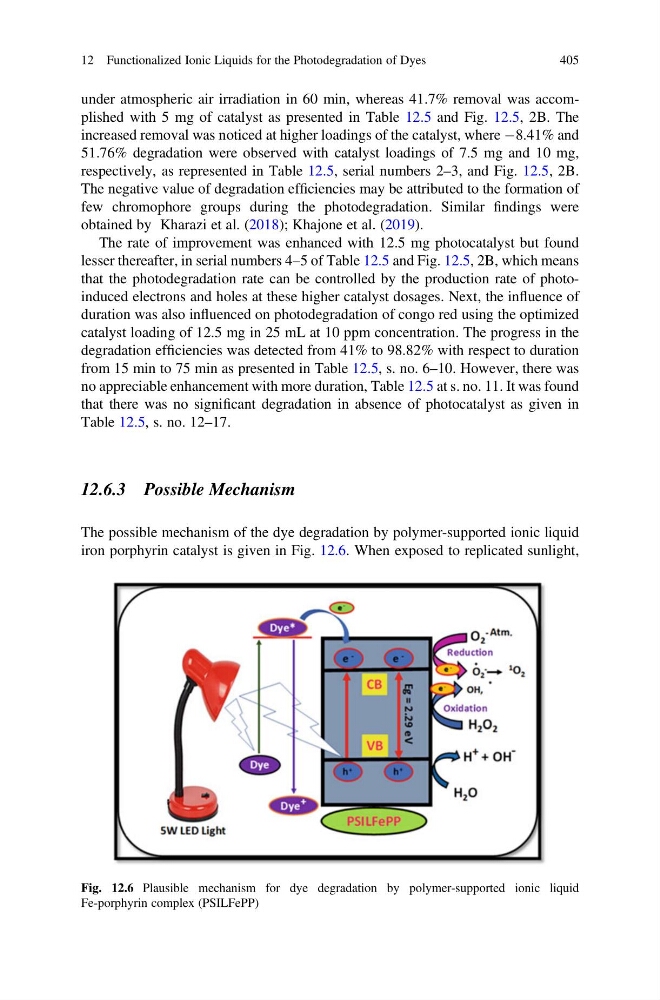
The possible mechanism of the dye degradation by polymer-supported ionic liquid
iron porphyrin catalyst is given in Fig. 12.6. When exposed to replicated sunlight,
Fig. 12.6 Plausible mechanism for dye degradation by polymer-supported ionic liquid
Fe-porphyrin complex (PSILFePP)
12 Functionalized Ionic Liquids for the Photodegradation of Dyes
405
increased removal was noticed at higher loadings of the catalyst, where À8.41% and
51.76% degradation were observed with catalyst loadings of 7.5 mg and 10 mg,
respectively, as represented in Table 12.5, serial numbers 2–3, and Fig. 12.5, 2B.
The negative value of degradation efficiencies may be attributed to the formation of
few chromophore groups during the photodegradation. Similar findings were
obtained by Kharazi et al. (2018); Khajone et al. (2019).
The rate of improvement was enhanced with 12.5 mg photocatalyst but found
lesser thereafter, in serial numbers 4–5 of Table 12.5 and Fig. 12.5, 2B, which means
that the photodegradation rate can be controlled by the production rate of photoinduced electrons and holes at these higher catalyst dosages. Next, the influence of
duration was also influenced on photodegradation of congo red using the optimized
catalyst loading of 12.5 mg in 25 mL at 10 ppm concentration. The progress in the
degradation efficiencies was detected from 41% to 98.82% with respect to duration
from 15 min to 75 min as presented in Table 12.5, s. no. 6–10. However, there was
no appreciable enhancement with more duration, Table 12.5 at s. no. 11. It was found
that there was no significant degradation in absence of photocatalyst as given in
Table 12.5, s. no. 12–17.
12.6.3 Possible Mechanism
The possible mechanism of the dye degradation by polymer-supported ionic liquid
iron porphyrin catalyst is given in Fig. 12.6. When exposed to replicated sunlight,
Fig. 12.6 Plausible mechanism for dye degradation by polymer-supported ionic liquid
Fe-porphyrin complex (PSILFePP)
12 Functionalized Ionic Liquids for the Photodegradation of Dyes
405