

from the sun, and the extent of sunlight absorbed by a compound parabolic collectors
is far better than parabolic trough collectors. Hence they can be used on overcast
days without the use of solar tracking systems which substantially reduces system
complexity with cost (Malato et al. 1997).
The pilot-scale compound parabolic collectors, have demonstrated photocatalytic
removal of biorecalcitrant compounds (Sarria et al. 2003; Malato et al. 2007b),
chlorophenols (Gernjak et al. 2003), bacteria (Fernández et al. 2005), pesticides
(Oller et al. 2006), chlorinated solvents (Blanco-Galvez et al. 2007), dyes (Malato
et al. 1997) and pathogenic organisms (Sarria et al. 2003; Malato et al. 2007b). They
have also been used for urban and olive mill wastewater treatment (Gernjak et al.
2004; Kositzi et al. 2004) and the treatment of sanitary landfill leachate (Silva et al.
2013).
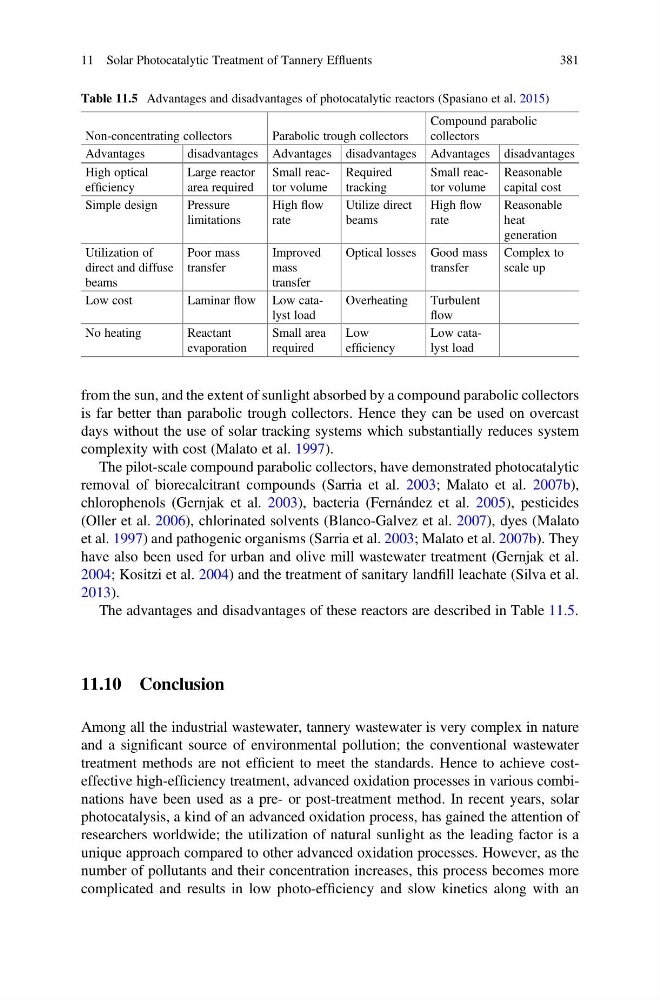
The advantages and disadvantages of these reactors are described in Table 11.5.
11.10 Conclusion
Among all the industrial wastewater, tannery wastewater is very complex in nature
and a significant source of environmental pollution; the conventional wastewater
treatment methods are not efficient to meet the standards. Hence to achieve costeffective high-efficiency treatment, advanced oxidation processes in various combinations have been used as a pre- or post-treatment method. In recent years, solar
photocatalysis, a kind of an advanced oxidation process, has gained the attention of
researchers worldwide; the utilization of natural sunlight as the leading factor is a
unique approach compared to other advanced oxidation processes. However, as the
number of pollutants and their concentration increases, this process becomes more
complicated and results in low photo-efficiency and slow kinetics along with an
Table 11.5 Advantages and disadvantages of photocatalytic reactors (Spasiano et al. 2015)
Non-concentrating collectors
Parabolic trough collectors
Compound parabolic
collectors
Advantages
disadvantages Advantages disadvantages Advantages disadvantages
High optical
efficiency
Large reactor
area required
Small reactor volume
Required
tracking
Small reactor volume
Reasonable
capital cost
Simple design
Pressure
limitations
High flow
rate
Utilize direct
beams
High flow
rate
Reasonable
heat
generation
Utilization of
direct and diffuse
beams
Poor mass
transfer
Improved
mass
transfer
Optical losses Good mass
transfer
Complex to
scale up
Low cost
Laminar flow Low catalyst load
Overheating
Turbulent
flow
No heating
Reactant
evaporation
Small area
required
Low
efficiency
Low catalyst load
11 Solar Photocatalytic Treatment of Tannery Effluents
381
is far better than parabolic trough collectors. Hence they can be used on overcast
days without the use of solar tracking systems which substantially reduces system
complexity with cost (Malato et al. 1997).
The pilot-scale compound parabolic collectors, have demonstrated photocatalytic
removal of biorecalcitrant compounds (Sarria et al. 2003; Malato et al. 2007b),
chlorophenols (Gernjak et al. 2003), bacteria (Fernández et al. 2005), pesticides
(Oller et al. 2006), chlorinated solvents (Blanco-Galvez et al. 2007), dyes (Malato
et al. 1997) and pathogenic organisms (Sarria et al. 2003; Malato et al. 2007b). They
have also been used for urban and olive mill wastewater treatment (Gernjak et al.
2004; Kositzi et al. 2004) and the treatment of sanitary landfill leachate (Silva et al.
2013).
The advantages and disadvantages of these reactors are described in Table 11.5.
11.10 Conclusion
Among all the industrial wastewater, tannery wastewater is very complex in nature
and a significant source of environmental pollution; the conventional wastewater
treatment methods are not efficient to meet the standards. Hence to achieve costeffective high-efficiency treatment, advanced oxidation processes in various combinations have been used as a pre- or post-treatment method. In recent years, solar
photocatalysis, a kind of an advanced oxidation process, has gained the attention of
researchers worldwide; the utilization of natural sunlight as the leading factor is a
unique approach compared to other advanced oxidation processes. However, as the
number of pollutants and their concentration increases, this process becomes more
complicated and results in low photo-efficiency and slow kinetics along with an
Table 11.5 Advantages and disadvantages of photocatalytic reactors (Spasiano et al. 2015)
Non-concentrating collectors
Parabolic trough collectors
Compound parabolic
collectors
Advantages
disadvantages Advantages disadvantages Advantages disadvantages
High optical
efficiency
Large reactor
area required
Small reactor volume
Required
tracking
Small reactor volume
Reasonable
capital cost
Simple design
Pressure
limitations
High flow
rate
Utilize direct
beams
High flow
rate
Reasonable
heat
generation
Utilization of
direct and diffuse
beams
Poor mass
transfer
Improved
mass
transfer
Optical losses Good mass
transfer
Complex to
scale up
Low cost
Laminar flow Low catalyst load
Overheating
Turbulent
flow
No heating
Reactant
evaporation
Small area
required
Low
efficiency
Low catalyst load
11 Solar Photocatalytic Treatment of Tannery Effluents
381