

parabolic surface used to concentrate the transparent tube through solar radiations by
which the fluid flows.
For maximum efficiency, the platform of the collector is controlled by two motors
in an azimuth and elevation tracking system to keep the aperture of parabolic trough
collector in perpendicular to the solar radiation (Fernández-García et al. 2010). With
regard to photocatalytic applications, the concentration factor of parabolic trough
collectors reactor lies from 5 to 35 suns; the concentration factor is the ratio of
collector’s aperture area and absorber area (Alfano et al. 2000). This system sustains
turbulent flow with well-organized uniforming, and the closed system of the tube
prevents the vapourization of volatile compounds during experiments.
In this reactor system, photocatalyst is usually suspended in a fluid, and the main
disadvantage of this system is the dependency on the direct radiation beams which
makes them impractical during cloudy days; in addition, their tracking system
contributes extra capital and operating cost (Fernández-García et al. 2010). The
parabolic trough collectors were used to treat wastewater containing heavy metals
and chlorinated solvents (Spasiano et al. 2015), for the production of 5-hydroxy-1,4naphthoquinone (Oelgemöller et al. 2006), for heterocyclization of ethyne (Jung
et al. 2005), acylation reaction of naphthoquinones and quinones (Schiel et al. 2001).
11.9.3 Compound Parabolic Collectors
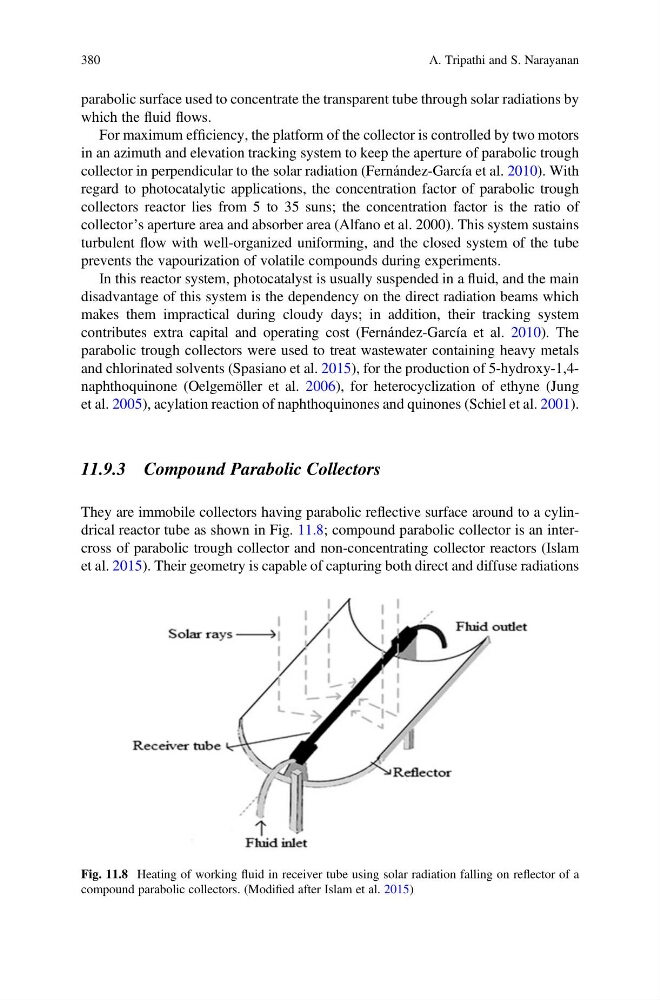
They are immobile collectors having parabolic reflective surface around to a cylindrical reactor tube as shown in Fig. 11.8; compound parabolic collector is an intercross of parabolic trough collector and non-concentrating collector reactors (Islam
et al. 2015). Their geometry is capable of capturing both direct and diffuse radiations
Fig. 11.8 Heating of working fluid in receiver tube using solar radiation falling on reflector of a
compound parabolic collectors. (Modified after Islam et al. 2015)
380
A. Tripathi and S. Narayanan
which the fluid flows.
For maximum efficiency, the platform of the collector is controlled by two motors
in an azimuth and elevation tracking system to keep the aperture of parabolic trough
collector in perpendicular to the solar radiation (Fernández-García et al. 2010). With
regard to photocatalytic applications, the concentration factor of parabolic trough
collectors reactor lies from 5 to 35 suns; the concentration factor is the ratio of
collector’s aperture area and absorber area (Alfano et al. 2000). This system sustains
turbulent flow with well-organized uniforming, and the closed system of the tube
prevents the vapourization of volatile compounds during experiments.
In this reactor system, photocatalyst is usually suspended in a fluid, and the main
disadvantage of this system is the dependency on the direct radiation beams which
makes them impractical during cloudy days; in addition, their tracking system
contributes extra capital and operating cost (Fernández-García et al. 2010). The
parabolic trough collectors were used to treat wastewater containing heavy metals
and chlorinated solvents (Spasiano et al. 2015), for the production of 5-hydroxy-1,4naphthoquinone (Oelgemöller et al. 2006), for heterocyclization of ethyne (Jung
et al. 2005), acylation reaction of naphthoquinones and quinones (Schiel et al. 2001).
11.9.3 Compound Parabolic Collectors
They are immobile collectors having parabolic reflective surface around to a cylindrical reactor tube as shown in Fig. 11.8; compound parabolic collector is an intercross of parabolic trough collector and non-concentrating collector reactors (Islam
et al. 2015). Their geometry is capable of capturing both direct and diffuse radiations
Fig. 11.8 Heating of working fluid in receiver tube using solar radiation falling on reflector of a
compound parabolic collectors. (Modified after Islam et al. 2015)
380
A. Tripathi and S. Narayanan