

11.7.1 Key Steps of Pollutant Degradation During Solar
Photocatalysis
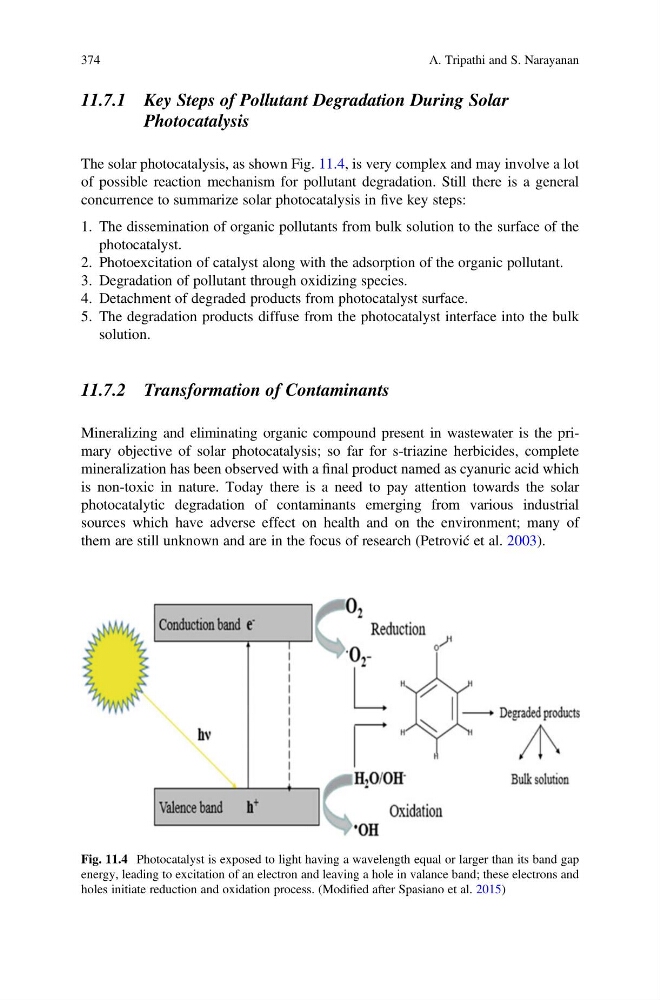
The solar photocatalysis, as shown Fig. 11.4, is very complex and may involve a lot
of possible reaction mechanism for pollutant degradation. Still there is a general
concurrence to summarize solar photocatalysis in five key steps:
1. The dissemination of organic pollutants from bulk solution to the surface of the
photocatalyst.
2. Photoexcitation of catalyst along with the adsorption of the organic pollutant.
3. Degradation of pollutant through oxidizing species.
4. Detachment of degraded products from photocatalyst surface.
5. The degradation products diffuse from the photocatalyst interface into the bulk
solution.
11.7.2 Transformation of Contaminants
Mineralizing and eliminating organic compound present in wastewater is the primary objective of solar photocatalysis; so far for s-triazine herbicides, complete
mineralization has been observed with a final product named as cyanuric acid which
is non-toxic in nature. Today there is a need to pay attention towards the solar
photocatalytic degradation of contaminants emerging from various industrial
sources which have adverse effect on health and on the environment; many of
them are still unknown and are in the focus of research (Petrović et al. 2003).
Fig. 11.4 Photocatalyst is exposed to light having a wavelength equal or larger than its band gap
energy, leading to excitation of an electron and leaving a hole in valance band; these electrons and
holes initiate reduction and oxidation process. (Modified after Spasiano et al. 2015)
374
A. Tripathi and S. Narayanan
Photocatalysis
The solar photocatalysis, as shown Fig. 11.4, is very complex and may involve a lot
of possible reaction mechanism for pollutant degradation. Still there is a general
concurrence to summarize solar photocatalysis in five key steps:
1. The dissemination of organic pollutants from bulk solution to the surface of the
photocatalyst.
2. Photoexcitation of catalyst along with the adsorption of the organic pollutant.
3. Degradation of pollutant through oxidizing species.
4. Detachment of degraded products from photocatalyst surface.
5. The degradation products diffuse from the photocatalyst interface into the bulk
solution.
11.7.2 Transformation of Contaminants
Mineralizing and eliminating organic compound present in wastewater is the primary objective of solar photocatalysis; so far for s-triazine herbicides, complete
mineralization has been observed with a final product named as cyanuric acid which
is non-toxic in nature. Today there is a need to pay attention towards the solar
photocatalytic degradation of contaminants emerging from various industrial
sources which have adverse effect on health and on the environment; many of
them are still unknown and are in the focus of research (Petrović et al. 2003).
Fig. 11.4 Photocatalyst is exposed to light having a wavelength equal or larger than its band gap
energy, leading to excitation of an electron and leaving a hole in valance band; these electrons and
holes initiate reduction and oxidation process. (Modified after Spasiano et al. 2015)
374
A. Tripathi and S. Narayanan