

The mineralization of nitrogen-containing compounds leads to form ammonium
cation and nitrate, these ammonium cation are relatively consistent, and their
proportionality is influenced by irradiation time and oxidation phase of organic
nitrogen. For the amine compounds, the primary product exists in the form of
ammonium cation, and the invasions of hydrogen-containing species on the amino
group govern the formation of ammonium cation. Hence at the end of experiments,
the amount of nitrogen-containing ions existing in the solution are much lesser than
expected from stoichiometry, implying the adsorption of nitrogen-containing species
on the surface of photocatalyst (Calza et al. 2005).
The generation of nitrogen in azo compounds can be represented by similar
procedures which are accountable for ammonium cation formation and comprises
of an exemplary case of decontamination reaction involving total innoxious nitrogen
as a concluding product (Konstantinou and Albanis 2004). In the case of photoFenton treatment of phosphates, more iron is necessary, and at potential of hydrogen
below 4, the phosphate ions stay adsorbed on the surface of photocatalyst (Malato
et al. 2009).
The photo-induced hydroxide radicals attack on sulphur-containing atom present
in wastewater to mineralize as sulphate ion; in most of the cases during the final stage
of photoreaction, stoichiometric formation was observed when organic intermediates
remained present in effluent solution (Malato et al. 2009). The strong adsorption of
sulphate ion on photocatalyst surface could inhibit the reaction rate and forms
non-stoichiometric sulphate ions. The presence of sulphate ion, chloride ion and
phosphate ion in concentration > 1 milli-molar can reduce the reaction rate because
of adsorption on the photo-activated reaction sites (Malato et al. 2009).
Industrial wastewater treatment is one of the major advantageous applications of
solar photocatalysis, and there is always a need to assess the probable pollutant for
optimized operations (Malato et al. 2007a). Generally, the compounds which have
been degraded by solar photocatalysis comprise of dyes, aliphatic alcohols, alkanes,
carboxylic acids, polymers, aromatics, alkenes, pesticides, surfactants, alkanes and
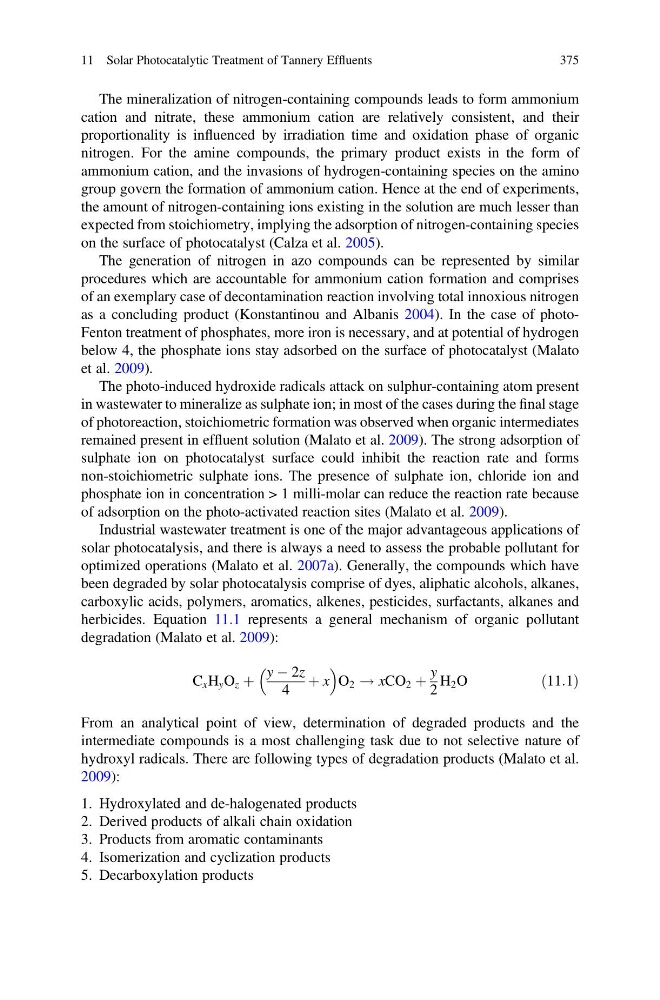
herbicides. Equation 11.1 represents a general mechanism of organic pollutant
degradation (Malato et al. 2009):
C x H y O z þ
y À 2z
4
þ x
O 2 ! xCO 2 þ
y
2
H 2 O
ð11:1Þ
From an analytical point of view, determination of degraded products and the
intermediate compounds is a most challenging task due to not selective nature of
hydroxyl radicals. There are following types of degradation products (Malato et al.
2009):
1. Hydroxylated and de-halogenated products
2. Derived products of alkali chain oxidation
3. Products from aromatic contaminants
4. Isomerization and cyclization products
5. Decarboxylation products
11 Solar Photocatalytic Treatment of Tannery Effluents
375
cation and nitrate, these ammonium cation are relatively consistent, and their
proportionality is influenced by irradiation time and oxidation phase of organic
nitrogen. For the amine compounds, the primary product exists in the form of
ammonium cation, and the invasions of hydrogen-containing species on the amino
group govern the formation of ammonium cation. Hence at the end of experiments,
the amount of nitrogen-containing ions existing in the solution are much lesser than
expected from stoichiometry, implying the adsorption of nitrogen-containing species
on the surface of photocatalyst (Calza et al. 2005).
The generation of nitrogen in azo compounds can be represented by similar
procedures which are accountable for ammonium cation formation and comprises
of an exemplary case of decontamination reaction involving total innoxious nitrogen
as a concluding product (Konstantinou and Albanis 2004). In the case of photoFenton treatment of phosphates, more iron is necessary, and at potential of hydrogen
below 4, the phosphate ions stay adsorbed on the surface of photocatalyst (Malato
et al. 2009).
The photo-induced hydroxide radicals attack on sulphur-containing atom present
in wastewater to mineralize as sulphate ion; in most of the cases during the final stage
of photoreaction, stoichiometric formation was observed when organic intermediates
remained present in effluent solution (Malato et al. 2009). The strong adsorption of
sulphate ion on photocatalyst surface could inhibit the reaction rate and forms
non-stoichiometric sulphate ions. The presence of sulphate ion, chloride ion and
phosphate ion in concentration > 1 milli-molar can reduce the reaction rate because
of adsorption on the photo-activated reaction sites (Malato et al. 2009).
Industrial wastewater treatment is one of the major advantageous applications of
solar photocatalysis, and there is always a need to assess the probable pollutant for
optimized operations (Malato et al. 2007a). Generally, the compounds which have
been degraded by solar photocatalysis comprise of dyes, aliphatic alcohols, alkanes,
carboxylic acids, polymers, aromatics, alkenes, pesticides, surfactants, alkanes and
herbicides. Equation 11.1 represents a general mechanism of organic pollutant
degradation (Malato et al. 2009):
C x H y O z þ
y À 2z
4
þ x
O 2 ! xCO 2 þ
y
2
H 2 O
ð11:1Þ
From an analytical point of view, determination of degraded products and the
intermediate compounds is a most challenging task due to not selective nature of
hydroxyl radicals. There are following types of degradation products (Malato et al.
2009):
1. Hydroxylated and de-halogenated products
2. Derived products of alkali chain oxidation
3. Products from aromatic contaminants
4. Isomerization and cyclization products
5. Decarboxylation products
11 Solar Photocatalytic Treatment of Tannery Effluents
375