

3. The essential oxygen for the reaction can be directly obtained from the
atmosphere.
4. The catalyst can be attached to different types of inert matrices.
5. The energy for the photo-excitation of the catalyst can be obtained from the sun.
The capability of this process to completely mineralize organic pollutants to
carbon dioxide, water and inorganic ions, applicability at ambient conditions, and
the absence of fouling differentiate solar photocatalysis with other conventional
techniques of wastewater treatment (Mamba and Mishra 2016).
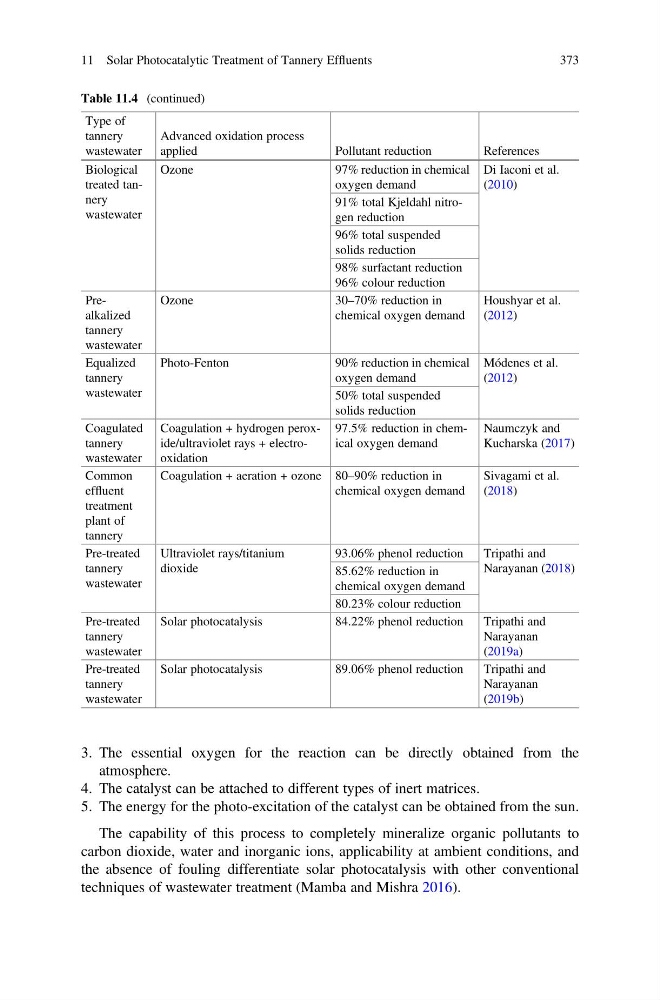
Table 11.4 (continued)
Type of
tannery
wastewater
Advanced oxidation process
applied
Pollutant reduction
References
Biological
treated tannery
wastewater
Ozone
97% reduction in chemical
oxygen demand
Di Iaconi et al.
(2010)
91% total Kjeldahl nitrogen reduction
96% total suspended
solids reduction
98% surfactant reduction
96% colour reduction
Prealkalized
tannery
wastewater
Ozone
30–70% reduction in
chemical oxygen demand
Houshyar et al.
(2012)
Equalized
tannery
wastewater
Photo-Fenton
90% reduction in chemical
oxygen demand
Módenes et al.
(2012)
50% total suspended
solids reduction
Coagulated
tannery
wastewater
Coagulation + hydrogen peroxide/ultraviolet rays + electrooxidation
97.5% reduction in chemical oxygen demand
Naumczyk and
Kucharska (2017)
Common
effluent
treatment
plant of
tannery
Coagulation + aeration + ozone 80–90% reduction in
chemical oxygen demand
Sivagami et al.
(2018)
Pre-treated
tannery
wastewater
Ultraviolet rays/titanium
dioxide
93.06% phenol reduction
Tripathi and
Narayanan (2018)
85.62% reduction in
chemical oxygen demand
80.23% colour reduction
Pre-treated
tannery
wastewater
Solar photocatalysis
84.22% phenol reduction
Tripathi and
Narayanan
(2019a)
Pre-treated
tannery
wastewater
Solar photocatalysis
89.06% phenol reduction
Tripathi and
Narayanan
(2019b)
11 Solar Photocatalytic Treatment of Tannery Effluents
373
atmosphere.
4. The catalyst can be attached to different types of inert matrices.
5. The energy for the photo-excitation of the catalyst can be obtained from the sun.
The capability of this process to completely mineralize organic pollutants to
carbon dioxide, water and inorganic ions, applicability at ambient conditions, and
the absence of fouling differentiate solar photocatalysis with other conventional
techniques of wastewater treatment (Mamba and Mishra 2016).
Table 11.4 (continued)
Type of
tannery
wastewater
Advanced oxidation process
applied
Pollutant reduction
References
Biological
treated tannery
wastewater
Ozone
97% reduction in chemical
oxygen demand
Di Iaconi et al.
(2010)
91% total Kjeldahl nitrogen reduction
96% total suspended
solids reduction
98% surfactant reduction
96% colour reduction
Prealkalized
tannery
wastewater
Ozone
30–70% reduction in
chemical oxygen demand
Houshyar et al.
(2012)
Equalized
tannery
wastewater
Photo-Fenton
90% reduction in chemical
oxygen demand
Módenes et al.
(2012)
50% total suspended
solids reduction
Coagulated
tannery
wastewater
Coagulation + hydrogen peroxide/ultraviolet rays + electrooxidation
97.5% reduction in chemical oxygen demand
Naumczyk and
Kucharska (2017)
Common
effluent
treatment
plant of
tannery
Coagulation + aeration + ozone 80–90% reduction in
chemical oxygen demand
Sivagami et al.
(2018)
Pre-treated
tannery
wastewater
Ultraviolet rays/titanium
dioxide
93.06% phenol reduction
Tripathi and
Narayanan (2018)
85.62% reduction in
chemical oxygen demand
80.23% colour reduction
Pre-treated
tannery
wastewater
Solar photocatalysis
84.22% phenol reduction
Tripathi and
Narayanan
(2019a)
Pre-treated
tannery
wastewater
Solar photocatalysis
89.06% phenol reduction
Tripathi and
Narayanan
(2019b)
11 Solar Photocatalytic Treatment of Tannery Effluents
373